
A Defiant Cry Against Silence—When Glam Rock Turned Loudness Into Identity and Rebellion
By late 1974, “Turn It Down” by Sweet had already marked a decisive shift in the band’s artistic direction—a bold declaration that they were no longer content to remain within the polished confines of their earlier pop image. Released as a single in November 1974, the song achieved solid chart success, reaching No. 41 on the UK Singles Chart and performing more strongly across parts of Europe, particularly in Germany and the Netherlands. While it did not match the explosive chart dominance of “Block Buster!” or “The Ballroom Blitz,” its cultural and artistic significance runs far deeper than its numerical ranking might suggest.
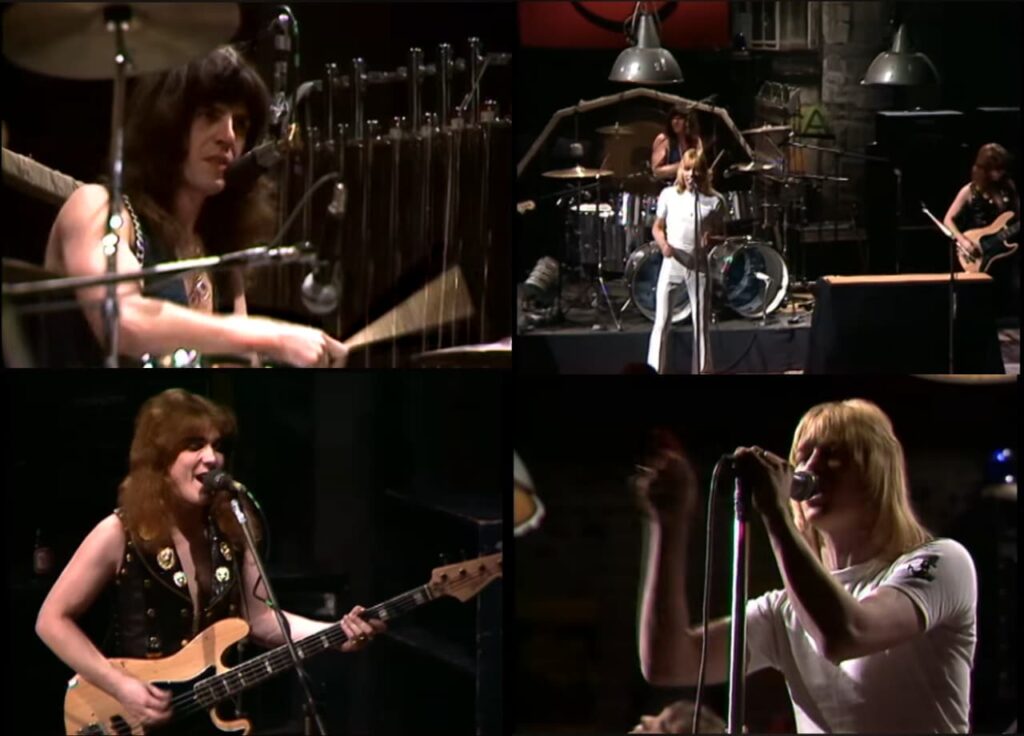
The performance on Musikladen on November 11, 1974, offers a vivid snapshot of a band fully embracing its transformation. Gone was the playful innocence of earlier hits; in its place stood a sharper, more assertive presence. Visually and sonically, Sweet had evolved into something heavier, more deliberate—reflecting the growing influence of hard rock within the glam movement. There is a certain electricity in that televised moment, as if the band understood they were crossing a threshold, leaving behind one chapter and stepping firmly into another.
The origins of “Turn It Down” are rooted in a tension that many artists of the era quietly faced—the struggle between commercial expectation and creative authenticity. Written by the prolific duo Nicky Chinn and Mike Chapman, the song carries an irony that is difficult to ignore. Its central message—resisting the demand to “turn it down”—can be interpreted as both literal and symbolic. On the surface, it speaks to the experience of playing music loudly, unapologetically. But beneath that, it resonates as a broader statement about artistic freedom, about refusing to dilute one’s voice to satisfy external pressures.
And yet, in a twist that feels almost poetic, the song itself reportedly faced resistance from broadcasters, with some radio stations hesitant to give it heavy airplay due to its perceived aggressive tone. There is something quietly telling in that reaction. A song about defiance encountering real-world hesitation—it is as though life briefly mirrored art.
Musically, “Turn It Down” is a departure from the band’s earlier formula. The guitars are heavier, the rhythm more insistent, and the vocal delivery carries a raw edge that had only been hinted at before. The production, while still polished, allows more space for that underlying grit to emerge. One can hear, quite clearly, the direction that Sweet would continue to pursue—a sound that would ultimately define their legacy far more than their early bubblegum successes.
What makes this track particularly compelling, however, is not just its sound, but its attitude. There is a quiet confidence running through it, a sense that the band is no longer asking for approval. They are stating who they are. For listeners at the time, this shift may have felt surprising, even jarring. But in hindsight, it feels inevitable—a natural progression for musicians who had always possessed more depth than their early image suggested.
The Musikladen performance captures this spirit beautifully. One can almost feel the atmosphere of that studio—the anticipation, the subtle tension, the awareness that something had changed. These televised appearances, much like those on Top Of The Pops, were more than mere promotions; they were moments of connection, shared experiences that lingered long after the broadcast ended.
Looking back, “Turn It Down” stands as a transitional piece—perhaps not the most celebrated in Sweet’s catalogue, but certainly one of the most revealing. It tells the story of a band asserting its identity, pushing against expectations, and choosing a path that felt truer to its instincts. There is a quiet courage in that decision, one that continues to resonate long after the amplifiers have gone silent.
And perhaps that is the lasting beauty of the song. It reminds us that sometimes, the most meaningful statements are not the loudest in terms of commercial success, but the ones that dare to speak honestly—even when the world isn’t quite ready to listen.