
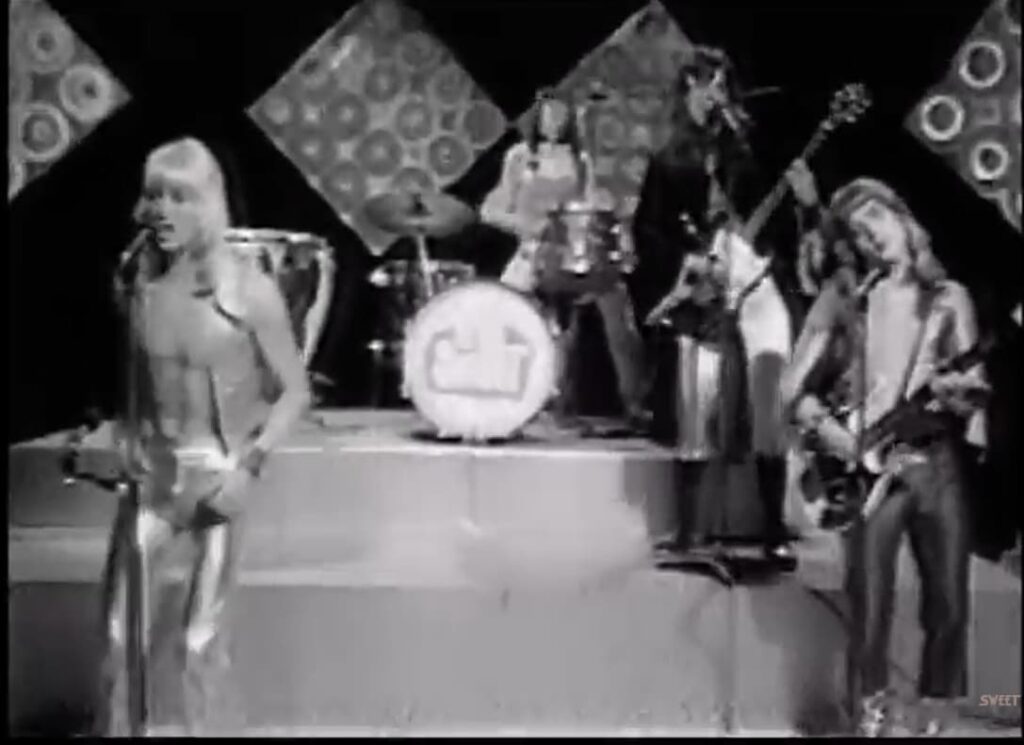
A playful burst of glam-era exuberance, where youthful fantasy and infectious rhythm collide in a dazzling moment of pure pop escape
When Sweet released “Wig-Wam Bam” in 1972, they were not merely offering another pop single—they were helping define the very texture of the glam rock era. Written by the prolific songwriting duo Nicky Chinn and Mike Chapman, the track became one of the band’s early breakthroughs, reaching No. 4 on the UK Singles Chart and climbing into the Top 10 across several European countries. At a time when British pop was shifting from the introspective tones of the late 1960s into something brighter, bolder, and more theatrical, “Wig-Wam Bam” arrived like a spark of glitter under stage lights.
The performance on “Lift Off with Ayshea” (24.12.1972) captures that moment with remarkable clarity. Broadcast on Christmas Eve—a time already filled with reflection and quiet celebration—the appearance offered something delightfully different: a burst of color, sound, and youthful mischief. Watching Sweet in that setting, one senses not just a band performing a hit song, but a group fully embracing a new musical identity, one that would soon propel them toward even greater success with tracks like “Block Buster!” and “Ballroom Blitz.”
At its core, “Wig-Wam Bam” is a song that does not ask to be taken too seriously—and that is precisely its charm. The lyrics, centered around a fictional Native American girl named Jezebel, are whimsical, almost surreal. They paint a picture that is less about narrative coherence and more about atmosphere—an imaginative escape into a world of rhythm and color. In many ways, the song reflects a time when pop music allowed itself to be playful, when storytelling could be abstract yet still emotionally resonant.
Musically, the track is built on a foundation of tight rhythm, handclaps, and a driving beat that feels both simple and irresistible. Producer Phil Wainman ensured that every element served the song’s infectious energy. There is a sense of precision beneath the apparent spontaneity—a carefully constructed sound designed to capture attention from the very first note. The layered vocals, combined with the band’s polished presentation, create a sound that is unmistakably of its time, yet still capable of stirring a sense of joy decades later.
Behind the scenes, Sweet were navigating the complex dynamics of being both performers and emerging artists in their own right. In their early years, much of their material came from outside songwriters like Chinn and Chapman, a partnership that would yield numerous hits but also raise questions about artistic identity. “Wig-Wam Bam” sits squarely within this phase—a period where the band’s image and sound were being shaped as much by industry forces as by their own instincts. Yet, even within those constraints, there is a palpable sense of personality in their delivery.
The meaning of the song may not lie in its lyrics alone, but in what it represents: a moment of transformation. It captures the transition from the restrained aesthetics of the previous decade into something more flamboyant, more expressive. It is a reminder that music does not always need to carry profound messages to leave a lasting impression. Sometimes, its greatest gift is the ability to lift the spirit, to offer a brief but vivid escape from the ordinary.
Revisiting the “Lift Off with Ayshea” performance today, one cannot help but feel a sense of nostalgia—not just for the song itself, but for the era it embodies. The fashion, the energy, the unmistakable sense of possibility—all are preserved in that fleeting television moment. It is a snapshot of a time when pop music was rediscovering its sense of spectacle, when bands like Sweet were redefining what it meant to be both seen and heard.
In the end, “Wig-Wam Bam” endures not because it seeks depth, but because it captures a feeling—light, vibrant, and unburdened. It reminds us that music can be a celebration as much as a reflection, a moment of brightness that lingers long after the final note fades. And in that brightness, Sweet found a voice that would echo far beyond the glitter of the early 1970s.