
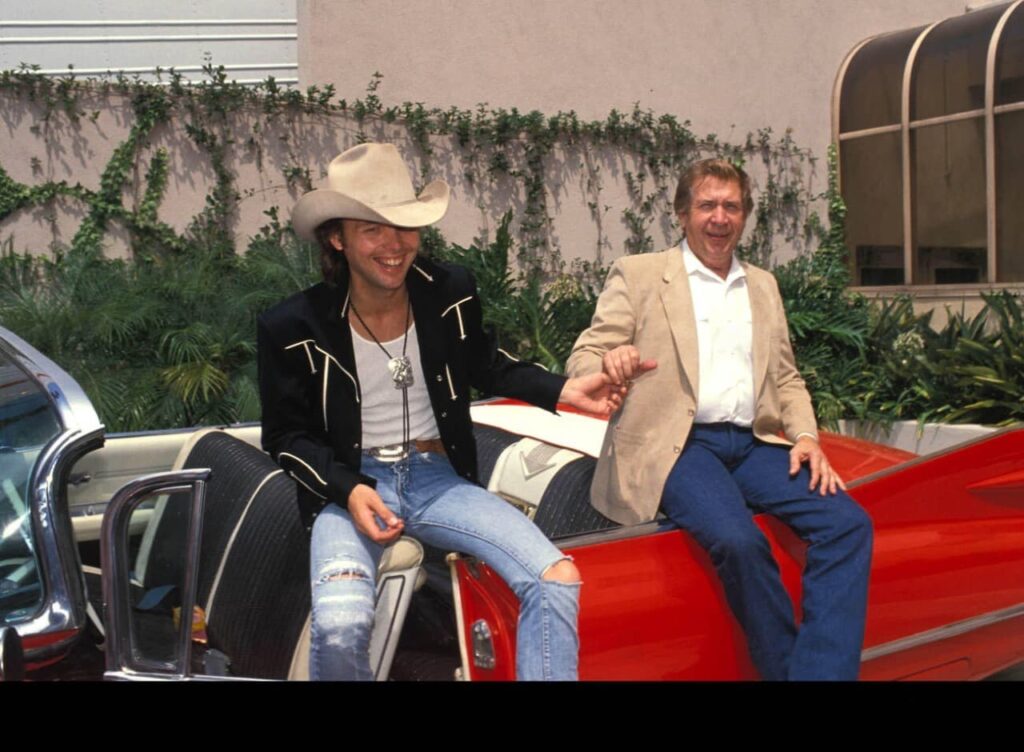
A song once forgotten returns as a quiet triumph—“Streets of Bakersfield” becomes a bridge between past and present, carrying Buck Owens back to where he belonged
There are moments in music history that feel less like comebacks and more like destiny patiently waiting for its time. The story of “Streets of Bakersfield”, as brought to life again by Buck Owens and Dwight Yoakam, is one of those rare moments where time itself seems to pause, reflect, and then gently correct its course. On October 15, 1988, the song reached No. 1 on the Billboard Hot Country Singles chart, marking Owens’ first chart-topping hit in sixteen years—a statistic that tells only part of a much deeper, more human story.
Originally recorded by Buck Owens in 1972 for the album Buck Owens in London, “Streets of Bakersfield” was, at the time, a quiet release that failed to make any significant impact. It was a song that spoke of displacement, of searching for belonging in a place that never quite feels like home. Perhaps it was too reflective, too honest for its moment. And so, like many songs ahead of their time, it slipped into obscurity—waiting.
By 1980, Owens had stepped away from the music industry altogether. After a career that had already produced an astonishing twenty No. 1 hits, he walked away from the stage, leaving behind the bright lights of the Bakersfield Sound he helped define. For many, it seemed like a closing chapter. The voice that once carried the raw, unpolished truth of working-class America had grown silent.
Then, in a twist that feels almost cinematic, a young artist appeared—unannounced, unassuming, but driven by a deep reverence. Dwight Yoakam, who had grown up immersed in Owens’ music, arrived not with ambition, but with admiration. He did not ask for something new, nor did he attempt to reshape the past. Instead, he reached back, gently, to a song that had been overlooked: “Streets of Bakersfield.”
What followed was not simply a duet—it was a conversation across generations. Released as part of Yoakam’s 1988 album Buenas Noches from a Lonely Room, the re-recorded version carried with it both the youthful energy of Yoakam and the seasoned, unmistakable voice of Owens. Together, they did not reinvent the song; they revealed it. The lyrics, once quiet and distant, now felt immediate and deeply personal.
“There’s a place where a man can feel alone,” the song seems to say—not in words alone, but in tone, in phrasing, in the space between notes. It is a meditation on identity, on pride, and on the quiet dignity of those who continue forward despite being unseen. In the hands of these two artists, the song found its rightful moment.
When the track climbed to No. 1, it was more than a chart achievement. It was a restoration. For Buck Owens, it marked a return—not just to the charts, but to the cultural conversation he had once shaped so profoundly. And yet, what lingered most was not the statistic, but the image: an older artist standing beside a younger one, not as a relic, but as an equal. There was something deeply moving in that shared space, something that spoke of respect, continuity, and quiet gratitude.
Musically, the recording stays true to the essence of the Bakersfield Sound—clean guitar lines, a steady rhythm, and an absence of unnecessary embellishment. It is country music in its most honest form, where every note serves the story. There is no excess, no distraction—only clarity.
Looking back, “Streets of Bakersfield” is no longer just a song. It is a reminder that music does not expire, that voices once silenced can still resonate, and that sometimes, the right moment arrives not when something is created, but when it is rediscovered.
And perhaps most quietly powerful of all is the understanding that not every ending is final. Sometimes, it is simply a pause—waiting for someone to listen closely enough to bring the story home again.