
A Timeless Melody Where Love Endures Beyond Charts, Becoming a Living Memory Shared Across Generations
When “That’s the Way Love Goes” first climbed to No. 1 on the Billboard Hot Country Singles chart in 1973, it marked a defining moment in the early career of Johnny Rodriguez—a young voice from Texas whose sincerity cut through the polished veneer of Nashville. Released as part of his debut album “Introducing Johnny Rodriguez”, the song did more than top the charts; it introduced a storyteller who understood that love, in all its quiet contradictions, could never be reduced to a simple melody. It was a breakthrough that would eventually lead to 15 Top 10 country hits, securing his place among the most distinctive voices of 1970s country music.
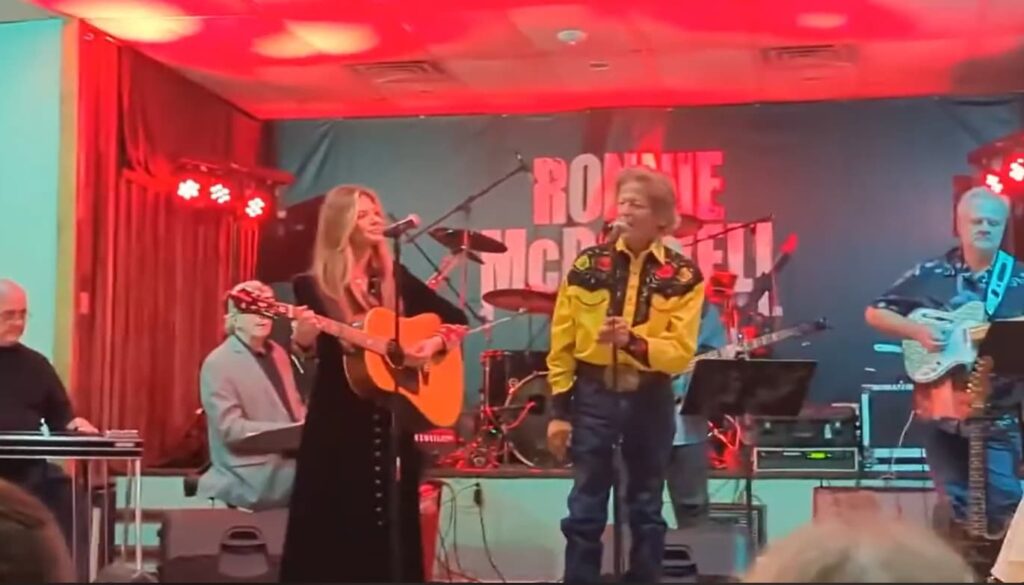
Yet, if one listens to the song today—particularly in later performances alongside his daughter Aubry Rodriguez—it becomes clear that its meaning has deepened in ways no chart position could ever measure.
Originally written by Lefty Frizzell and Sanger D. Shafer, “That’s the Way Love Goes” carries the unmistakable DNA of classic country songwriting: simple phrasing, conversational honesty, and an emotional undercurrent that lingers long after the final note. The lyrics speak of love not as an idealized dream, but as something unpredictable—something that bends, breaks, and somehow continues. In 1973, when Johnny Rodriguez recorded it, he sang with the freshness of someone just beginning to understand those truths. His voice, youthful yet already tinged with a knowing ache, gave the song a sincerity that resonated instantly with audiences across America.
At the time, country music was undergoing a quiet transformation. Artists were beginning to move away from strict traditionalism, blending influences and expanding emotional range. Rodriguez stood at the crossroads of that shift. As one of the first Mexican-American stars in mainstream country, he carried not only his own story but also the weight of representation in a genre that had rarely made space for voices like his. And yet, when he sang “That’s the Way Love Goes”, none of that seemed to matter. What listeners heard was not identity politics or cultural novelty—but truth. Pure, unfiltered, deeply human truth.
Fast forward more than fifty years, and the song has taken on a second life—one that feels even more intimate. Performing it beside his daughter Aubry, Johnny Rodriguez is no longer the rising star chasing radio success. He is a man looking back across decades, holding onto a melody that has quietly accompanied him through the seasons of his life. The warmth in his voice remains, but it is now layered with something richer: experience, memory, perhaps even a quiet gratitude.
Aubry’s presence transforms the performance in a way that is difficult to describe but impossible to ignore. She represents a generation that did not witness the original chart triumph, yet somehow carries its emotional legacy forward. When their voices blend, it is not simply harmony—it is continuity. A reminder that music, at its best, is not bound by time but passed gently from one heart to another.
And this is where the true meaning of “That’s the Way Love Goes” reveals itself most fully. It is no longer just a song about romantic love, with its unpredictable turns and lingering regrets. It becomes something broader, more profound—a reflection on connection itself. The love between parent and child, the shared history embedded in a melody, the quiet understanding that some songs are not merely performed, but lived.
There is a certain stillness in these later performances, a sense that the urgency of youth has given way to reflection. The tempo feels more deliberate, the pauses more meaningful. Each line seems to carry the weight of years, as if the singer is not only delivering lyrics, but revisiting moments long past. And in that space, the listener is invited to do the same—to remember, to reflect, to feel.
In the end, what makes this song endure is not its chart success, remarkable as that may have been. It is the way it continues to evolve, to gather new layers of meaning with each passing year. “That’s the Way Love Goes” is no longer confined to 1973. It exists now in every performance where memory meets melody, where a father’s voice carries both history and hope, and where a daughter’s harmony ensures that the story does not end, but quietly continues.
Because sometimes, the truest measure of a song is not how high it once climbed—but how deeply it still lives.