
A Father’s Voice, A Daughter’s Harmony — When Love and Legacy Meet in One Song
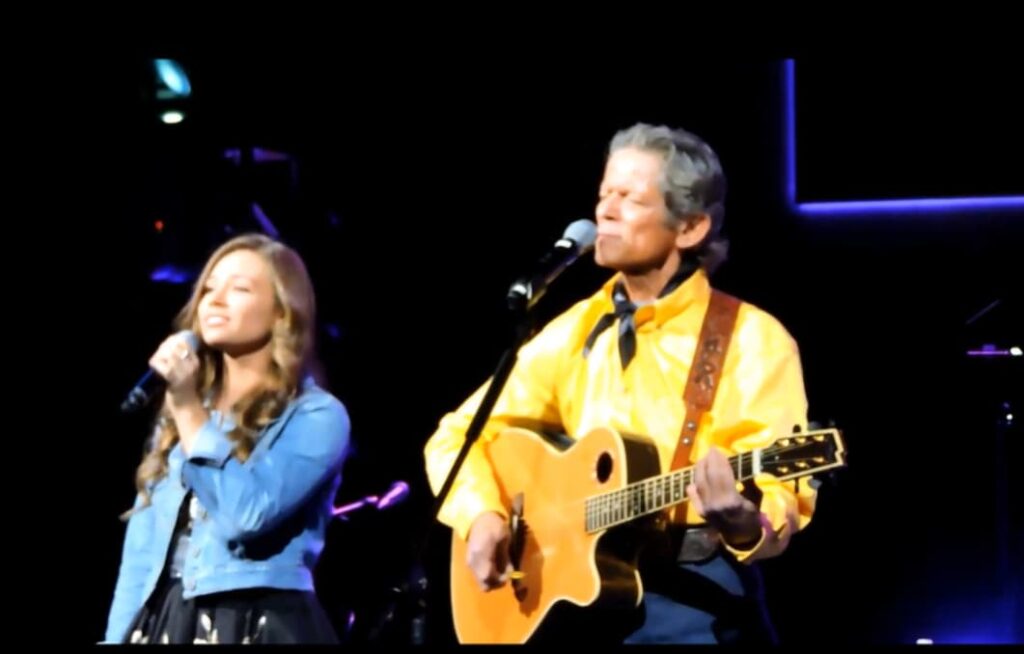
There are performances that transcend the boundaries of stage and audience, where music becomes something far more intimate—almost like a conversation carried through melody. When Johnny Rodriguez stood beside his daughter Aubry on October 29, 2014, to sing “We Believe in Happy Endings,” it was not merely a revisiting of an old country song. It was a living, breathing reflection of time, family, and the quiet endurance of belief itself.
Originally released in 1978, “We Believe in Happy Endings” was first recorded by Johnny Rodriguez and later re-recorded as a duet with Dottie West in 1979. That duet version reached No. 8 on the Billboard Hot Country Singles chart, marking one of the memorable collaborations of Rodriguez’s career. Written by Bob McDill, the song carried a message that felt both simple and quietly profound: even after heartbreak, even after life’s unexpected turns, there remains a place for hope—for endings that bring peace rather than regret.
By the late 1970s, Johnny Rodriguez had already secured his place in country music history. With a string of six No. 1 hits on the Billboard Hot Country Songs chart, including “You Always Come Back (To Hurting Me)” and “Ridin’ My Thumb to Mexico,” he was among the first major Hispanic stars in country music, bringing a unique voice and perspective to the genre. His style blended traditional country storytelling with a smooth, almost conversational delivery that made each song feel personal.
Yet, watching the 2014 performance with his daughter, one senses that the meaning of “We Believe in Happy Endings” had deepened over the years. What was once a narrative about romantic resilience now carried the weight of lived experience—of years passed, of challenges faced, and of the quiet wisdom that comes with time.
Aubry’s presence adds a delicate new dimension to the song. Her voice, fresh yet respectful of the original melody, intertwines with her father’s in a way that feels less like a duet and more like a continuation. There is a tenderness in the way their voices meet—no competition, no attempt to outshine, only a shared understanding. It is as if the song itself has been handed down, not just performed but inherited.
The lyrics, already rich with meaning, take on an almost reflective tone in this setting. Lines that once spoke of romantic reconciliation now seem to echo a broader truth: that life, in all its unpredictability, still allows room for grace. The idea of a “happy ending” is no longer confined to a single relationship—it becomes a philosophy, a quiet belief carried forward despite everything.
Musically, the arrangement remains faithful to its roots. There is no need for reinvention here. The strength of the song lies in its simplicity—gentle instrumentation, steady pacing, and a melody that unfolds naturally. This restraint allows the emotional core to remain undisturbed, giving space for the voices to carry the story.
What makes this performance particularly moving is its authenticity. There is no sense of nostalgia being forced or recreated for effect. Instead, it emerges naturally, shaped by the passage of time and the bond between father and daughter. It reminds us that music is not static; it evolves, gathering new meanings as it is revisited in different moments of life.
In a world where endings are often uncertain, the enduring appeal of “We Believe in Happy Endings” lies in its quiet optimism. It does not promise perfection, nor does it deny hardship. Rather, it suggests that within the complexities of life, there is still a possibility for resolution—for something gentle and reassuring at the close of each chapter.
And perhaps that is why this 2014 performance resonates so deeply. It is not just a song being sung again; it is a belief being reaffirmed. Through the voices of Johnny Rodriguez and his daughter, the message feels both timeless and immediate—a reminder that some truths, once discovered, continue to echo long after the final note has faded.
A Father’s Voice, A Daughter’s Harmony — When Love and Legacy Meet in One Song
There are performances that transcend the boundaries of stage and audience, where music becomes something far more intimate—almost like a conversation carried through melody. When Johnny Rodriguez stood beside his daughter Aubry on October 29, 2014, to sing “We Believe in Happy Endings,” it was not merely a revisiting of an old country song. It was a living, breathing reflection of time, family, and the quiet endurance of belief itself.
Originally released in 1978, “We Believe in Happy Endings” was first recorded by Johnny Rodriguez and later re-recorded as a duet with Dottie West in 1979. That duet version reached No. 8 on the Billboard Hot Country Singles chart, marking one of the memorable collaborations of Rodriguez’s career. Written by Bob McDill, the song carried a message that felt both simple and quietly profound: even after heartbreak, even after life’s unexpected turns, there remains a place for hope—for endings that bring peace rather than regret.
By the late 1970s, Johnny Rodriguez had already secured his place in country music history. With a string of six No. 1 hits on the Billboard Hot Country Songs chart, including “You Always Come Back (To Hurting Me)” and “Ridin’ My Thumb to Mexico,” he was among the first major Hispanic stars in country music, bringing a unique voice and perspective to the genre. His style blended traditional country storytelling with a smooth, almost conversational delivery that made each song feel personal.
Yet, watching the 2014 performance with his daughter, one senses that the meaning of “We Believe in Happy Endings” had deepened over the years. What was once a narrative about romantic resilience now carried the weight of lived experience—of years passed, of challenges faced, and of the quiet wisdom that comes with time.
Aubry’s presence adds a delicate new dimension to the song. Her voice, fresh yet respectful of the original melody, intertwines with her father’s in a way that feels less like a duet and more like a continuation. There is a tenderness in the way their voices meet—no competition, no attempt to outshine, only a shared understanding. It is as if the song itself has been handed down, not just performed but inherited.
The lyrics, already rich with meaning, take on an almost reflective tone in this setting. Lines that once spoke of romantic reconciliation now seem to echo a broader truth: that life, in all its unpredictability, still allows room for grace. The idea of a “happy ending” is no longer confined to a single relationship—it becomes a philosophy, a quiet belief carried forward despite everything.
Musically, the arrangement remains faithful to its roots. There is no need for reinvention here. The strength of the song lies in its simplicity—gentle instrumentation, steady pacing, and a melody that unfolds naturally. This restraint allows the emotional core to remain undisturbed, giving space for the voices to carry the story.
What makes this performance particularly moving is its authenticity. There is no sense of nostalgia being forced or recreated for effect. Instead, it emerges naturally, shaped by the passage of time and the bond between father and daughter. It reminds us that music is not static; it evolves, gathering new meanings as it is revisited in different moments of life.
In a world where endings are often uncertain, the enduring appeal of “We Believe in Happy Endings” lies in its quiet optimism. It does not promise perfection, nor does it deny hardship. Rather, it suggests that within the complexities of life, there is still a possibility for resolution—for something gentle and reassuring at the close of each chapter.
And perhaps that is why this 2014 performance resonates so deeply. It is not just a song being sung again; it is a belief being reaffirmed. Through the voices of Johnny Rodriguez and his daughter, the message feels both timeless and immediate—a reminder that some truths, once discovered, continue to echo long after the final note has faded.