
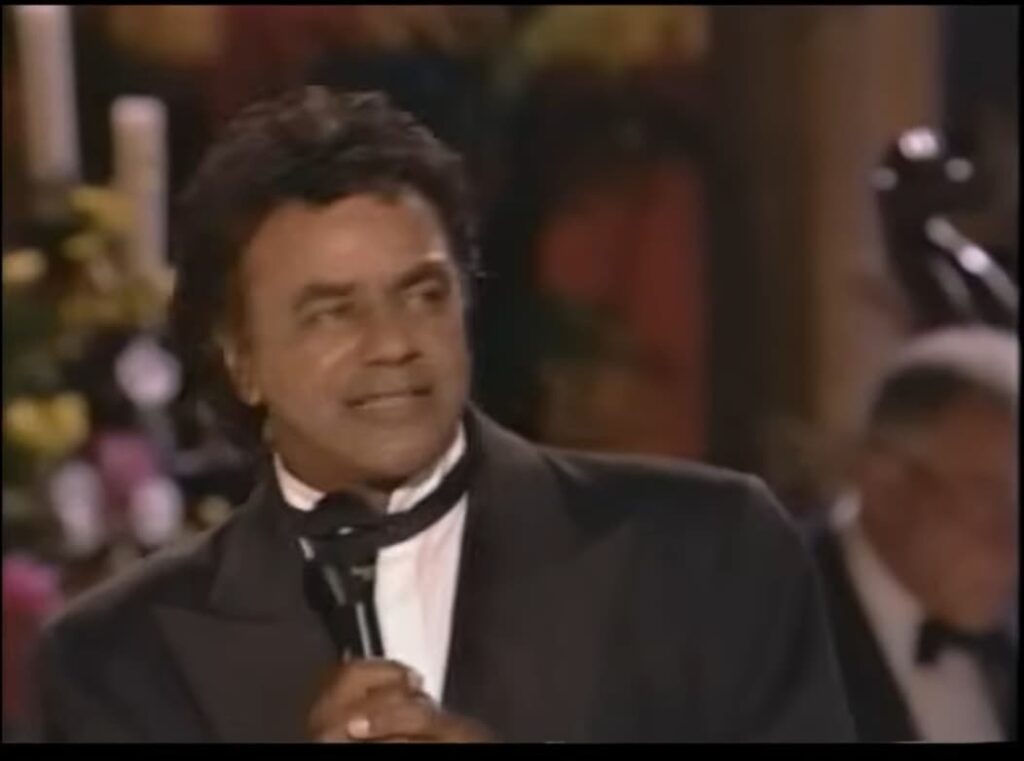
A melody of memory and mystery—where love lingers like a distant dream, forever just beyond reach
When Johnny Mathis lends his voice to “Laura”, featured on the tribute album Too Marvelous for Words: A Tribute to Johnny Mercer, he is not merely revisiting a classic—he is stepping into a musical legacy that predates even his own remarkable rise. Originally composed by David Raksin in 1944, with lyrics later added by Johnny Mercer, “Laura” first gained prominence as the haunting theme from the film Laura (1944). Its early instrumental version reached No. 1 on the Billboard charts in 1945, recorded by bandleader Woody Herman, while subsequent vocal renditions by artists like Frank Sinatra and Ella Fitzgerald cemented its place within the Great American Songbook.
By the time Johnny Mathis approached “Laura” for this tribute project—released in the 1990s as a homage to the lyrical genius of Johnny Mercer—the song had already lived many lives. Yet, Mathis’s interpretation does not attempt to overshadow those earlier versions. Instead, it gently reimagines the piece through the lens of maturity, restraint, and a deeply personal understanding of romantic nuance.
What makes Mathis’s rendition so compelling is his instinct for subtlety. His voice, long celebrated for its velvety smoothness and emotional clarity, moves through the melody with an almost whispered reverence. There is no urgency here, no attempt to dramatize the inherent mystery of the song. Rather, he allows the listener to arrive at that mystery naturally, as though rediscovering something half-forgotten. The arrangement on Too Marvelous for Words: A Tribute to Johnny Mercer reflects this same philosophy. The orchestration is lush yet controlled, echoing the cinematic origins of the song while leaving ample space for the vocal to breathe. Strings swell gently, never overwhelming, and the tempo remains unhurried—inviting reflection rather than demanding attention.
At its core, “Laura” is a song about absence. It speaks of a presence that is felt more strongly in memory than in reality—a figure who exists somewhere between imagination and longing. The lyrics, crafted by Johnny Mercer, are deliberately elusive. Laura is never fully defined; she is glimpsed in fragments, in fleeting impressions. This ambiguity is precisely what gives the song its enduring power.
In Johnny Mathis’s hands, this sense of distance becomes even more pronounced. His phrasing suggests not just admiration, but a quiet resignation—as though the singer understands that Laura is not meant to be possessed, only remembered. It is a delicate balance, one that requires not only technical skill but emotional insight. There is also a deeper resonance when considering Mathis’s long-standing relationship with romantic ballads. Throughout his career—from “Chances Are” (1957), which reached No. 1 on the Billboard Most Played by Jockeys chart, to countless interpretations of standards—he has consistently demonstrated an ability to inhabit the emotional core of a song without overstating it. In “Laura,” this quality reaches a particularly refined expression.
Listening to this recording, one cannot help but feel a sense of stillness. It is the kind of performance that does not seek to impress in the conventional sense. Instead, it invites the listener inward, into a space where memory and imagination intertwine. The song unfolds slowly, almost reluctantly, as though aware that its true power lies not in revelation, but in suggestion. There is a certain timelessness in this approach. While musical styles have evolved dramatically since the song’s original release, the emotional landscape it inhabits remains unchanged. Love, memory, longing—these are constants, and “Laura” captures them with a quiet elegance that resists the passage of time.
In the end, Johnny Mathis’s interpretation of “Laura” is less about reinvention and more about preservation. It honors the original composition while offering a perspective shaped by decades of experience. It reminds us that some songs do not need to be altered to remain relevant—they simply need to be understood. And in that understanding, the melody lingers—softly, persistently—like a name remembered in silence, or a face glimpsed in a dream that never quite fades.
Video:
