
A Playful Clash of Personalities Wrapped in Humor, Where Everyday Absurdity Becomes Timeless Entertainment
There are moments in entertainment history that never relied on chart positions, grand orchestration, or sweeping lyrical poetry—yet they linger just as vividly in memory. The sketch “Sardines”, performed by Kenny Everett and David Essex on Kenny’s Thames Television series, is one such piece. Not a song in the conventional sense, nor a chart-topping release, it instead belongs to that cherished corner of British television where humor, character, and timing created something quietly unforgettable.
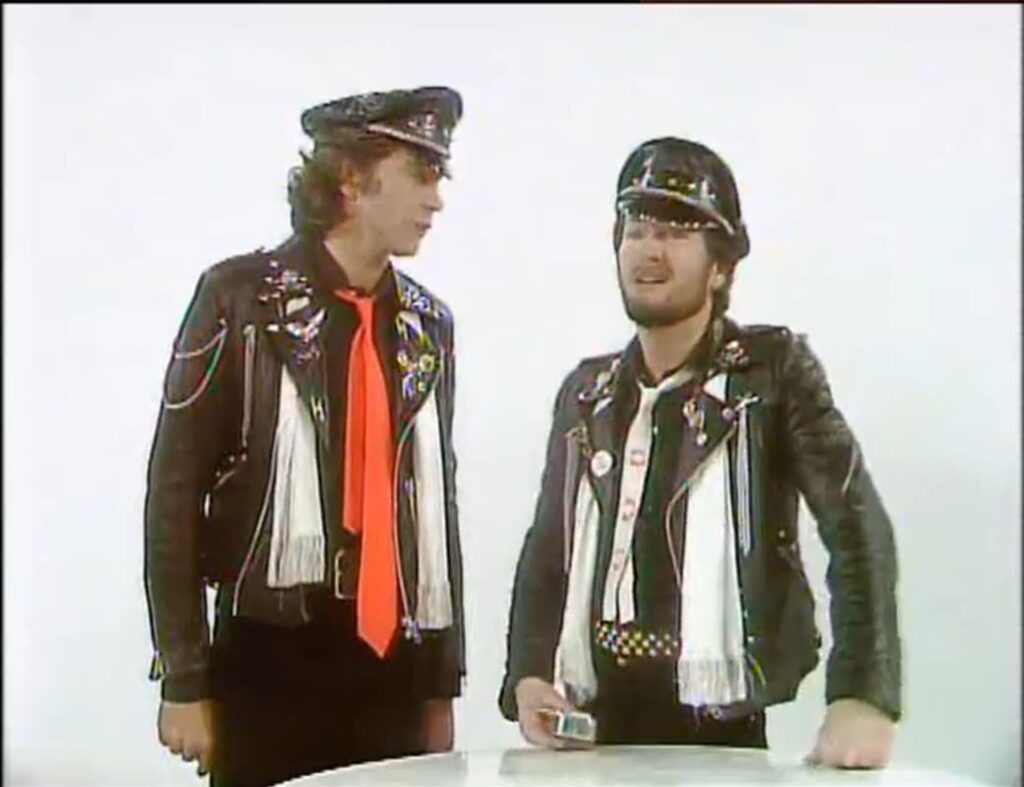
First aired during the late 1970s era of Kenny Everett’s television work—an era defined by irreverence, quick wit, and a refusal to follow traditional formats—the “Sardines” sketch featured Everett’s infamous alter ego Sid Snot, a grotesque yet oddly charming parody figure. Opposite him stood David Essex, already a well-established musical star known for hits like “Rock On” and “Gonna Make You a Star”, here stepping away from the spotlight of melody to engage in something far more intimate: comedic tension over something as trivial as a tin of sardines.
There is no chart history to speak of for “Sardines,” no Billboard rankings or UK Singles Chart placements, because it was never meant to compete in that arena. Yet, in a deeper sense, it achieved something many charting songs never do—it embedded itself into the cultural memory of those who witnessed it. That quiet endurance, that ability to resurface decades later in conversation or recollection, speaks volumes about its subtle brilliance.
At its core, the sketch is deceptively simple: two men arguing over the contents of a sardine tin. But within that simplicity lies a masterclass in performance. Kenny Everett, through Sid Snot, exaggerates irritation, selfishness, and absurd logic to almost surreal levels, while David Essex plays the straight man—grounded, reactive, and increasingly drawn into the ridiculousness. The humor builds not from punchlines alone, but from rhythm, pauses, expressions, and the slow escalation of something utterly insignificant into a theatrical conflict.
What makes this moment particularly fascinating is the presence of David Essex, a figure so strongly associated with music and emotional storytelling, stepping into a comedic role without losing his natural charisma. There is a certain warmth in his performance—an unspoken understanding that he is both part of the joke and an anchor for the audience. In that contrast, the sketch finds its balance.
Behind the laughter, however, there is something quietly reflective. The argument over sardines becomes a miniature portrait of human nature—the tendency to cling to trivial matters, to defend positions that hardly matter, to inflate the small into the significant. It is comedy, yes, but also observation. And perhaps that is why it resonates so deeply: it mirrors something familiar, something recognizable in everyday life. The late 1970s television landscape in Britain was rich with experimentation, and Kenny Everett stood at the forefront of that movement. His shows blurred the lines between music, sketch comedy, and surreal performance art. Bringing in guests like David Essex was not merely about celebrity appeal—it was about creating unexpected chemistry, allowing different worlds to collide in ways that felt spontaneous and alive.
Looking back now, the “Sardines” sketch feels like a small, preserved moment in time—a reminder of when entertainment did not always strive for scale, but instead found magic in the immediate, the absurd, and the human. There is a certain comfort in that simplicity, a gentle echo of an era where a few minutes of well-crafted interaction could leave a lasting impression. And so, while it may not sit in any official chart archive, “Sardines” holds its own quiet place in the history of performance—where humor meets personality, and where even a humble tin of fish can become the center of something enduring.