
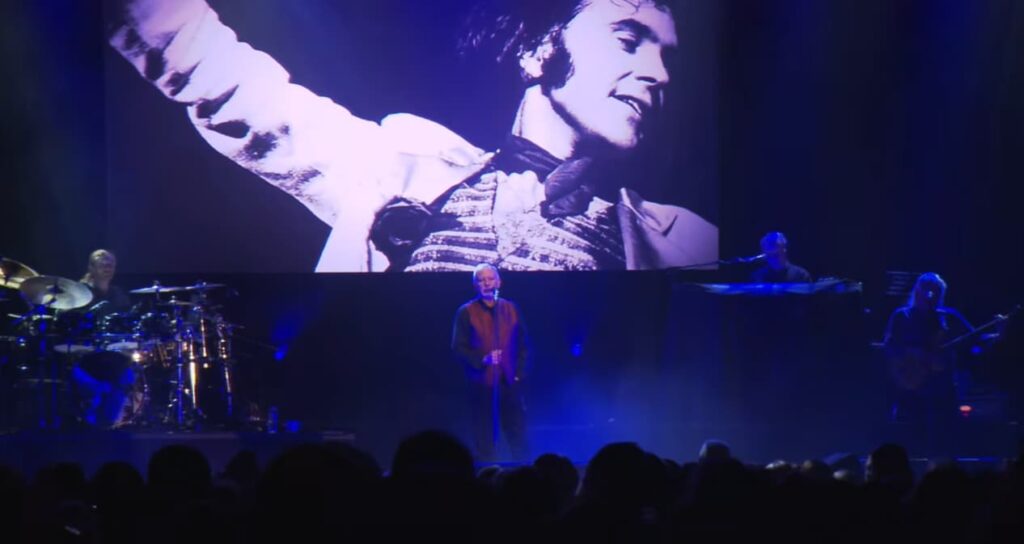
A voice that refuses to fade—where time passes, but emotion lingers “on and on,” echoing through every stage and every memory
There is something profoundly moving about a live performance that arrives not at the height of youth, but in the fullness of experience—when every note carries the quiet authority of a life lived both on and off the stage. The live rendition of “On and On” during the UK Tour at Wolverhampton by David Essex is one such moment, a performance that transcends the boundaries of time and reaffirms the enduring bond between artist and audience.
Though “On and On” was never among the chart-dominating singles that defined David Essex’s early career—unlike “Rock On” (1973), which reached No. 3 on the UK Singles Chart and No. 5 on the Billboard Hot 100, or “Gonna Make You a Star” (1974), which climbed to No. 1 in the UK—it occupies a different, perhaps more intimate space within his musical catalogue. It is a song less concerned with commercial success and more attuned to reflection, continuity, and the passage of time.
By the time of this Wolverhampton performance, David Essex was no longer the youthful figure who once stood at the forefront of glam-influenced pop. Instead, he appeared as something richer—an artist shaped by decades of evolution, carrying with him not only his voice but the weight of memory. And it is precisely this transformation that gives “On and On” its quiet power in a live setting.
The performance itself unfolds with a sense of unhurried grace. There is no need for spectacle; the stage becomes a space of connection rather than display. As the first notes emerge, there is an immediate recognition—not just of the melody, but of everything it represents. The audience, too, seems to understand this. They are not merely listeners; they are participants in a shared recollection.
Lyrically, “On and On” speaks to the persistence of feeling—the idea that certain emotions do not simply disappear with time, but instead settle into the fabric of one’s life, resurfacing in unexpected moments. It is a theme that resonates deeply when performed live, particularly by an artist who has lived long enough to embody those very sentiments. The words, once perhaps abstract, now feel grounded in reality. What makes this Wolverhampton rendition especially compelling is the subtle interplay between voice and silence. David Essex’s vocal delivery is measured, deliberate. There are moments where he allows the music to breathe, where a pause carries as much meaning as a lyric. It is in these spaces that the performance truly comes alive—not through volume or intensity, but through restraint.
The arrangement, too, reflects this maturity. Gone are the heavier embellishments that often accompany studio recordings. In their place is a more stripped-down sound, one that prioritizes clarity and emotional resonance. Each instrument serves a purpose, but none seek to dominate. The result is a soundscape that feels both intimate and expansive. There is also an undeniable sense of continuity embedded within the performance. For those who have followed David Essex’s career from its early days, this moment feels like a bridge between past and present. The voice may have changed—become deeper, perhaps more textured—but the essence remains unmistakable. It is this continuity that gives the song its title a deeper meaning: not just a phrase within the lyrics, but a reflection of the artist’s journey itself.
In many ways, this live performance of “On and On” is less about the song alone and more about what it represents. It is a reminder that music does not exist in isolation; it grows alongside those who create it and those who listen. It gathers memories, associations, and emotions, becoming something far greater than its original form. As the final notes fade within the Wolverhampton venue, there is no abrupt ending—only a gentle sense of closure, as though the song continues beyond the stage, carried quietly in the hearts of those who heard it. And perhaps that is the true essence of “On and On.” Not a song confined to a moment, but one that lingers, softly and persistently, long after the music itself has ended.