
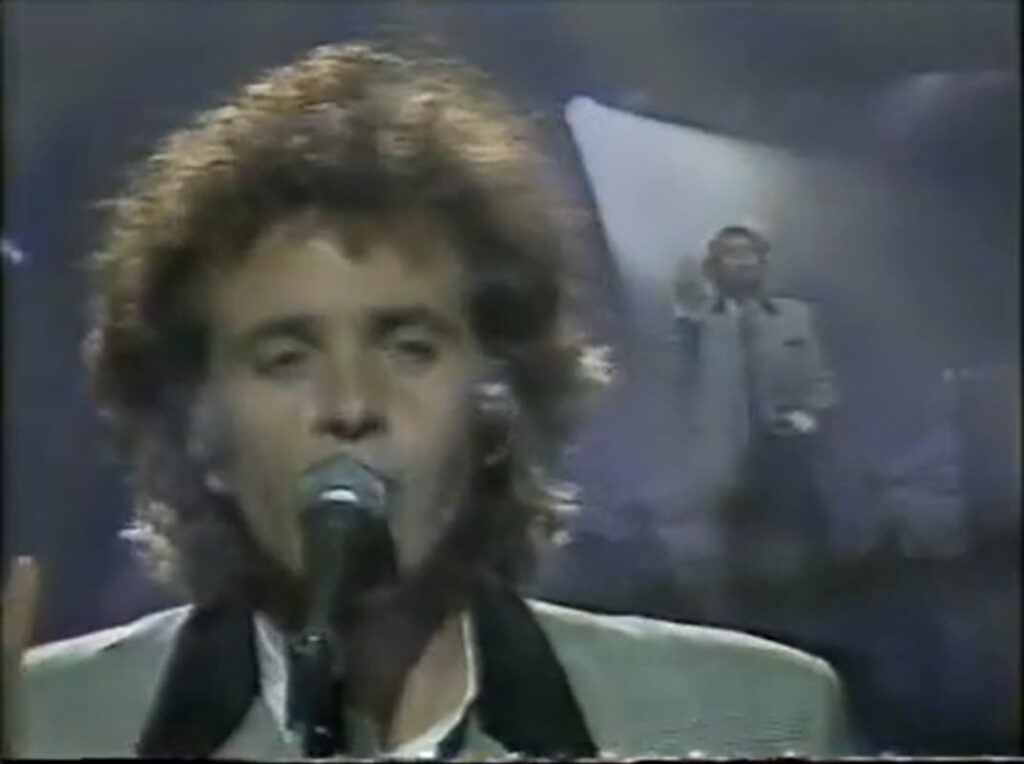
A tender echo of devotion and cultural memory, where love is whispered through melody and carried across time with quiet reverence
By the time “Myfanwy” (1987) found its place in the repertoire of David Essex, it was already a song steeped in history, longing, and a deeply rooted sense of place. Unlike many of Essex’s earlier works that were born from the vibrant pulse of 1970s pop and glam rock, “Myfanwy” belongs to a different emotional landscape altogether—one shaped by tradition, heritage, and the enduring power of a love that feels almost sacred in its stillness.
Originally a Welsh song composed by Joseph Parry in the 19th century, “Myfanwy” had long been cherished as a classic of choral and folk music before Essex brought his own interpretation to it. His 1987 version did not aim for chart domination in the conventional sense; indeed, it did not achieve significant positions on major UK or US singles charts. Yet, to measure this recording solely by commercial metrics would be to misunderstand its purpose entirely. This was not a song meant to compete—it was a song meant to endure. Essex included “Myfanwy” in his performances and recordings during a period when his artistic identity had matured considerably. The youthful urgency of his earlier hits had softened into something more reflective, more measured. In this rendition, he steps away from the spotlight of pop stardom and into a more intimate space, where the voice becomes a vessel for emotion rather than display.
The story behind “Myfanwy” is as poignant as the melody itself. The name “Myfanwy” refers to a beloved woman, and the lyrics speak of a love that remains constant despite distance, hardship, or the passage of time. It is a love that does not demand attention, nor does it seek resolution. Instead, it exists quietly, almost like a memory that refuses to fade. In Essex’s interpretation, this sense of quiet devotion is preserved with remarkable sensitivity. What makes his version particularly moving is the restraint he brings to the performance. There is no excess here—no dramatic flourishes or attempts to modernize the song beyond recognition. Instead, Essex allows the melody to breathe, to unfold at its own pace. His voice, now carrying the weight of years and experience, lends the song a depth that cannot be manufactured. Each phrase feels considered, each note placed with care, as though he understands the responsibility of interpreting something so deeply cherished.
Musically, the arrangement remains faithful to the song’s origins. Gentle instrumentation—often centered around piano or orchestral backing—creates a sense of space, allowing the listener to focus on the emotional core of the piece. There is a stillness in the music, a deliberate absence of distraction, which invites reflection rather than excitement. In the broader context of David Essex’s career, “Myfanwy” (1987) stands as a quiet testament to artistic evolution. It reveals a side of him that is often overshadowed by his earlier fame—a side that values subtlety over spectacle, emotion over immediacy. It is the work of an artist who no longer feels the need to prove anything, and who instead chooses to honor the music itself.
Listening to this song now, one cannot help but feel a sense of distance—not in a cold or detached way, but in the manner of looking back across years filled with moments both vivid and blurred. “Myfanwy” does not demand to be remembered; it simply exists, waiting patiently to be rediscovered. And when it is, it brings with it a quiet reminder of the enduring nature of love, memory, and the songs that carry them forward through time. In a world that often moves too quickly, David Essex’s interpretation of “Myfanwy” offers something rare: a pause, a breath, a moment to listen—not just to the music, but to the echoes of something deeply human and profoundly lasting.
Video:
