
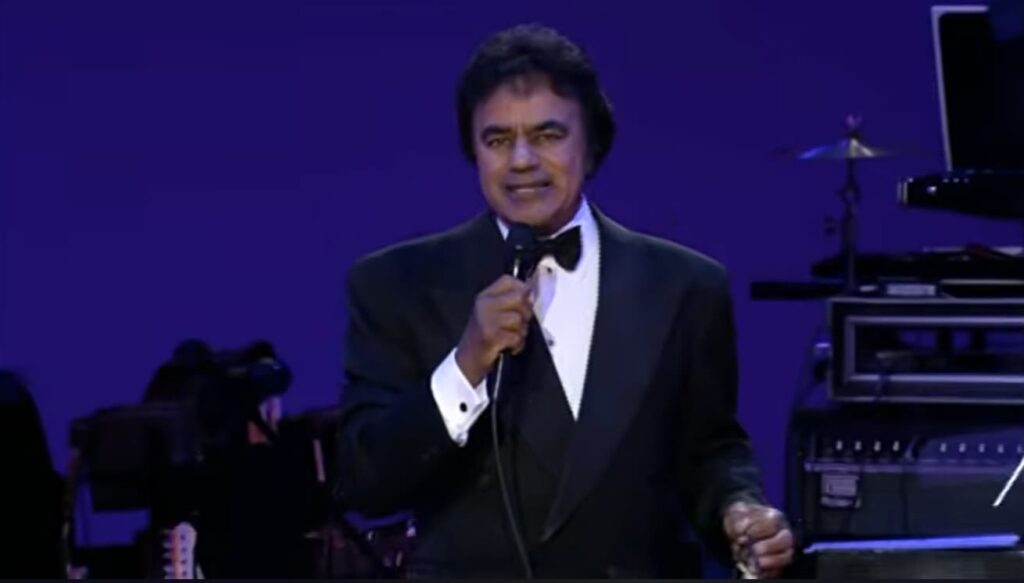
A Golden Voice Across Half a Century—When Memory, Melody, and Time Converge on One Stage
In October 2006, beneath the warm lights of the Tropicana Hotel in Atlantic City, Johnny Mathis stood before an audience not simply as a performer, but as a living archive of song. This 50th anniversary concert, later remembered through its orchestral highlights, was far more than a celebratory milestone—it was a quiet, dignified summation of a career that had shaped the emotional vocabulary of popular music for half a century. The instrumental passages captured during this performance—rich, elegant, and deeply expressive—served as a reflective mirror, allowing listeners to revisit decades of music without a single lyric needing to be sung.
By 2006, Johnny Mathis had long secured his place in musical history. With over 350 million records sold worldwide and timeless hits like “Chances Are” (which reached No. 1 on the Billboard Most Played by Jockeys chart) and “Misty” (a Top 20 hit on the Billboard Hot 100), his voice had become synonymous with romance, refinement, and emotional sincerity. Albums such as “Johnny’s Greatest Hits”—which astonishingly remained on the Billboard charts for nearly ten years—had already defined an era. Yet this 2006 performance was not about chart positions or accolades. It was about continuity, about honoring the journey rather than measuring its success.
What makes this orchestral commemoration so profoundly moving is its restraint. The absence of lyrics in certain segments allows the arrangements themselves to speak—strings rising and falling like breath, horns echoing distant memories, and piano lines threading everything together with quiet grace. These instrumental interpretations do not replace the songs; they reveal their inner architecture. One begins to hear not just the melody, but the passage of time embedded within it—the years between the first recording and this reflective performance.
The setting itself adds another layer of meaning. Atlantic City, with its blend of nostalgia and reinvention, feels like an apt backdrop. The Tropicana stage becomes a space where past and present coexist, where the echoes of earlier performances linger in the air. As Mathis moves through the evening, there is no sense of urgency, no need to prove anything. Instead, there is a calm assurance, a recognition that the music has already done its work—and continues to do so.
Behind this anniversary event lies a deeper narrative about endurance. Few artists sustain relevance across five decades, and fewer still do so without compromising the essence of their artistry. Johnny Mathis achieved this by remaining faithful to the emotional core of his music. He never chased trends; he allowed time to pass through his voice, enriching it rather than diminishing it. This concert, particularly in its instrumental moments, reflects that philosophy. It does not attempt to modernize or reinterpret aggressively. It simply presents the music as it has always been—timeless, unhurried, and deeply felt.
There is also a quiet universality in this performance. Without words, the music becomes open to personal interpretation. Each listener brings their own memories, their own associations, their own sense of what these melodies mean. In that sense, the concert becomes a shared experience, yet deeply individual. It reminds us that music’s true power lies not in its ability to impress, but in its capacity to accompany—to be present in moments both large and small.
Looking back, the 50th anniversary concert of Johnny Mathis is not just a celebration of longevity. It is a meditation on what it means to endure with grace. The instrumental passages, in particular, feel like a conversation between the past and the present—gentle, unspoken, but profoundly understood. And as the final notes fade into silence, one is left with a simple realization: some voices may soften with time, but the feelings they carry remain as vivid as ever, quietly echoing across the years.