
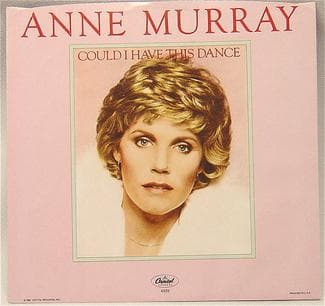
A Gentle Invitation to Forever, Captured in a Simple Question and a Tender Melody
When Anne Murray released Could I Have This Dance in August 1980, the song arrived quietly, without spectacle, yet it carried with it a sincerity that felt instantly timeless. At a moment when popular music was becoming increasingly polished and urbanized, this gentle country ballad stood apart by doing something remarkably simple. It spoke softly, honestly, and directly to the heart. That simplicity became its greatest strength.
Recorded for the soundtrack of the 1980 film Urban Cowboy, Could I Have This Dance quickly transcended its cinematic origins. It was included on the Urban Cowboy soundtrack album, later appeared on Anne Murray’s Greatest Hits released in late 1980, and decades afterward was lovingly revisited as a duet with Amy Grant on the 2007 album Anne Murray Duets: Friends & Legends. From the beginning, however, the song belonged to a very specific emotional space. It was not about drama or heartbreak. It was about the fragile, hopeful moment when love asks permission to begin.
Commercially, the song marked a significant milestone in Murray’s career. As a single, it became her fifth number one hit on the Billboard Hot Country Singles chart as a solo artist, spending one week at the top and remaining on the chart for ten weeks in total. On the U.S. pop singles chart, it reached number 33, becoming her tenth Top 40 pop hit. These chart positions are important not merely as statistics, but as evidence of how widely the song resonated across audiences who might not have otherwise crossed paths.
Written by Wayland Holyfield and Bob House, the song is constructed around a deceptively modest question. Could I have this dance. In those five words lies an entire emotional universe. The narrator does not demand love, nor assume it. Instead, the song unfolds as a quiet pledge, offering companionship, devotion, and emotional presence. Lines such as “I’ll be there whenever you need me” and “I’ll love you through the good and bad” feel less like poetic flourishes and more like vows spoken in everyday language. This is love imagined not as passion alone, but as endurance.
Anne Murray’s performance is central to the song’s enduring power. Her voice, warm and unforced, carries a sense of emotional maturity that few singers could deliver with such restraint. She does not over-sing or dramatize the lyric. Instead, she allows the song to breathe, trusting the listener to meet it halfway. There is an almost conversational quality to her phrasing, as if the song is being offered across a quiet room rather than projected from a stage.
That sense of intimacy was recognized at the highest level of the music industry. At the 23rd Annual Grammy Awards, Anne Murray won her second Grammy for Best Country Vocal Performance, Female for Could I Have This Dance. The win was particularly notable given the strength of the competition that year, including Crystal Gayle, Emmylou Harris, Barbara Mandrell, and Sissy Spacek for her performance in Coal Miner’s Daughter. The award affirmed not only Murray’s vocal excellence, but her ability to convey emotional truth with grace and humility.
Over time, the song has taken on a life of its own beyond charts and awards. It has become a staple at weddings, anniversaries, and quiet moments of reflection. Its meaning deepens with age, as the promise it offers feels less like youthful optimism and more like lived wisdom. Love, the song suggests, is not defined by grand gestures, but by the willingness to stay, to listen, and to walk alongside another person through all seasons.
In the larger arc of Anne Murray’s career, Could I Have This Dance stands as one of her most defining recordings. It captures her artistry at its most honest and human. Decades after its release, the song remains a gentle reminder that sometimes the most powerful declarations of love begin not with certainty, but with a question spoken softly, and a hand extended in trust.
 Music Legend