
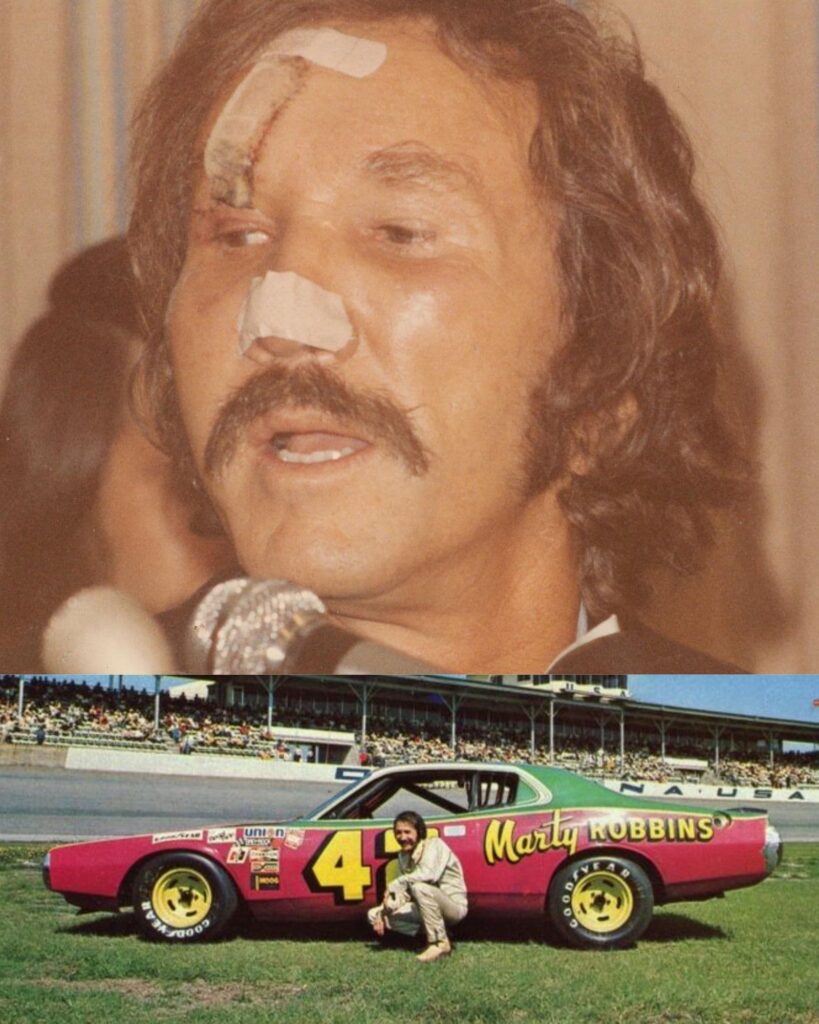
Marty Robbins – “Scars Beneath the Velvet Coat”: The High-Stakes Health Battle of the Cowboy Who Refused to Quit
To the millions of fans who watched him command the stage of the Grand Ole Opry, Marty Robbins was the picture of effortless grace. Clad in his signature “White Sport Coat” or a sharp Western suit, he moved with a confidence that masked a staggering physical reality. Beneath that polished exterior lay the scars of a life-or-death struggle that predated modern medical miracles. Long before he was a NASCAR daredevil or a Grammy-winning icon, Marty was a pioneer of a different sort: a survivor who stood at the absolute edge of medical history, fighting a silent war against a failing heart to keep his “Velvet Voice” singing for the world.
The “backstory” of this battle is one of the most harrowing in music history. In August 1969, at the height of his fame and just as “My Woman, My Woman, My Wife” was taking shape in his mind, Marty suffered a massive heart attack while traveling to a performance. At only 44 years old, the “Gentle Giant” was faced with a “ranking” of odds that were grim. In January 1970, he became one of the first human beings to undergo a triple bypass surgery—a procedure so experimental at the time that it was considered a “passion and danger” mission in its own right. He didn’t just survive; he became a living testament to the resilience of the human spirit, returning to the stage a mere six weeks later.
The Architecture of Endurance: Singing Through the Pain
For the sophisticated listener who has faced their own “mountain climbs” regarding health and mortality, Marty’s journey offers a profound sense of companionship. He didn’t let the scars define him; he let them drive him. The realization that his time might be short gave his 1970s work under Columbia Records a new, urgent depth. When you listen to the high notes in his later ballads, you aren’t just hearing a trained baritone; you are hearing a man who knew exactly how precious every breath truly was.
“I’ve survived the crashes and I’ve survived the knife… I’m just thankful for the extra miles I’ve been given in this life.”
This defiance was most visible on the NASCAR tracks. Despite his doctors’ warnings, Marty refused to live a “safe” life. He understood that a “Happy Home” was worth protecting, but a life without “Passion” wasn’t a life at all. He drove at 200 miles per hour with a heart held together by surgical thread and sheer willpower, proving to every working-class fan that a diagnosis is not a destiny.
A Legacy of Courage Behind the Curtain
As we look back at the grand legacy of Marty Robbins, we must see the “Titan” and the “Patient” as one. His final years were a marathon of willpower. He underwent further major heart surgeries in the late 70s and early 80s, never once losing the “Gentle” nature that defined him. For the mature audience, his story is a “souvenir” of an era when men carried their burdens with a quiet, stubborn dignity. He showed us that you can have “scars beneath the coat” and still be the most elegant man in the room.
He remains a monolith of authenticity because he was honest about his fragility. He didn’t hide his health battles; he used them to connect with his audience, reminding us that we are all “Lonesome Fugitives” running from time, but that the race is beautiful while it lasts. When he finally passed in the winter of 1982, he didn’t leave as a victim of illness, but as a victor who had squeezed every possible drop of life out of the years he was given.
 Music Legend