
A Whisper That Became a Roar — “Rock On” Marked the Moment David Essex Turned a Minimalist Sound Into a Pop Revolution
When David Essex released “Rock On” in 1973, few listeners could have predicted how unusual and influential the record would become. The song did not arrive with the grand orchestration or explosive guitars that defined much of early 1970s rock. Instead, it moved forward with a hypnotic bass rhythm, sparse instrumentation, and a vocal delivery that sounded almost like a secret being shared late at night. Yet that quiet confidence helped transform “Rock On” into one of the most distinctive hits of the decade.
Originally appearing on the album Rock On (1973), the single quickly captured public attention. In the United Kingdom, “Rock On” climbed to No. 3 on the UK Singles Chart, establishing David Essex as one of the most intriguing new voices in British pop music. The song later crossed the Atlantic and became a major success in the United States as well, reaching No. 5 on the Billboard Hot 100 in 1974. For a debut single built on such an unconventional sound, the achievement was remarkable.
The origins of the song reveal much about its unique character. David Essex, who had grown up in working-class London and spent his early years performing in small clubs, wrote “Rock On” during a time when he was still searching for his own musical identity. Unlike many artists who relied heavily on large studio productions, Essex wanted to experiment with something simpler and more atmospheric.
Working with producer Jeff Wayne, he helped shape a recording that relied on a stripped-down rhythm built around bass, percussion, and subtle electronic effects. This minimalist approach created a haunting soundscape that felt almost futuristic at the time. The production allowed Essex’s voice to float above the music in an unusual way, often delivered in a soft, half-spoken style.
Lyrically, “Rock On” reads almost like a series of fleeting images from a late-night cityscape. The song references figures from American pop culture such as James Dean, while also evoking scenes of restless youth drifting through neon-lit streets. Rather than telling a clear story, the lyrics create an atmosphere of mystery and movement.
This abstract quality was part of what made the song so compelling. Instead of explaining everything, David Essex allowed listeners to step into a mood — a world where music, youth, and rebellion blended together in a kind of dreamlike rhythm.
The success of “Rock On” also arrived at a pivotal moment in Essex’s career. Only a short time earlier, he had gained public attention for his acting role in the British film That’ll Be the Day (1973), where he portrayed a young musician struggling to find his place in the world. The film, which also featured Ringo Starr, explored the rise of rock and roll in post-war Britain.
In many ways, “Rock On” felt like the musical counterpart to that story. Both the film and the song captured a sense of youthful ambition balanced with uncertainty. The difference was that the song delivered this feeling not through dialogue or plot, but through rhythm and atmosphere.
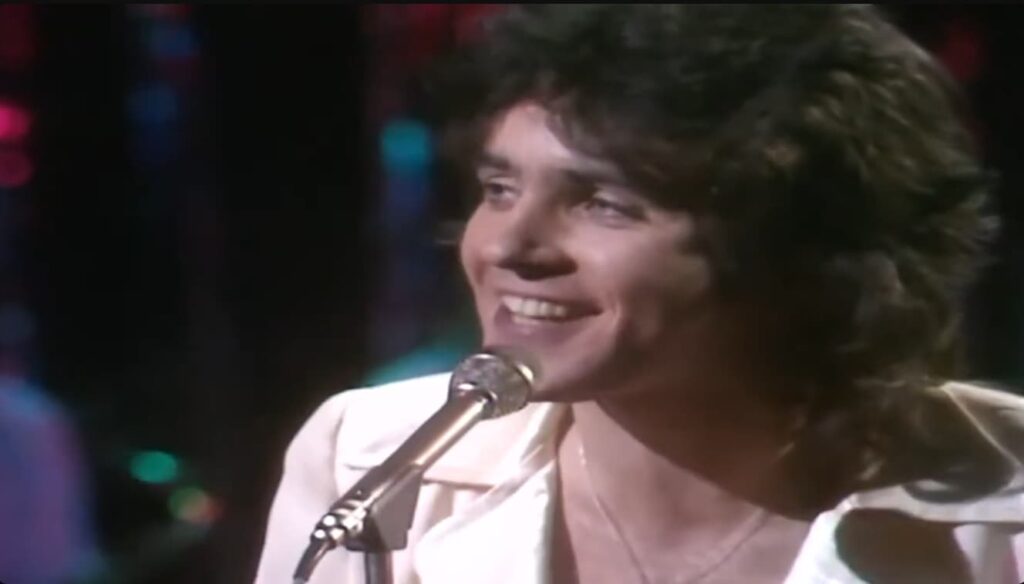
Hearing a rare live version from 1973 reveals an additional layer of fascination. On stage, David Essex transforms the studio’s restrained atmosphere into something more immediate and electric. The bass line pulses with greater urgency, while his voice carries a slightly raw edge that reminds the audience that the song emerged from the energy of live performance.
Yet even in a concert setting, the essential character of “Rock On” remains unchanged. The song never becomes overly dramatic or exaggerated. Instead, it maintains the cool, mysterious tone that made the original recording so distinctive.
Looking back now, it is clear that “Rock On” represented more than a successful debut single. It demonstrated that a pop song did not need grand arrangements or overwhelming volume to capture attention. Sometimes a quiet voice, placed carefully within a sparse musical landscape, can speak even more powerfully.
Decades later, the opening rhythm of “Rock On” still carries that same sense of late-night intrigue. It feels like the sound of a city after midnight — restless, thoughtful, and filled with possibilities waiting just beyond the next streetlight.
And within that atmosphere, the voice of David Essex continues to echo softly, reminding listeners of the moment when a whispered melody turned into one of the most unforgettable sounds of the 1970s.