
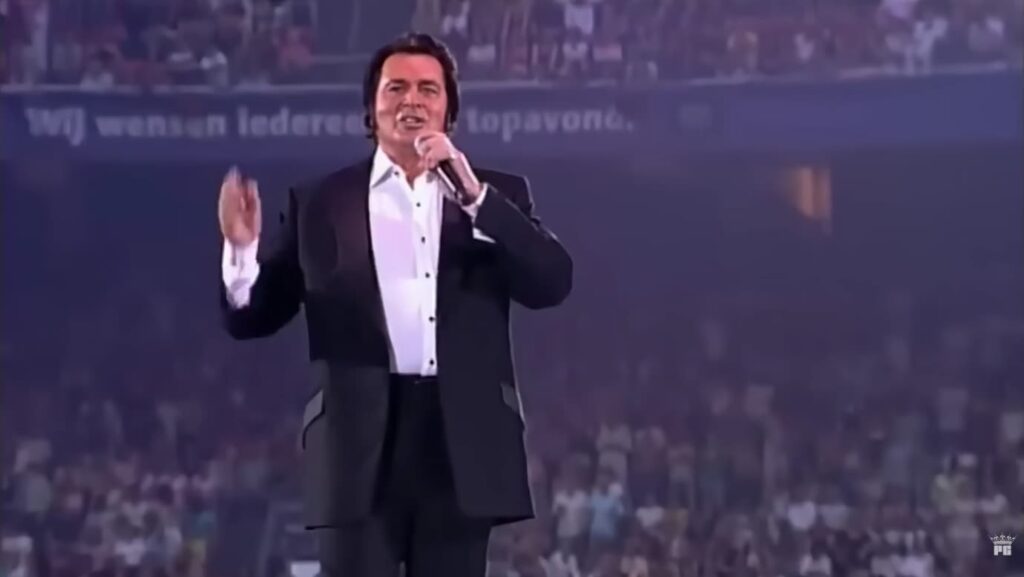
A voice that refuses to fade—Engelbert Humperdinck returns on stage in 2007, weaving decades of romance into one timeless medley
There is something quietly profound about hearing a seasoned voice revisit the songs that once defined an era. In the case of Engelbert Humperdinck, the “Medley Live – Toppers In Concert 2007”, performed at the vast Amsterdam Arena, is not merely a performance—it is a living archive of memory, devotion, and enduring artistry. By 2007, Humperdinck was already a legend whose career had spanned over four decades, yet here he stood, commanding a modern stage with the same velvet resonance that had once dominated global charts in the late 1960s.
This particular medley does not correspond to a single charting release, as it is a live compilation of his greatest hits performed during the annual Dutch concert series Toppers in Concert. However, the songs within the medley—especially classics like “Release Me”, “The Last Waltz”, and “After the Lovin’”—carry with them remarkable chart histories. “Release Me” (1967) famously reached No. 1 on the UK Singles Chart, holding off even The Beatles’ “Penny Lane/Strawberry Fields Forever”, a feat that remains one of the most talked-about chart upsets in music history. Meanwhile, “The Last Waltz” also soared to No. 1 in the UK, further cementing Humperdinck’s dominance during that golden period.
Watching him perform these songs live in 2007 is to witness time folding gently upon itself. The Amsterdam Arena, filled with thousands of voices, becomes less a venue and more a shared memory space. The audience does not simply listen—they remember. And Humperdinck, with his measured phrasing and unmistakable warmth, becomes both storyteller and guide.
The story behind this performance is deeply tied to the Toppers in Concert tradition in the Netherlands—an annual musical spectacle where celebrated artists perform elaborate, nostalgia-rich shows. For Humperdinck, this appearance was more than a guest slot; it was a reaffirmation of his international appeal. Despite the passing of musical trends—from rock revolutions to synth-pop waves—his style remained untouched by time’s erosion. Instead, it matured, gaining a reflective depth that younger voices often lack.
What makes this medley particularly moving is not just the selection of songs, but the way they are delivered. There is no urgency, no attempt to modernize or reinvent. Instead, Humperdinck leans into the sincerity that made his music resonate in the first place. His voice, slightly weathered yet still remarkably controlled, carries a sense of lived experience. Each lyric feels less like performance and more like confession.
The meaning behind these songs—love found, love lost, and love remembered—takes on new dimensions in this context. When he sings of longing, it no longer feels like youthful yearning, but rather a reflection shaped by time and understanding. There is a quiet dignity in that transformation. It reminds listeners that music does not age; it evolves alongside those who carry it in their hearts.
One cannot ignore the visual spectacle of the performance either. The Amsterdam Arena glows with theatrical lighting, the orchestration lush and expansive, yet none of it overshadows the central figure. Engelbert Humperdinck remains the emotional anchor, his presence both commanding and comforting. In an age increasingly driven by digital perfection, there is something deeply reassuring about a voice that embraces imperfection and humanity.
Ultimately, the “Medley Live – Toppers In Concert 2007” stands as a testament to endurance—not just of a career, but of a feeling. It speaks to a time when songs were not just heard, but held onto. And as the final notes fade into the vastness of the arena, one is left with a quiet realization: some voices do not belong to a particular decade—they belong to memory itself.