
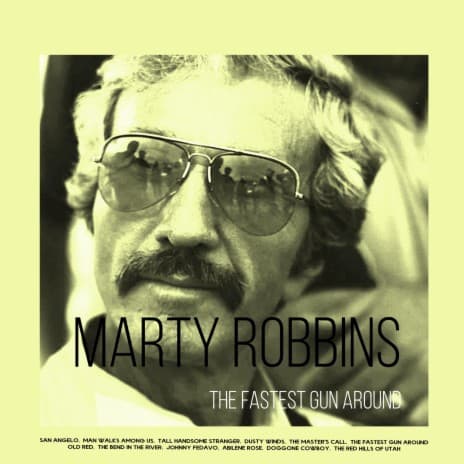
A stark Western murder ballad where fate, jealousy, and silence collide beneath the desert sun.
Among the darker corners of Marty Robbins’s legendary Western songbook, “Johnny Fedavo” stands as one of his most chilling and morally complex narratives. Recorded in 1959 and released as part of the landmark album Gunfighter Ballads and Trail Songs, the song was not issued as a commercial single and therefore did not enter the major Billboard singles charts at the time of its release. Yet its absence from the charts has never diminished its power. Within the album’s sequence, “Johnny Fedavo” functions as a quiet but devastating counterweight to more widely known tracks, revealing Robbins’s extraordinary gift for storytelling and emotional restraint.
Gunfighter Ballads and Trail Songs, released by Columbia Records in September 1959, would go on to reach No. 6 on the Billboard Top Pop Albums chart and eventually become one of the most enduring albums in American country music history. While songs like “El Paso” carried the album into chart immortality, “Johnny Fedavo” remained a deeper cut, known intimately by listeners who stayed with the record from beginning to end. Its strength lies not in spectacle, but in its cold, steady unfolding of tragedy.
The song tells the story of Johnny Fedavo, a man betrayed not by enemies or the law, but by love itself. The narrator recounts how Johnny discovers that his sweetheart is unfaithful, choosing another man. In a moment of irreversible decision, Johnny kills both lovers and disappears into the desert, carrying his crime and his sorrow with him. Robbins delivers this narrative with remarkable calm. There is no melodrama, no moral lecture, no plea for sympathy. The song simply lays out events as if carved into stone, leaving the weight of judgment to settle quietly in the listener’s mind.
This emotional restraint is central to the meaning of “Johnny Fedavo.” Unlike many ballads that seek redemption or justification, this song offers neither. It reflects an older storytelling tradition in which actions have consequences that are neither softened nor explained away. Robbins sings not as a participant, but as a witness, his voice warm yet detached, allowing the tragedy to speak for itself. The effect is haunting. Each verse feels like another step deeper into silence, where regret has no language left.
Musically, the arrangement is spare and deliberate. Acoustic guitar and subtle rhythm provide a steady pulse, mirroring the inevitability of the story. There are no lush orchestral swells, no dramatic crescendos. This simplicity enhances the song’s gravity, drawing attention to the lyrics and Robbins’s measured phrasing. His baritone voice, already famous for its warmth and clarity, here becomes a vehicle for restraint, proving that emotional impact does not require excess.
The placement of “Johnny Fedavo” within Gunfighter Ballads and Trail Songs is significant. The album as a whole explores violence, honor, betrayal, and destiny across the mythic landscape of the American West. Yet where other tracks contain motion and drama, “Johnny Fedavo” feels almost still, as if time itself has paused. It is not about gunfights in the open street, but about a private moment when love collapses and a man crosses a line he can never uncross.
Historically, the song reflects the tradition of folk and country murder ballads that date back centuries. These songs were never meant to comfort. They served as cautionary tales, reflections on human weakness, and mirrors of moral consequence. Robbins understood this lineage deeply. Rather than modernizing the form, he honored it, presenting the story without commentary and trusting the listener to feel its weight.
Today, “Johnny Fedavo” endures not because it was popular, but because it was honest. It captures a truth that remains timeless: that jealousy can harden into violence, and that some choices leave only silence in their wake. In the broader arc of Marty Robbins’s career, the song stands as a reminder that his greatness was not only in chart topping hits, but in the quiet, shadowed stories where emotion was carried not by volume, but by restraint.
Long after the final note fades, “Johnny Fedavo” lingers like a desert horizon at dusk, empty, unresolved, and unforgettable.