
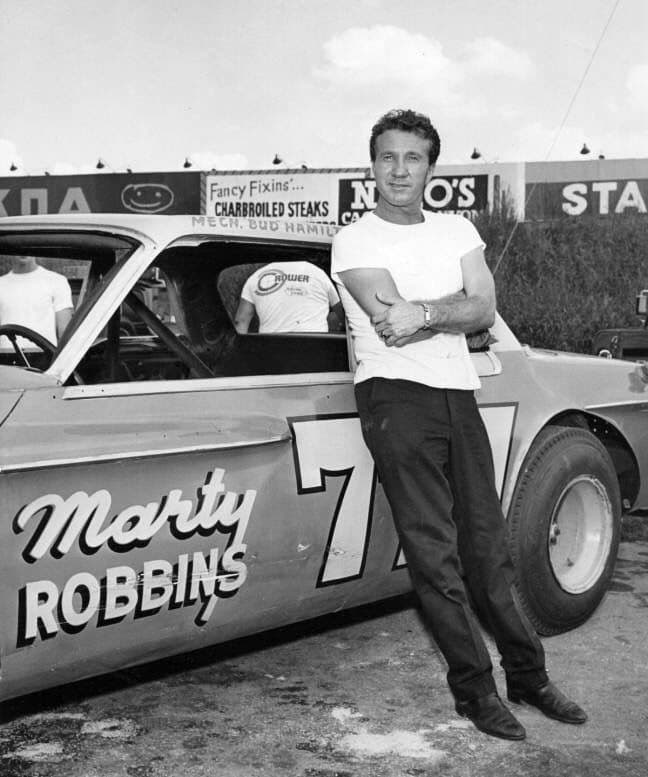
A lonely road, a burning engine, a restless heart — “Twentieth Century Drifter” is the anthem of a man forever chasing tomorrow.
Few songs capture the bittersweet ache of a restless soul quite like Twentieth Century Drifter by Marty Robbins. First released in 1974 on the album Good’n Country, the song climbed to No. 10 on the U.S. Billboard Country chart — a respectable showing that belies just how deeply it resonated with listeners who understood long highways, longing, and the price of dreams.
From the very first lines you know this isn’t a love-song in the gentle sense. There’s no soft cradle of romance — instead, there’s rubber on asphalt, the loneliness of departure, and the weight of a dream that demands sacrifice. Robbins sings as a driver: “Drivin’ my race car is my way of making a livin’, my way of puttin’ the bread on the table at home.” This isn’t a cowboy wandering under stars. It’s a man in a roaring machine, chasing a finish line, carrying both hope and burden.
The story behind the song is as vivid as the lyrics. Robbins himself wasn’t just a country singer — he was a passionate race-car driver, lacing up boots and strapping into a stock car nearly as often as he grabbed a guitar. That lifelong tension — between studio lights and roaring engines, between ballads and burnout lines — pulses in this track. As one retrospective piece on classic racing songs puts it: “Twentieth Century Drifter is about the ramblin’ life of a professional driver… but fittingly, Robbins puts a romantic spin on it.”
When you listen, you can almost smell the gasoline, hear the tires screech at the starting line, feel the solitude of motel rooms and empty highways. The narrator is gone thirty-two weekends a year — chasing speed, chasing victory — and every goodbye kiss at the porch feels heavy. Yet beneath the grit, there’s longing: for home, for love, for rest. It’s a dual portrait of longing and ambition, of roots and restlessness.
Musically, the arrangement supports that duality: you hear the steady pulse of drums and guitars, the faint echo of roads ahead, and Robbins’s voice — part weary, part hopeful — carrying the weight of a man who trades comfort for chasing dreams. There’s melancholy, yes, but also determination: “First place could be just a dream, but I’m gonna chase it.” If the song had a photograph, it would be a lone car headed into a dusty sunset, tires kicking up memories.
In the context of Robbins’s life, “Twentieth Century Drifter” feels almost autobiographical. Born Martin David Robinson in Arizona, he walked a rough path from a turbulent childhood, served in World War II, then found his way as a singer and — uniquely — a racing driver. His career spanned nearly four decades, producing 94 charted country songs, 16 number ones, and a legacy of versatility spanning ballads, rockabilly, western tunes — and even tire smoke and checkered flags.
But beneath his success, Robbins carried restlessness — a longing that wouldn’t settle. As one biographer’s evocative portrait suggests, he saw himself as a “drifter,” a man always searching for self-fulfillment and inner peace. That sense of wandering, of never quite arriving, lies at the heart of this song.
For those who lived through the era of vinyl and roadside diners, the song may stir memories: of longing for something more, of nights spent dreaming by the radio, of youthful hope and the ache of leaving. For newer listeners, it might feel like a window into an age when country music sang less of glamour and more of honest lives — of people who loved, labored, left, and kept dreaming.
“Twentieth Century Drifter” doesn’t promise redemption. It doesn’t promise home. It offers movement — the kind that carries you forward even when your heart is heavy. And for anyone who ever chased a dream on restless nights, it resonates: a hymn for wanderers, for those driven by something beyond comfort, forever searching for the next horizon.