
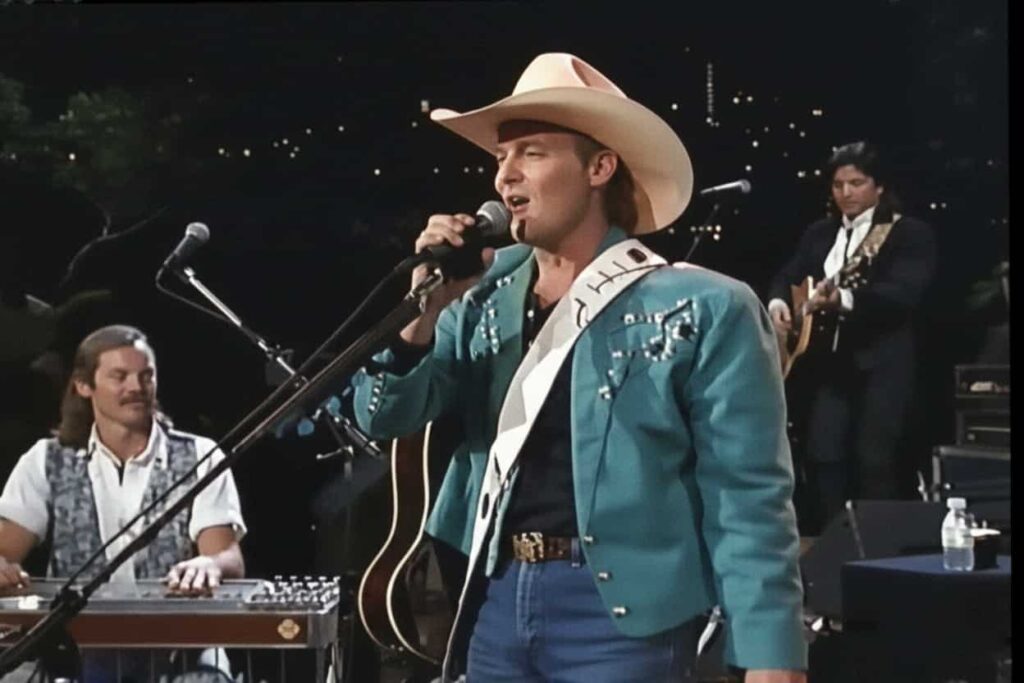
A joyful stomp that turns back the clock to the carefree spirit of American dance floors and the enduring charm of a timeless novelty hit.
When people think of Ricky Van Shelton, they usually picture his mellow baritone drifting through heartfelt country ballads. Yet among the more unexpected delights in his repertoire is his rollicking cover of Wooly Bully. The song itself, of course, belonged originally to Sam the Sham and the Pharaohs, who released it in 1965. It stormed the Billboard Hot 100, peaking at number 2, and despite never reaching the top, it became the biggest-selling single of 1965 in the United States. Few songs from that era captured the wild, good-humored nonsense of mid-sixties pop quite like it. Its Tex-Mex organ riff, its shouted count-offs, and its pure irreverence gave older teens of the time something irresistible: a song that didn’t ask to be analyzed, only danced to.
Shelton, a traditionalist from Virginia with a deep love for the classics, understood this spirit better than most. His attraction to Wooly Bully wasn’t about rewriting history; it was about keeping a small flame of joy alive from a simpler musical age. In his concerts, where fans often shared the room with decades of their own memories, his version acted as a bridge between two worlds: the 1960s dance halls of youthful abandon, and the country stages where Shelton’s warm voice felt like home.
The original song’s backstory is famously lighthearted. Domingo Samudio, known as Sam the Sham, built an entire persona around playful showmanship. Wooly Bully was inspired partly by his pet cat, named “Wooly Bully,” and partly by the nonsensical fun of novelty rock. The lyrics don’t chase a moral or unfold a narrative. They simply revel in sound, rhythm, and the carefree thrill of shouting out a refrain with friends. That, in many ways, is where the deeper meaning lies. For listeners who grew up during that era, the song recalls Friday nights at the roller rink, school dances, jukeboxes glowing in the corner of a diner, and the first taste of freedom that came with turning up the radio just a little too loud.
Shelton’s cover leans into this nostalgia instead of trying to modernize it. His country phrasing gives the song a different texture, but the heart remains the same: contagious joy. When he performed it onstage, audiences often responded with the same laughter, clapping, and foot-tapping energy that fans brought to the original in 1965. It wasn’t just a cover. It was a reminder that fun, too, deserves its place in the musical canon.
For older listeners today, hearing Shelton’s take on Wooly Bully can feel like rediscovering a forgotten photograph tucked in an album sleeve. It carries a spark of youthful mischief, untouched by time or sorrow. And perhaps that is why the song continues to endure. In a world that often demands seriousness, it offers something beautifully simple: a few minutes where rhythm outruns worry, where memory dances again, and where joy returns without asking for permission.In the hands of Ricky Van Shelton, that simplicity becomes a gift.
 Music Legend