
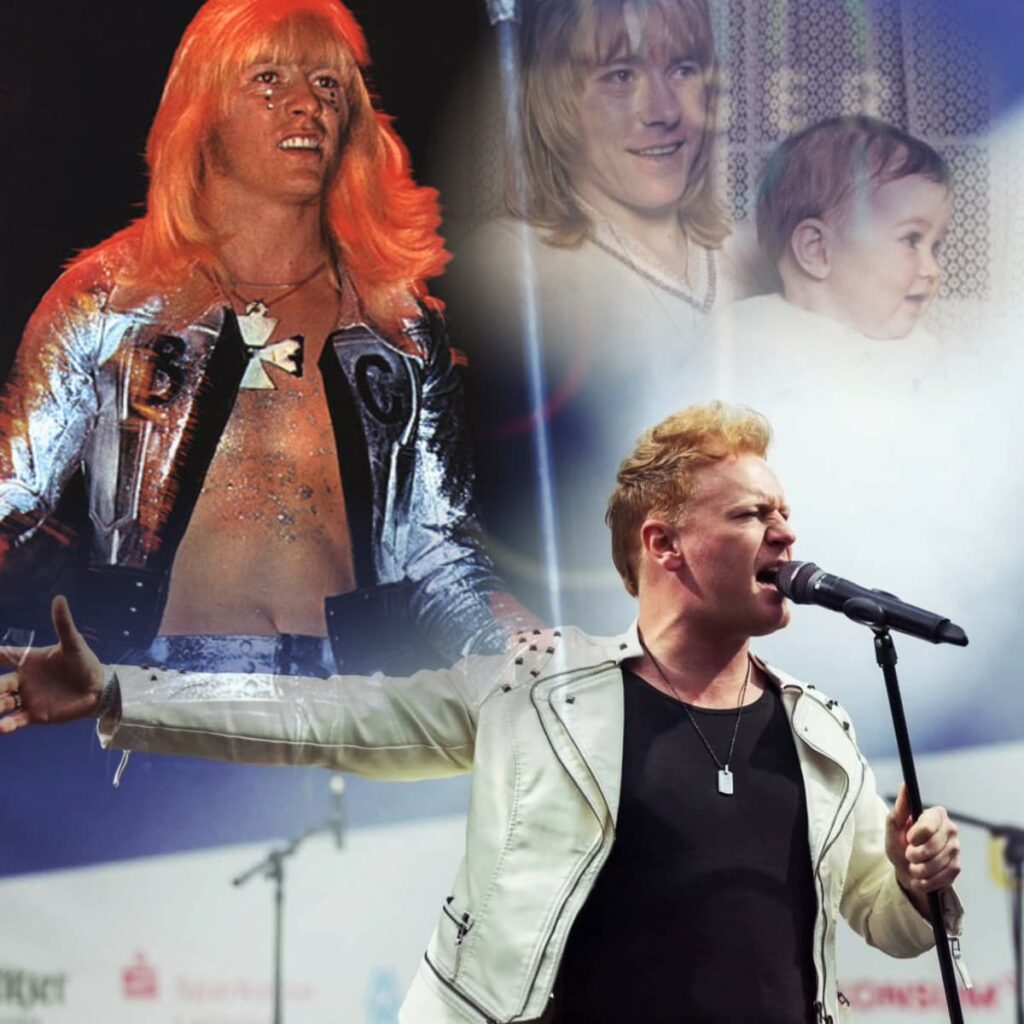
A son’s voice stepping into a song that once shook the world, now carrying love, memory, and an unbroken bond
When Brian Connolly Junior chose to cover “Ballroom Blitz”, it was never about reviving a hit or chasing nostalgia. It was an act of remembrance, a deeply personal tribute to his father, Brian Connolly, the unmistakable voice and frontman of Sweet, whose energy helped define one of the most explosive moments in 1970s glam rock. This cover stands not as a recreation of noise and spectacle, but as a quiet, resolute gesture of love between a son and a father whose presence still echoes through music.
Originally released in 1973, “Ballroom Blitz” was a cultural detonation. The song reached number 1 on the UK Singles Chart and climbed to number 5 on the US Billboard Hot 100, turning Sweet into an international force almost overnight. Its pounding rhythm, shouted roll call, and fearless swagger captured the chaos and thrill of live music at its most unrestrained. Inspired by a real-life incident in which the band was pelted with bottles and chairs at a gig in Scotland, the song transformed confrontation into celebration, danger into exhilaration. At its center was Brian Connolly, whose commanding vocal performance gave the song both authority and theatrical charm.
Yet decades later, when Brian Connolly Junior stepped forward to sing this same song, its meaning shifted. The familiar opening lines no longer introduced a band about to explode onto a stage. They opened a door into memory. For a son, singing “Ballroom Blitz” is not simply stepping into his father’s spotlight, but standing inside his shadow with reverence and courage. Every lyric carries the weight of inheritance. Every note becomes a conversation across time.
The emotional power of this cover lies in what it does not attempt. Brian Connolly Junior does not try to outdo the original, nor does he seek to modernize it beyond recognition. Instead, he treats the song as something sacred. His voice carries restraint where the original carried bravado. Where his father’s delivery was explosive and defiant, the son’s interpretation is reflective, almost tender beneath the surface. The contrast is striking and intentional. It reminds the listener that this is no longer about survival onstage, but about connection.
The relationship between Brian Connolly and his son was shaped by the complicated reality of fame. A life lived loudly on stage often leaves quieter spaces at home, filled with absence, longing, and unanswered questions. For Brian Connolly Junior, covering “Ballroom Blitz” becomes a way of stepping closer to a father known to the world but known differently at home. Music becomes the shared language where ordinary words fall short.
What makes this tribute especially moving is that “Ballroom Blitz” was always about chaos, movement, and collective energy. It thrived on crowds and noise. In the hands of a son honoring his father, it becomes intimate. The song no longer asks who is ready for the fight. Instead, it asks who is willing to remember. The answer comes quietly, carried in breath and tone rather than volume.
Within the broader legacy of Sweet, Brian Connolly remains an irreplaceable presence. His voice had a clarity and edge that balanced the band’s thunderous sound, giving glam rock a human center. His struggles later in life only deepen the poignancy of his music. For Brian Connolly Junior, revisiting this signature song is not about preserving perfection, but acknowledging complexity. Love, like music, is rarely simple.
The act of a son singing his father’s most famous song carries a symbolism that cannot be manufactured. It speaks of lineage, of stories passed down not through lectures but through sound. It suggests that even when time creates distance, music can shorten it. In Brian Connolly Junior’s cover of “Ballroom Blitz”, the song becomes a bridge between who his father was on stage and who he was away from the lights.
In the end, this tribute reminds us that great songs do not belong solely to charts or eras. They belong to families, to memories, to moments of quiet courage. A son standing where his father once stood is not repeating history. He is honoring it. And in that act, “Ballroom Blitz” finds a new meaning, no longer just a roar from the past, but a heartbeat that continues, steady and enduring, from one generation to the next.