
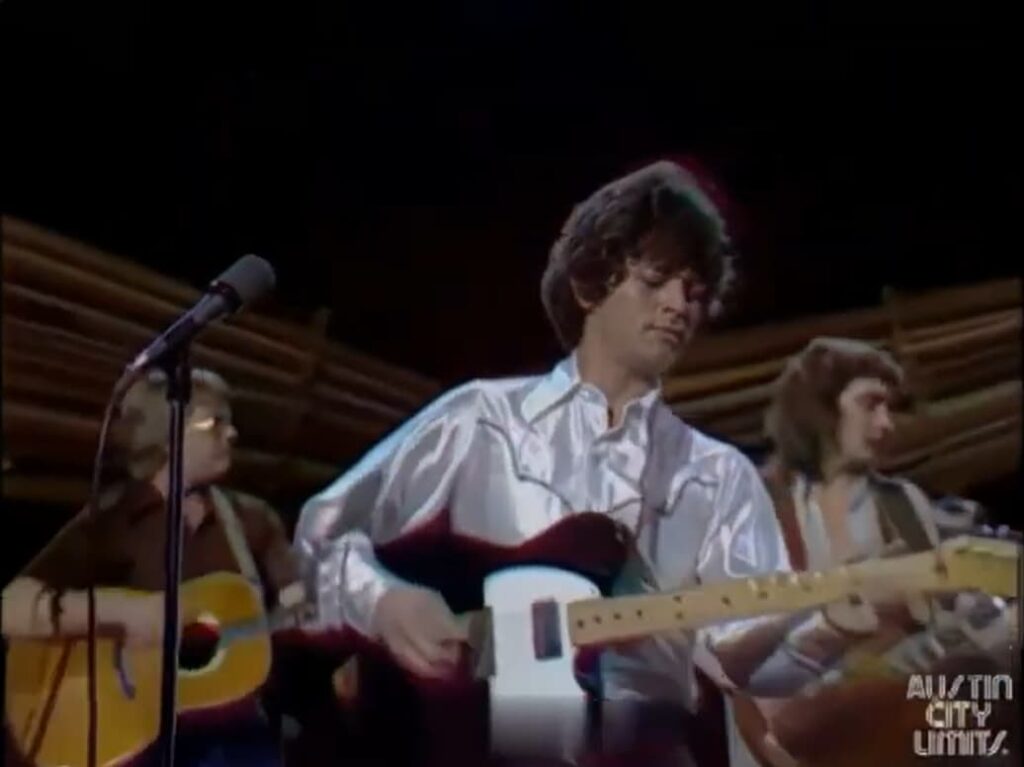
A quiet confession wrapped in distance—where love lingers, even when life has already moved on
In 1981, Johnny Rodriguez released “Alabama”, a song that would become one of the most understated yet emotionally resonant recordings of his career. Included on the album “Rodriguez” (1981), the single climbed to No. 34 on the Billboard Hot Country Singles chart—a modest peak compared to his earlier string of No. 1 hits in the 1970s, yet one that reveals a different, more reflective phase in his artistic journey.
By the early 1980s, Johnny Rodriguez was no longer the young breakthrough star who had reshaped country music with bilingual phrasing and a fresh, effortless charm. The industry itself had begun to change, and so had he. There is a noticeable shift in “Alabama”—a sense that the voice carrying the song has lived through something quieter, heavier, and perhaps more complicated than before.
The song unfolds with a simplicity that feels almost deceptive. On the surface, it tells the story of a man recalling a past love connected to a place—Alabama. But as the verses progress, it becomes clear that this is not merely a memory being revisited. It is something unresolved, something that lingers just beneath the surface of everyday life. The kind of memory that does not demand attention, but never quite fades either.
Rodriguez delivers the lyrics with remarkable restraint. There is no dramatic emphasis, no attempt to heighten the emotion beyond what the words already carry. Instead, he leans into subtlety. His phrasing feels conversational, almost as if the story is being shared rather than performed. That approach allows the listener to step into the space between the lines—to sense what is not being said as much as what is.
Musically, “Alabama” reflects the transitional nature of country music at the time. The arrangement is clean and unembellished, with gentle instrumentation that supports rather than defines the song. There are traces of the smoother production style that would come to dominate the decade, yet it remains grounded in the storytelling tradition that had always been central to Rodriguez’s work.
What gives “Alabama” its lasting weight is not its structure or even its melody, but its emotional honesty. The song does not attempt to resolve its central feeling. It does not offer closure or reconciliation. Instead, it presents a moment of recognition—the realization that certain connections remain, even when they no longer have a place in the present.
There is also a quiet sense of distance running through the song. Not just geographical distance, though that is certainly part of it, but emotional distance as well. The narrator seems aware that the past cannot be revisited in the way it once was. And yet, there is no bitterness in that awareness. Only acceptance, and perhaps a trace of longing that has softened over time.
In the broader context of Johnny Rodriguez’s career, “Alabama” stands as a reminder of his ability to adapt without losing his identity. While his earlier hits often carried a brighter, more immediate appeal, this recording reveals a deeper layer—one shaped by experience, by time, and by the quiet understanding that comes with both.
Listening to the song now, there is a sense that it belongs to a different kind of moment. Not the kind marked by celebration or heartbreak, but the kind that arrives unexpectedly—when a name, a place, or a memory surfaces without warning, bringing with it a feeling that cannot be easily explained.
And perhaps that is the true meaning of “Alabama.” It is not about returning, nor about forgetting. It is about carrying something forward, quietly, without resolution. Johnny Rodriguez does not try to define that feeling. He simply gives it a voice—soft, steady, and honest enough to remain long after the song has ended.