
A Quiet Reckoning Where Forgiveness Feels Simple in Words, Yet Heavy with Memory and Regret
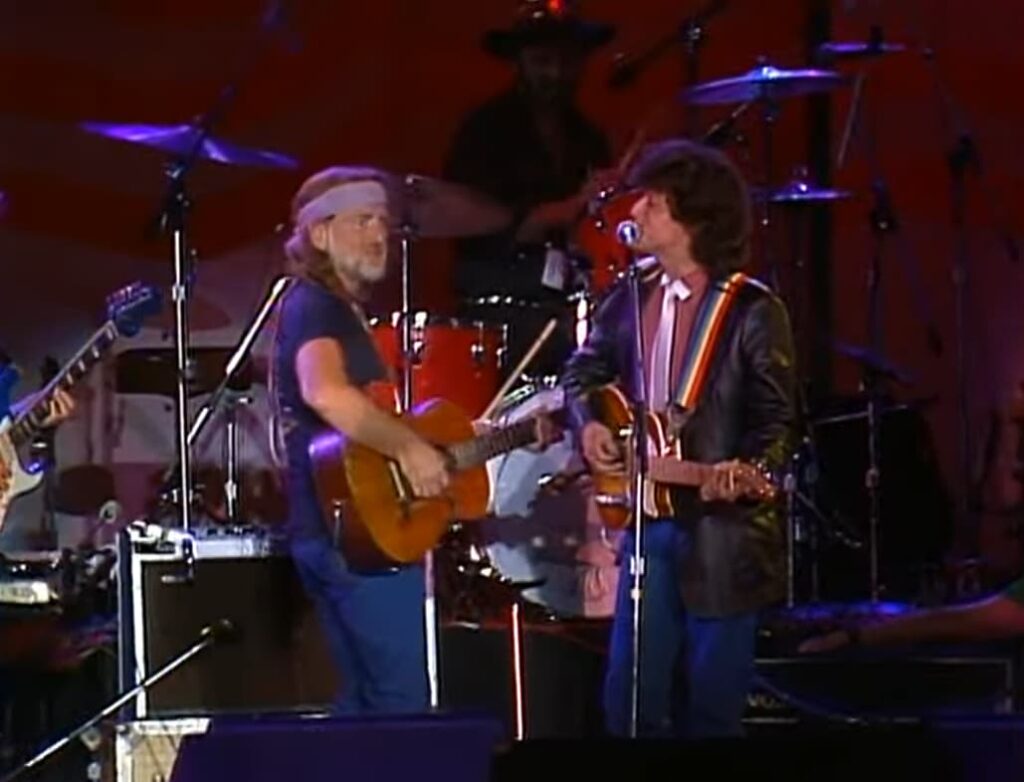
When “Forgiving You Was Easy” was performed live at Farm Aid 1985 by Willie Nelson alongside Johnny Rodriguez, it carried with it a history already etched into the fabric of country music. Originally written and recorded by Willie Nelson, the song was released in 1985 as part of the album “Me & Paul”, and it climbed to No. 1 on the Billboard Hot Country Singles chart, reaffirming Nelson’s unmatched ability to translate emotional complexity into something that feels almost disarmingly simple.
By the time of that Farm Aid performance—an event founded in part by Willie Nelson himself to support American farmers—the song had already found its place among his most quietly devastating works. Yet hearing it in a live setting, shared between two voices, added a new dimension. It no longer felt like a solitary confession. It became something shared, almost conversational, as though two men were revisiting the same memory from slightly different distances.
At first glance, “Forgiving You Was Easy” seems built on contradiction. The title suggests resolution, a kind of emotional closure. And yet, as the song unfolds, it becomes clear that forgiveness, in this context, is not an act of strength, but one of lingering vulnerability. The words imply that letting go should have been simple—but the tone, the phrasing, the quiet pauses between lines reveal something else entirely. There is a weight beneath the surface, an understanding that forgiveness does not erase what came before.
Willie Nelson’s writing has always carried this kind of subtle tension. He does not overwhelm the listener with elaborate metaphors or dramatic declarations. Instead, he relies on understatement. In “Forgiving You Was Easy”, that restraint becomes the song’s greatest strength. Each line feels measured, almost hesitant, as though carefully chosen to avoid saying too much, and yet revealing everything.
The live performance at Farm Aid 1985 deepens this effect. Johnny Rodriguez, known for his smooth, expressive delivery, brings a complementary warmth to the song. Where Nelson’s voice carries a weathered honesty, Rodriguez adds a certain clarity, a softness that balances the narrative. Together, they create a dialogue—not in the literal sense, but in the emotional interplay between their voices.
There is something particularly fitting about this song being performed at Farm Aid. The event itself was rooted in compassion, in the idea of coming together to support those facing hardship. In that context, “Forgiving You Was Easy” feels almost symbolic. It speaks to resilience, to the quiet endurance required not just in relationships, but in life itself. Forgiveness, like survival, is rarely as simple as it appears.
Musically, the arrangement remains understated, allowing the lyrics to carry the emotional weight. Gentle acoustic guitar, subtle phrasing, and the absence of unnecessary embellishment create a space where the listener is drawn inward rather than outward. It is a performance that does not seek applause—it invites reflection.
For Johnny Rodriguez, sharing the stage with Willie Nelson in this moment also carries its own significance. As an artist who had experienced both remarkable success and personal struggles, Rodriguez brings an authenticity to the performance that cannot be manufactured. His presence does not overshadow Nelson’s song; it enriches it, adding another layer of lived experience.
Looking back, “Forgiving You Was Easy” stands as one of those songs that reveals more with time. What may have once sounded like a simple statement begins to feel more complex, more nuanced. The idea of forgiveness becomes less about resolution and more about acceptance—the quiet acknowledgment that some feelings never fully disappear, but can be carried with a kind of grace.
In the broader landscape of Willie Nelson’s career, the song is a reminder of his unique place in country music. He does not chase grand emotional climaxes. Instead, he lingers in the in-between spaces—the moments where words falter, where feelings remain unresolved. It is in those spaces that his music finds its deepest resonance.
And in that live performance, shared with Johnny Rodriguez, the song becomes something even more enduring. Not a declaration, not a conclusion, but a quiet understanding—one that lingers long after the final note fades.