
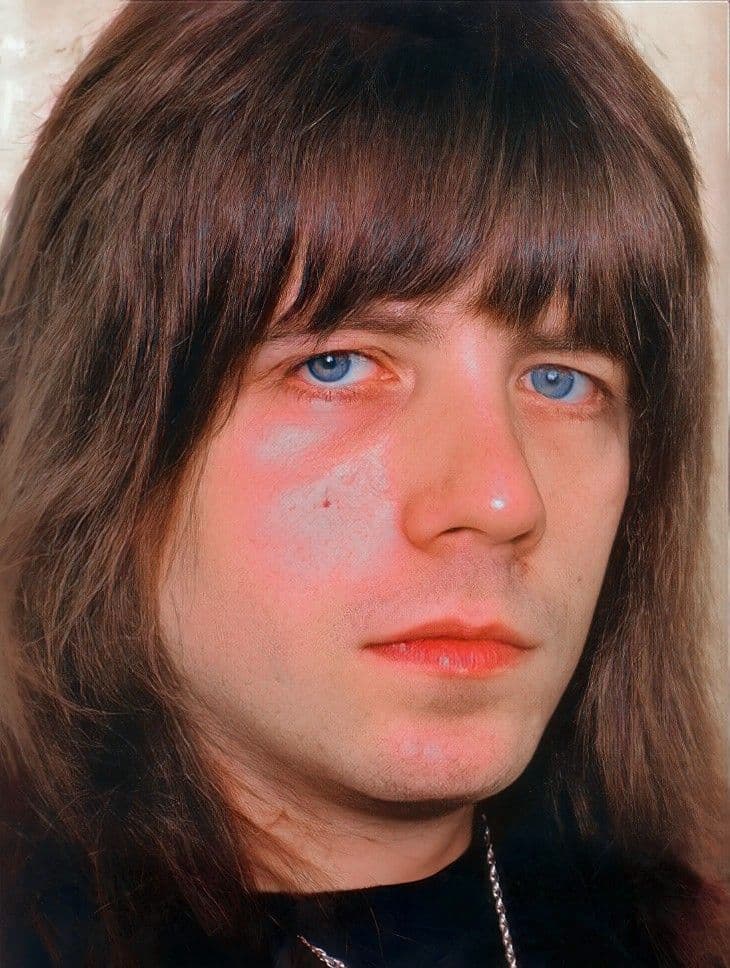
A legacy rebuilt in changing times—when Sweet returned in the mid 1980s, it was no longer about chart positions, but about carrying a sound forward without losing its soul
By 1985, the story of Sweet had already passed through its brightest chapter. The era of glitter, towering choruses, and chart-dominating singles like “Ballroom Blitz” and “Fox on the Run” belonged to an earlier decade, one that had begun to fade as musical tastes shifted toward harder edges and new identities. Yet for Andy Scott and Mick Tucker, the band was never just a moment in time. It was something that could be reshaped, reinterpreted, and carried forward—even if the path ahead looked very different from the one behind.
The reformation of Sweet in 1985 brought with it a lineup that, at first glance, seemed far removed from the group’s original image. Paul Day, once associated with the early days of Iron Maiden, stepped into the role of lead vocalist. Alongside him came Phil Lanzon, whose later work with Uriah Heep would further define his place in rock history, and Mal McNulty, bringing a solid, grounded presence on bass.
It was, in many ways, a new band carrying an old name. But rather than attempting to recreate the past exactly as it was, this incarnation chose a different approach. The essence of Sweet—the driving rhythms, the layered harmonies, the unmistakable sense of theatrical energy—remained intact. Yet there was also a noticeable shift. The sound leaned slightly harder, more aligned with the evolving rock landscape of the 1980s, without ever abandoning the melodic core that had defined the band’s earlier success.
There is something quietly admirable in that balance. Too often, bands returning after their peak years fall into one of two paths: either chasing modern trends so completely that their identity dissolves, or clinging so tightly to the past that they become a reflection rather than a continuation. This version of Sweet managed to stand somewhere in between. It acknowledged change without surrendering to it.
Live performances during this period carried a particular kind of energy—not the explosive, almost chaotic excitement of their early fame, but something steadier, more deliberate. The songs were still there, familiar and immediate, but they were delivered with a sense of perspective that only time can bring. There is a difference between playing a hit and understanding what that hit has come to mean.
When Mick Tucker departed in 1991, it marked another turning point. His presence had always been central, not just as a drummer, but as part of the band’s original heartbeat. From that moment on, the group continued under the name Andy Scott’s Sweet, a subtle but important distinction. It was no longer the collective identity of the past, but rather a continuation guided by one of its defining voices.
Under Andy Scott’s leadership, the band became something closer to a living archive—yet one that refused to stand still. Touring consistently, performing across countries and generations, Andy Scott’s Sweet ensured that the music remained not just remembered, but experienced. The songs were not preserved behind glass. They were played, night after night, in front of audiences who carried their own memories into the room.
What emerges from this later chapter is not a story of reinvention in the dramatic sense, but one of endurance. The glam rock era may have passed, the charts may have moved on, but the music itself found a way to remain present. Not as nostalgia alone, but as something still capable of connection.
In the end, the reformation of Sweet in 1985 and its continuation into the years that followed speaks to a deeper truth about music that lasts. It is not defined solely by its peak, nor confined to the moment it first appears. It evolves, carried by those willing to keep it alive—not perfectly, not unchanged, but honestly. And in that honesty, the legacy of Sweet continues, not as it once was, but as it has chosen to become.