
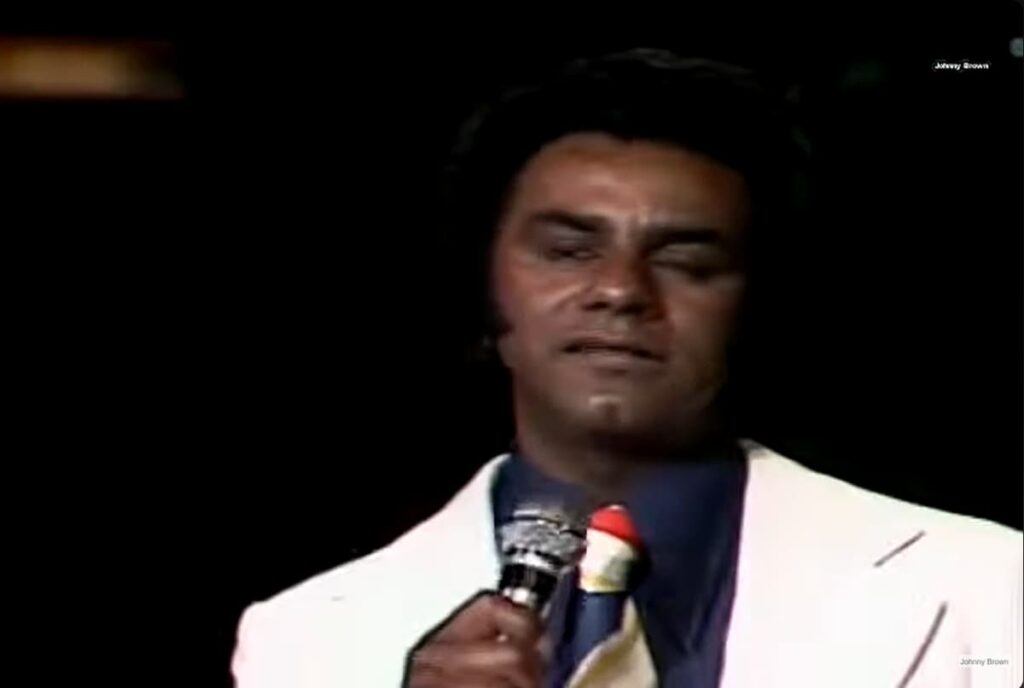
A quiet hymn of hope and humanity—where love is not merely a feeling, but the last refuge against a restless and uncertain world
There are songs that entertain, and there are songs that elevate. “If We Only Have Love”, performed by Johnny Mathis during his 1975 concert in Paris, belongs unmistakably to the latter. Though not a chart-topping single in the conventional sense during that period, the song itself carries a distinguished lineage—originally written by Jacques Brel as “Quand on n’a que l’amour” in 1956, a composition that has long been regarded as one of the most profound musical statements on love and human dignity. By the time Johnny Mathis brought it to the Parisian stage, it had already transcended charts and commercial metrics, living instead in the realm of timeless expression.
The 1975 Paris performance stands as a particularly luminous moment in Mathis’s career. Known for his velvet voice and romantic balladry, he approached this song with a reverence that set it apart from his more familiar repertoire. There was no attempt to reshape it into something more accessible or commercially appealing. Instead, Johnny Mathis leaned into its solemn beauty, allowing the song’s message to unfold with patience and grace.
At its core, “If We Only Have Love” is not simply about romance—it is about the idea that love, in its purest form, is enough to sustain humanity even in its darkest hours. The lyrics speak of a world stripped of material wealth, of certainty, even of peace, yet still held together by the fragile but enduring thread of compassion. It is a message that resonates deeply, especially when delivered in a setting like Paris—a city that has long symbolized both artistic brilliance and historical resilience.
What makes Mathis’s interpretation so compelling is the restraint he brings to it. His voice, often celebrated for its smoothness, takes on a slightly different character here—less about polish, more about sincerity. There is a quiet strength in his delivery, a sense that he is not merely performing the song, but inhabiting it. Each phrase is allowed to linger, to breathe, to settle gently into the listener’s consciousness.
The orchestration during that 1975 performance complements this approach beautifully. Sweeping yet never overwhelming, it provides a delicate backdrop that enhances rather than competes with the vocal line. Strings rise and fall like distant waves, while subtle instrumental accents underscore the emotional weight of the lyrics. It is a masterclass in balance—knowing when to hold back, when to let the silence speak as loudly as the music itself.
In many ways, this performance reflects a broader moment in time. The mid-1970s were marked by both cultural richness and underlying uncertainty. Against that backdrop, a song like “If We Only Have Love” feels almost like a quiet protest—not against any one issue, but against the very idea that hope can be diminished. It insists, gently but firmly, that love remains a constant, even when everything else seems to shift.
Listening to this recording today, there is an almost meditative quality to it. It invites reflection, not distraction. One can imagine it playing softly in a dimly lit room, where memories come and go like shadows—moments of joy, of loss, of quiet understanding. The song does not demand answers; it simply offers a space in which questions can exist.
And perhaps that is why Johnny Mathis’s rendition continues to resonate. It does not belong to a specific chart position or a fleeting trend. Instead, it belongs to something deeper—a shared human experience that transcends time and place.
In the end, “If We Only Have Love” is less a song and more a gentle reminder. That even in a world that often feels uncertain, there remains something steadfast, something quietly powerful. And when voiced by an artist like Johnny Mathis, that reminder becomes not just something we hear, but something we feel—long after the final note has faded into silence.