
A Sweeping Ballad of Nation-Building, Memory, and the Human Cost Behind Steel and Stone
Few songs in the folk tradition carry the narrative weight and quiet grandeur of “Canadian Railroad Trilogy” by Gordon Lightfoot. First composed in 1966 to commemorate Canada’s centennial, the piece stands not merely as a song, but as a musical chronicle—an evocative retelling of the construction of the Canadian Pacific Railway and the lives forever shaped by it. Though it was never designed as a conventional chart single, and therefore did not achieve notable positions on mainstream pop charts, its legacy has far surpassed the metrics of commercial ranking. It has endured as one of Lightfoot’s most revered compositions, a cornerstone of his repertoire and a defining work in North American folk music.
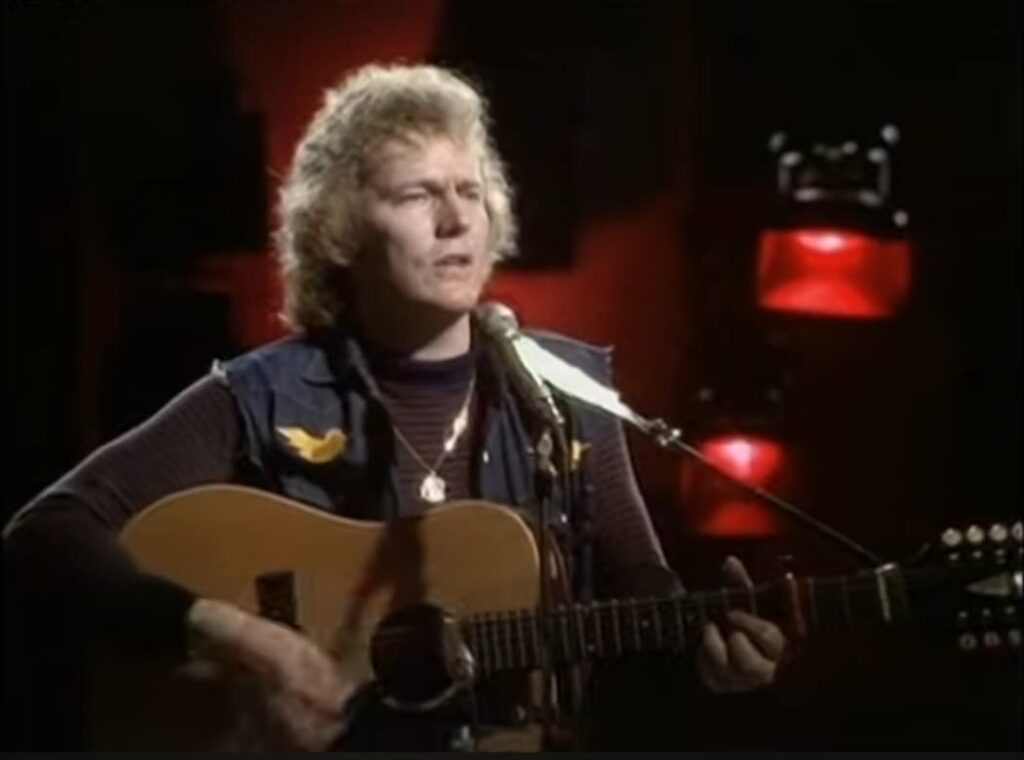
By the time Gordon Lightfoot performed the song during his BBC concert in 1972, he had already established himself as a master storyteller, a craftsman of melody and memory. That particular live rendition carries a certain intimacy—stripped of excess, guided only by voice, guitar, and the quiet attention of the audience. It is in such settings that “Canadian Railroad Trilogy” reveals its full emotional depth. The performance does not overwhelm; it unfolds, slowly and deliberately, much like the history it recounts.
The origins of the song are rooted in a commission from the Canadian Broadcasting Corporation, inviting Lightfoot to create a piece that would reflect the nation’s first hundred years. Rather than offering a celebratory anthem filled with easy triumph, he chose a more nuanced path. The song acknowledges progress, yes—but it also honors the labor, sacrifice, and hardship that made such progress possible. In doing so, Lightfoot crafted something far more enduring than a patriotic tribute; he created a meditation on time, effort, and the often unseen human cost behind great achievements.
Lyrically, “Canadian Railroad Trilogy” is structured almost like a series of moving images. It begins with the vastness of the Canadian landscape—open, untouched, almost eternal. Then, gradually, the railway enters the scene, bringing with it change, disruption, and connection. Lightfoot’s voice carries a quiet reverence, never rushing, allowing each line to settle like dust on an old photograph. There is no need for dramatic emphasis; the weight of the story speaks for itself.
What makes the song particularly powerful is its balance. It does not romanticize the past, nor does it condemn it. Instead, it observes. The workers—many of them immigrants—are portrayed not as symbols, but as individuals whose lives were shaped by forces larger than themselves. Their presence lingers in the song like a distant echo, reminding the listener that history is not built by ideas alone, but by hands, by effort, by endurance.
The 1972 BBC performance adds another layer of meaning. Removed from the Canadian setting, presented to an international audience, the song takes on a universal quality. It becomes less about one nation’s railway and more about the shared human experience of building, striving, and remembering. In that quiet studio, far from the landscapes described in the lyrics, Lightfoot’s voice bridges distance and time, carrying the listener into a world both specific and deeply familiar.
Musically, the composition is deceptively simple. The acoustic arrangement allows the narrative to take center stage, yet there is a subtle complexity in the phrasing, in the way the melody rises and falls like the terrain it describes. Lightfoot understood that sometimes, restraint is the most powerful tool an artist can use. By leaving space within the music, he invites the listener to step inside the story, to walk alongside it.
Looking back, “Canadian Railroad Trilogy” stands as one of those rare works that seem to exist outside of time. It does not belong solely to the 1960s or the 1970s; it belongs to anyone willing to listen with patience and reflection. The 1972 performance, in particular, captures a moment when music still carried the weight of storytelling in its purest form—unhurried, thoughtful, deeply human.
And perhaps that is why it continues to resonate. Not because it seeks to impress, but because it chooses to remember.