
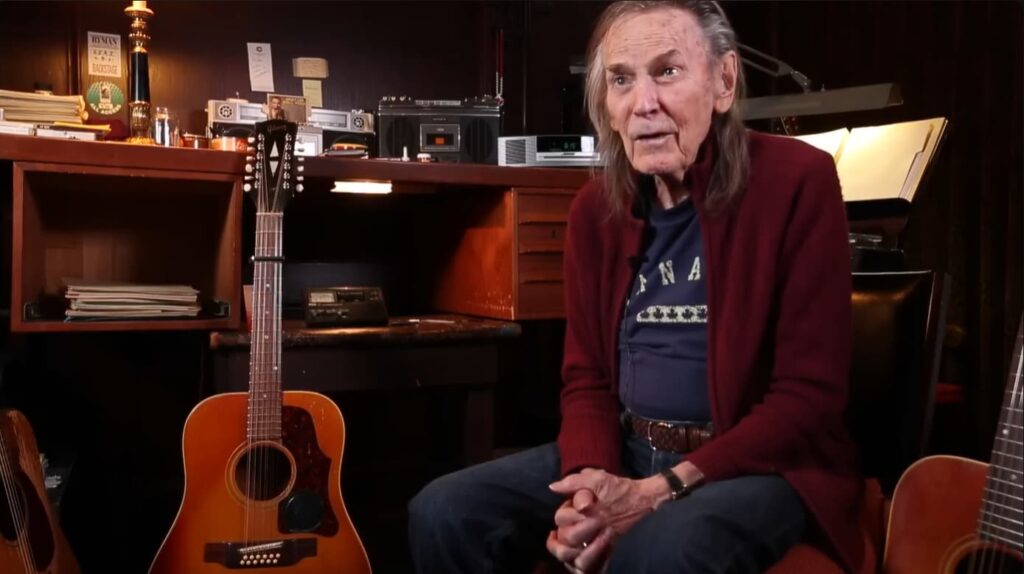
A quiet conversation with time itself—where memory, music, and a lifetime of stories gather in one room and speak without urgency
On February 4th, 2020, the world was offered something far more intimate than a performance, more revealing than any chart-topping single—a rare, reflective moment inside the home of Gordon Lightfoot. This sit-down interview was not tied to the release of a new hit, nor did it revolve around chart positions or commercial milestones. Yet, to understand its significance, one must look beyond numbers and instead into the quiet legacy of a man whose songs once climbed the highest peaks of the Billboard charts—from “If You Could Read My Mind” (1970) to the unforgettable “Sundown” (1974), which reached No. 1 on the Billboard Hot 100.
By 2020, Gordon Lightfoot was no longer chasing success—he had long since defined it on his own terms. What this interview captures is something rarer: the stillness that follows a life fully lived in music. Sitting in his own home, surrounded perhaps by the silent echoes of melodies that shaped generations, Lightfoot speaks not as a legend conscious of his status, but as a storyteller revisiting familiar roads.
There is a certain gravity in hearing him reflect. His voice, weathered yet steady, carries the same narrative strength that defined his songwriting. One is reminded of how his compositions—particularly “The Wreck of the Edmund Fitzgerald” (1976), which reached No. 2 on the Billboard Hot 100—were never just songs, but carefully crafted stories. In this interview, that same storytelling instinct remains intact, though quieter now, less urgent, as though time itself has softened its edges.
The setting of the interview plays a role that cannot be overlooked. This is not a stage, not a studio polished for performance—it is his home. And in that space, there is an unspoken honesty. The walls, one imagines, have witnessed decades of creation, doubt, triumph, and solitude. It is here that the public figure dissolves, leaving behind the man who once sat with a guitar, shaping words into melodies that would travel far beyond those walls.
What emerges from this conversation is not merely a recounting of achievements, but a meditation on endurance—on how music evolves alongside the person who creates it. Lightfoot speaks with the calm assurance of someone who understands that songs are never truly owned; they are released into the world, where they gather meaning through the lives of those who hear them.
There is also an undercurrent of reflection on the passage of time. In earlier years, his music often carried themes of longing, distance, and introspection. Listening to him now, one senses that those themes were not merely artistic choices, but glimpses into a deeper awareness that has only grown clearer with age. The interview does not rush to conclusions or dramatic revelations. Instead, it lingers—much like his songs—allowing silence to speak as eloquently as words.
For those familiar with his body of work, this interview feels like turning the final pages of a well-loved book—not because the story is ending, but because it has already been told with such completeness. There is comfort in that realization. The urgency of youth has given way to a quiet acceptance, and in that space, something profoundly human emerges.
In many ways, this February 2020 conversation serves as a companion piece to his music. Where the songs once carried emotion through melody and verse, here it is conveyed through pause, tone, and memory. It reminds us that behind every enduring song lies a life filled with moments both ordinary and extraordinary—moments that, when gathered together, form something lasting.
And perhaps that is the true significance of this interview. It is not about revisiting fame or recounting accolades. It is about presence—about sitting still long enough to listen, not just to the words being spoken, but to everything that exists between them. In the quiet of his home, Gordon Lightfoot offers something that no chart position could ever measure: a glimpse into the soul of a songwriter who has spent a lifetime turning experience into music, and who now, gently, allows the music to speak for itself.