
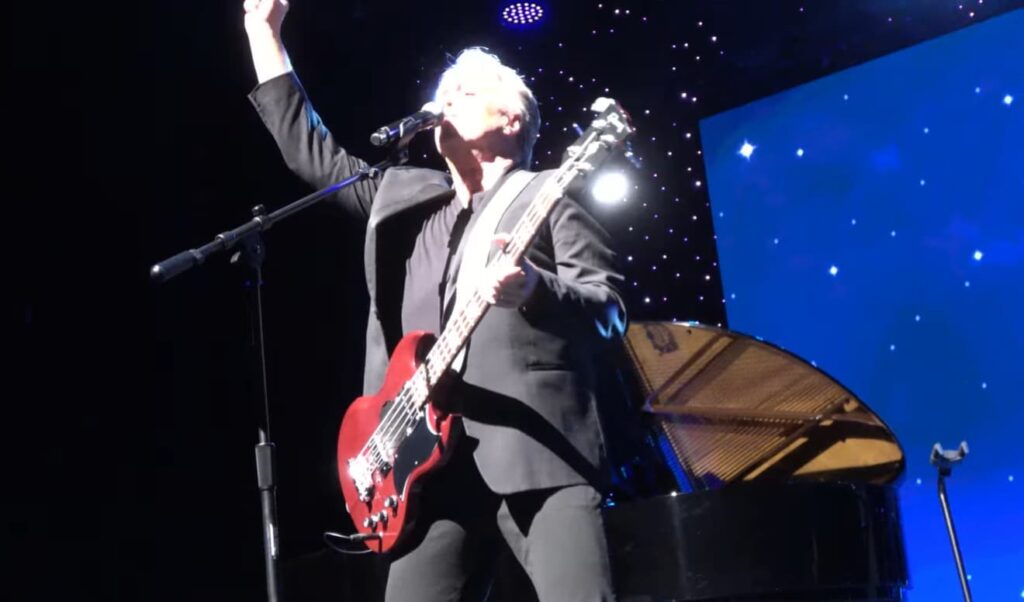
A Return to Youthful Echoes—Where “Da Doo Ron Ron” Meets Gentle Reflection in Time’s Embrace
On March 13, 2026, in Ledyard, Shaun Cassidy stepped once again into the glow of the stage, carrying with him not only a repertoire of beloved songs, but an entire era of memory. When he performed the pairing of “Da Doo Ron Ron” and “Til There Was You,” it became more than a nostalgic medley—it felt like a quiet conversation between two sides of a lifetime: the exuberance of youth and the tenderness of reflection.
For those who remember the late 1970s, Shaun Cassidy was not simply a singer—he was a phenomenon. His version of “Da Doo Ron Ron,” released in 1977 on the album “Shaun Cassidy,” climbed to No. 1 on the Billboard Hot 100, becoming one of the defining pop hits of that summer. Originally recorded by The Crystals in 1963, the song found new life in Cassidy’s hands, infused with a youthful energy that captured the spirit of a generation discovering its own voice. The album itself achieved multi-platinum status, solidifying his place among the most prominent teen idols of the decade.
And yet, decades later, standing in Ledyard, there was a noticeable shift—not in relevance, but in tone.
The inclusion of “Til There Was You,” a song immortalized by The Beatles on their 1963 album “With the Beatles” (though originally from the 1957 musical The Music Man), added a layer of introspection to the performance. Where “Da Doo Ron Ron” is playful, rhythmic, and driven by the excitement of young love, “Til There Was You” is gentle, almost fragile—a song about discovery, about the quiet realization that life gains meaning through connection.
To hear these two songs performed side by side in 2026 is to witness a subtle but powerful transformation.
Because time changes not only the voice, but the way a song is understood.
In his earlier years, Shaun Cassidy sang “Da Doo Ron Ron” with a kind of effortless charm, the lyrics carried by bright melodies and youthful confidence. It was music meant to be shared loudly—through radios, through laughter, through moments that felt endless. But in this later performance, there is often a softening, a sense that the song is no longer just about the excitement of meeting someone new, but about remembering what that feeling once meant.
And then comes “Til There Was You.”
There is something deeply moving in the way this song fits into the performance. Its lyrics speak of a world that was once incomplete, only to be transformed by the presence of another. In the context of a life already lived, those words take on a different weight. They become less about discovery and more about gratitude—about looking back and recognizing the moments that quietly shaped everything that followed.
The setting in Ledyard itself contributes to the intimacy of the experience. Unlike the massive venues of his early career, this is a space where the distance between performer and audience feels smaller, more personal. Every note, every pause, every subtle inflection carries meaning. There is no need for spectacle. The connection is already there.
What makes this performance especially compelling is not technical perfection, but emotional honesty. Shaun Cassidy does not attempt to recreate the past exactly as it was. Instead, he allows the songs to evolve alongside him. The energy may be more measured, the delivery more reflective, but the sincerity remains untouched.
And perhaps that is the true essence of enduring music.
Songs like “Da Doo Ron Ron” and “Til There Was You” do not belong to a single moment in time. They travel with us, changing shape as we do, revealing new meanings with each passing year. What once felt like simple joy becomes layered with memory. What once seemed fleeting reveals itself to have been lasting all along.
In the end, that evening in Ledyard was not about revisiting the past, but about understanding it.
Through two songs—one bright with youthful rhythm, the other rich with quiet reflection—Shaun Cassidy offered something rare: not just a performance, but a passage through time. A reminder that while voices may soften and years may pass, the emotions carried within a song remain, waiting patiently to be heard again… and understood anew.