
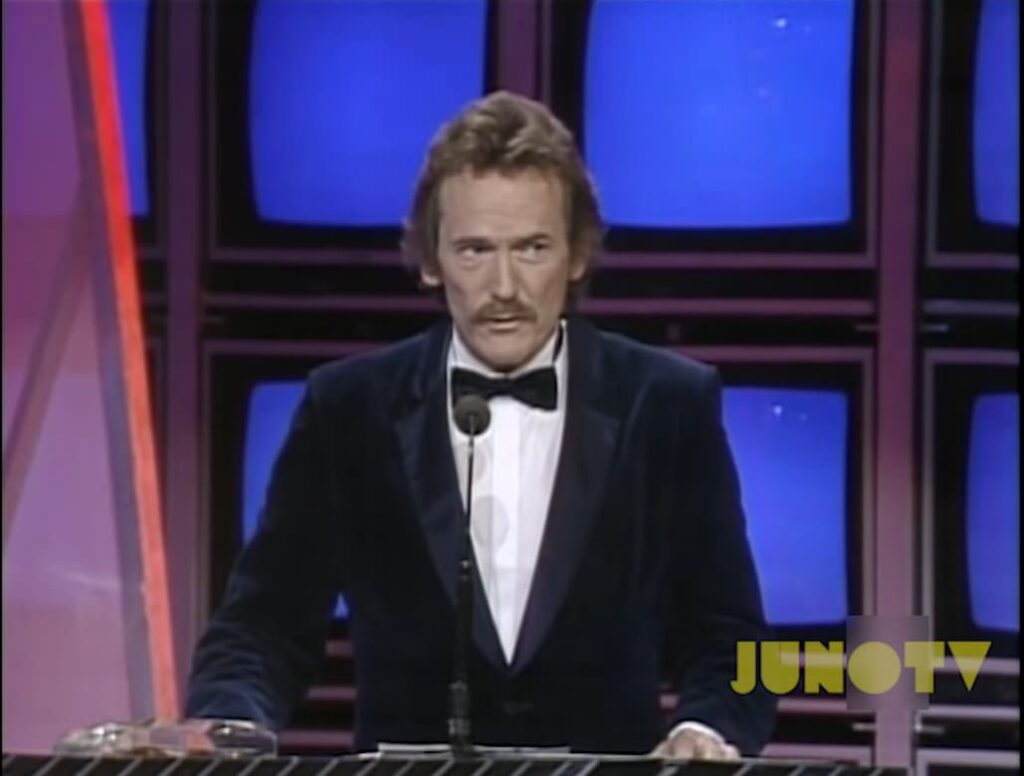
A Poet Honors a Storyteller—When Bob Dylan Saluted Gordon Lightfoot’s Quiet Greatness
At the 1986 JUNO Awards, a moment of rare and lasting significance unfolded when Bob Dylan stepped forward to induct Gordon Lightfoot into the Canadian Music Hall of Fame. It was not merely a ceremonial gesture, nor simply an acknowledgment of commercial success. Instead, it was something far deeper—a meeting of two master songwriters, one recognizing in the other a kindred spirit whose work had shaped the emotional landscape of modern folk and country music.
By 1986, Gordon Lightfoot had already secured his place as one of the most important voices in North American songwriting. His career, which began in the early 1960s, was defined by a remarkable consistency—songs that did not chase trends, but instead carved their own path through storytelling, melody, and quiet introspection. His 1974 single “Sundown” reached No. 1 on the Billboard Hot 100, a rare achievement for a folk-rooted artist, while also topping the Easy Listening chart. That same year, the album “Sundown” became his most commercially successful release, solidifying his presence far beyond Canadian borders.
And yet, chart success alone does not explain why Bob Dylan was chosen to deliver the induction.
Because Dylan, himself a figure synonymous with lyrical depth and cultural influence, understood something essential about Lightfoot’s work—something that statistics could never fully capture. In his speech, Dylan is known to have expressed deep admiration for Lightfoot’s songwriting, even admitting that he wished he had written some of those songs himself. Coming from an artist of Dylan’s stature, such words carried immense weight. It was not flattery; it was recognition.
Recognition of craftsmanship.
Recognition of honesty.
Recognition of a voice that never needed to shout to be heard.
Gordon Lightfoot’s songs—whether “If You Could Read My Mind” (No. 5 on the Billboard Hot 100, 1971), “Carefree Highway” (No. 10, 1974), or the hauntingly narrative “The Wreck of the Edmund Fitzgerald” (No. 2, 1976)—have always been rooted in storytelling. But unlike many of his contemporaries, Lightfoot did not rely on grand gestures or overt drama. His strength lay in restraint, in the ability to let a story unfold naturally, allowing listeners to find themselves within it.
That quality resonated deeply with Bob Dylan.
Because at their core, both artists shared a similar philosophy: that a song is not merely entertainment, but a vessel for truth—however subtle, however personal. And in Lightfoot’s case, that truth often came wrapped in melodies so gentle that one might not immediately realize their emotional weight until long after the song had ended.
The setting of the JUNO Awards adds another layer to the moment.
Unlike the global stages both men had known, this was a distinctly Canadian celebration—an acknowledgment of a national treasure whose influence had quietly reached across borders. For Dylan, an American icon, to stand there and deliver the induction was to bridge that distance, to affirm that Lightfoot’s music belonged not only to Canada, but to the wider world.
There is something profoundly moving in that gesture.
Because it speaks to the universality of music—the way a song written in one place, shaped by one life, can find meaning in countless others. Gordon Lightfoot’s work had done exactly that. His songs traveled far, not because they were designed to, but because they carried something genuine.
In reflecting on that 1986 moment, one is struck not by spectacle, but by sincerity.
There were no elaborate performances, no dramatic flourishes—just words, spoken with respect, acknowledging a lifetime of artistry. And perhaps that is what makes it endure. In an industry often driven by visibility and noise, this was a quiet moment. But within that quiet, there was clarity.
A recognition that true influence does not fade.
That songs, when written with care and honesty, continue to live far beyond their original moment.
And that sometimes, the greatest tribute one artist can offer another is simply this:
To stand before the world, and say—without hesitation—that these songs mattered.
That they still do.
And that they always will.