
A Voice That Outlived Time — Where Romance, Memory, and Grace Still Resonate at Eighty
When Johnny Mathis reached his 80th birthday and celebrated it with the release of the “Singles Collection” on FOX 11 Los Angeles, it was not merely a milestone—it was a quiet reaffirmation of a voice that had never truly faded. Few artists in popular music can look back on a career that began in the 1950s and still feel present, still relevant, still capable of stirring something deeply personal in the listener. And yet, Mathis has always belonged to that rare category where time seems less like an obstacle and more like a companion.
To understand the weight of this celebration, one must return to the beginning. Emerging in 1957 with hits like “Chances Are” and “It’s Not for Me to Say”, both of which reached the Top 10 on the Billboard Hot 100, Mathis quickly established himself as one of the defining romantic voices of his generation. His album “Johnny’s Greatest Hits” (1958) would go on to spend an astonishing 490 consecutive weeks on the Billboard 200, a record that stood unchallenged for decades. These are not just statistics; they are markers of a cultural presence that extended far beyond fleeting popularity.
By the time the “Singles Collection” arrived decades later, it served as more than a retrospective. It was a carefully curated journey through the emotional landscapes Mathis had navigated over a lifetime—love, longing, hope, and quiet reflection. Each track felt less like a recording and more like a memory preserved. Listening to these songs in sequence is akin to opening a series of letters written across time, each one carrying a piece of the man behind the voice.
What has always distinguished Johnny Mathis is not simply his vocal purity—though that alone would have secured his legacy—but the emotional restraint with which he delivers a song. In an era when many singers sought to impress with power, Mathis chose intimacy. His phrasing is gentle, almost conversational, as if he is confiding rather than performing. This quality has allowed his music to age with remarkable grace. It does not feel tied to a specific decade; instead, it exists in a space where sentiment remains constant.
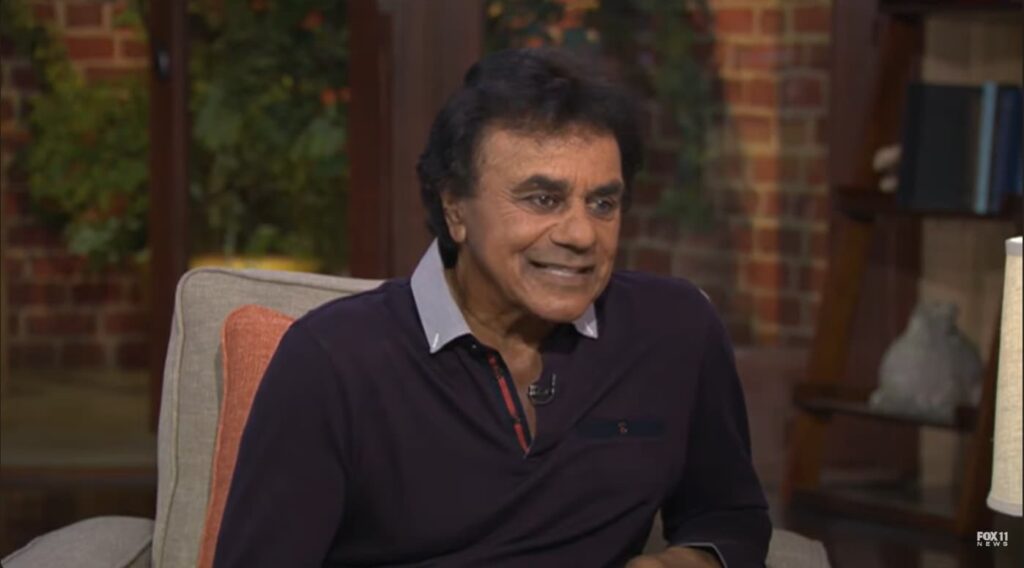
During his appearance on FOX 11 Los Angeles, there was a noticeable sense of calm reflection. Mathis spoke not with grand declarations, but with the quiet assurance of someone who has lived fully within his art. There was no need to revisit every triumph or recount every accolade. The songs themselves carried that history. And perhaps that is what made the moment so moving—an understanding that the music had long since taken on a life of its own.
The “Singles Collection” also highlights the remarkable consistency of his career. While many artists experience peaks and valleys, Mathis maintained a steady presence, adapting subtly without ever losing his identity. Albums like “Heavenly” (1959) and later works throughout the 1960s and 1970s continued to chart, reinforcing his status as a reliable voice in a rapidly changing musical landscape. Even as rock and roll evolved into new forms, Mathis remained anchored in melody and emotion, offering something that felt increasingly rare: sincerity without excess.
There is a particular poignancy in hearing these recordings while reflecting on the passage of time. The voice may carry the faintest traces of age, but it is the same voice that once filled living rooms, accompanied quiet evenings, and marked moments that would later become memories. It is not simply nostalgia—it is continuity. A reminder that some things do not need to change in order to remain meaningful.
In many ways, Johnny Mathis at 80 represents more than longevity. He embodies a kind of artistic integrity that resists the pressures of reinvention. Rather than chasing trends, he allowed his music to mature naturally, trusting that authenticity would endure. And it has. The songs in the “Singles Collection” do not feel like relics; they feel alive, still capable of reaching across time and touching something deeply personal.
Perhaps the most remarkable aspect of this celebration is its quietness. There is no sense of finality, no dramatic conclusion. Instead, there is a gentle acknowledgment of a journey still unfolding. The music continues, the voice remains, and the connection between artist and listener persists—unchanged, unwavering.
In the end, what Johnny Mathis offers is not just a catalog of hits, but a lifelong conversation set to music. And as that conversation reaches its eighth decade, it does so with the same grace and tenderness that first captured hearts so many years ago.