
A return not to the spotlight, but to the soul—where memory, tradition, and quiet resilience shape every note of a late-career recording.
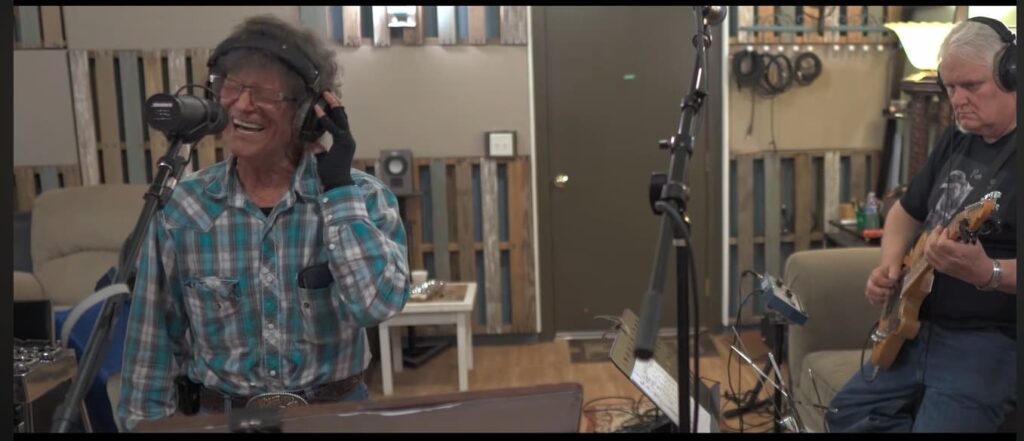
There is something profoundly moving about the image of Johnny Rodriguez stepping once again into the recording studio, surrounded not by the machinery of commercial expectation, but by the warmth of familiar collaborators and the echo of a lifetime in music. As he prepares a new album slated for completion in 2025, the moment feels less like a comeback and more like a continuation—a gentle, deliberate extension of a story that began decades ago in the golden era of country music.
To understand the significance of this new project, one must recall the remarkable trajectory of Johnny Rodriguez in the 1970s. With a string of number-one hits such as “I Just Can’t Get Her Out of My Mind” (1973), “Ridin’ My Thumb to Mexico” (1973), and “That’s the Way Love Goes” (1973), he quickly established himself as one of the defining voices of country music. His debut album, “Introducing Johnny Rodriguez” (1973), soared to No. 1 on the Billboard Top Country Albums chart, while his singles consistently topped the Hot Country Songs chart during that period. These were not merely commercial successes—they were cultural moments, songs that found their way into homes, cars, and quiet evenings across America.
And yet, what unfolds in the studio today is something far removed from the urgency of chart positions. There are no visible metrics here, no immediate race toward radio airplay. Instead, there is a slower rhythm—one shaped by reflection, by lived experience, and by an artist who no longer needs to prove anything to anyone.
Inside the studio, a few details stand out—small, almost incidental moments that reveal the deeper texture of this recording process. There is laughter between takes, the kind that comes easily among old friends who share not just music, but history. There are pauses, too—moments where a lyric is reconsidered, not for its market appeal, but for its truth. One can imagine Rodriguez leaning back, eyes half-closed, listening not just to the playback, but to the memory behind the melody.
The presence of “friends” in this recording is particularly telling. Country music, at its heart, has always been communal—a genre built on storytelling, on shared experience, on voices that blend rather than compete. In this setting, the album becomes less of a solo statement and more of a conversation. Each collaborator brings a fragment of their own journey, and together they create something that feels both new and deeply rooted.
As for the songs themselves, while specific titles and chart ambitions remain unannounced, the thematic direction seems clear. There is a sense of looking back—not with regret, but with a kind of quiet acceptance. Love, loss, distance, and return—these are not new themes for Rodriguez, but they carry a different weight now. Time has a way of reshaping meaning, of adding layers to even the simplest lyric. Musically, one might expect a return to the elements that first defined his sound: the gentle blend of traditional country with subtle Latin influences, a hallmark that set him apart in the 1970s. His voice, no longer as youthful but perhaps richer in texture, likely carries a different kind of authority—less about power, more about presence.
There is also something deeply reassuring about the very act of recording at this stage in life. It speaks to a kind of artistic persistence that transcends trends. In an era where music often feels transient, disposable even, the image of Johnny Rodriguez in the studio offers a quiet counterpoint—a reminder that some songs are not written for the moment, but for the long road. And perhaps that is the true meaning behind this forthcoming album. It is not about reclaiming past glory or chasing new accolades. It is about honoring a lifetime of music, about gathering the threads of memory and weaving them into something that can still speak, still resonate. In the end, what we are witnessing is not just the making of an album, but the continuation of a voice that has never quite faded—only softened, deepened, and waited for the right moment to be heard again.