
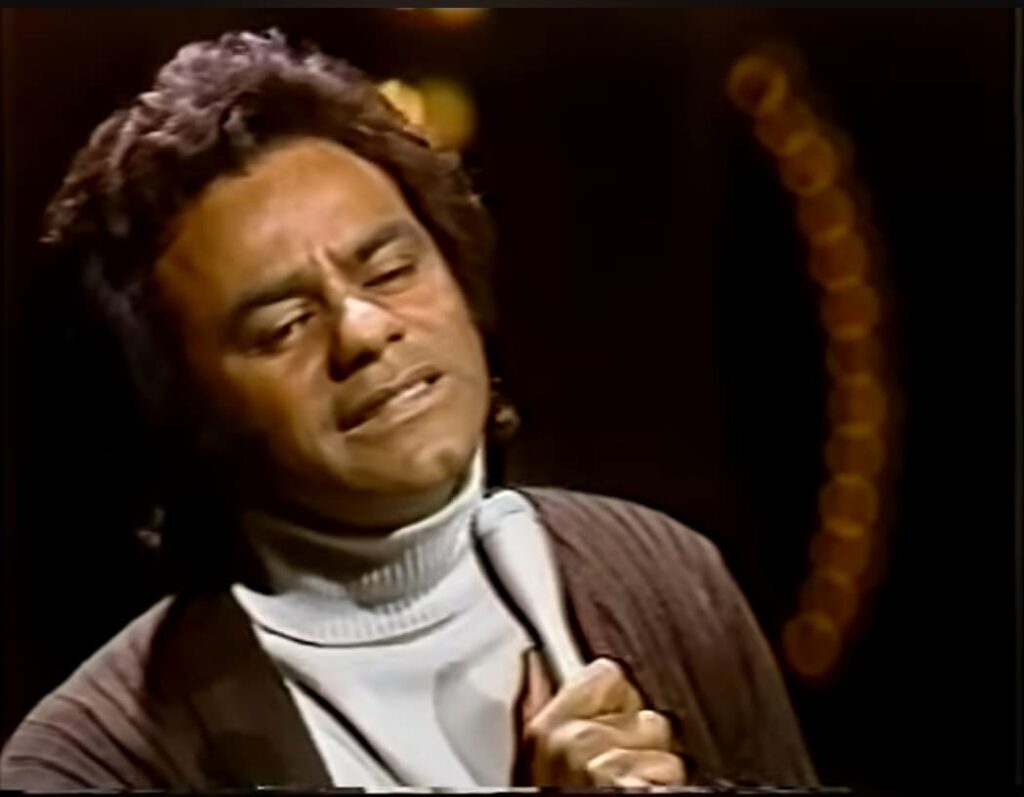
A tender reflection on memory and love, “The Way We Were” captures the fragile beauty of moments that linger long after they fade.
Few songs in the vast landscape of popular music carry the same quiet emotional gravity as “The Way We Were”, a composition that, even decades after its release, continues to stir something deeply personal within the listener. When Johnny Mathis lent his unmistakably warm and velvety voice to this song in 1975, he was not merely covering a hit—he was reinterpreting a cultural memory, reshaping it through his own signature elegance and restraint.
Originally written by the celebrated songwriting trio Marvin Hamlisch, Alan Bergman, and Marilyn Bergman, “The Way We Were” first gained prominence through Barbra Streisand’s 1973 recording for the film of the same name. That version soared to No. 1 on the Billboard Hot 100 and became one of the defining ballads of its era, even winning the Academy Award for Best Original Song. By the time Johnny Mathis approached the piece in the mid-1970s, the song was already steeped in recognition and emotional weight.
Yet Mathis’s interpretation stands apart in its own quiet way. While it did not chart as prominently as Streisand’s original, it found a devoted audience among listeners who favored subtlety over grandeur. His version, often performed in live settings and television appearances during that period, carries a more intimate tone—less theatrical, perhaps, but deeply reflective. In Mathis’s hands, the song feels less like a dramatic recollection and more like a personal confession whispered in the stillness of night.
What makes “The Way We Were” so enduring is not simply its melody—though that, too, is exquisitely crafted—but its universal theme: the selective nature of memory. The lyrics speak of how we tend to remember the sweetness of the past while gently softening its harsher edges. “Memories may be beautiful and yet / What’s too painful to remember / We simply choose to forget.” These lines resonate because they mirror a truth many come to understand over time—that nostalgia is as much about what we leave behind as what we hold on to.
For Johnny Mathis, a singer whose career has long been defined by romantic ballads and emotional sincerity, the song fits naturally within his repertoire. His voice does not overpower the arrangement; instead, it glides effortlessly across it, allowing each word to breathe. There is a sense, listening to him, that he is not performing for an audience but revisiting something quietly personal—perhaps even something lost.
The mid-1970s marked an interesting phase in Mathis’s career. Having already established himself as one of the premier vocalists of his generation, he was navigating a musical landscape that was rapidly evolving. Rock, soul, and disco were dominating the charts, yet Mathis remained steadfast in his commitment to timeless balladry. His rendition of “The Way We Were” can be seen as both a nod to contemporary success and a reaffirmation of his artistic identity. There is also a broader cultural context to consider. The 1970s were a decade marked by reflection—post-Vietnam, post-Watergate, a time when many were looking back with a mixture of longing and disillusionment. Songs like this became emotional anchors, offering listeners a space to process their own memories and experiences. In that sense, Mathis’s version feels particularly fitting: less about spectacle, more about introspection.
Listening today, one cannot help but feel the passage of time embedded within every note. The song does not demand attention; it gently invites it. It reminds us that music, at its best, is not just something we hear—it is something we carry with us, often without realizing it, until a familiar melody brings it all rushing back. And perhaps that is the quiet magic of “The Way We Were” as interpreted by Johnny Mathis. It does not seek to redefine the past, nor does it attempt to compete with what came before. Instead, it offers a simple, poignant truth: that the past, however imperfect, remains a part of us—softened by time, illuminated by memory, and forever echoing in the songs we return to when we need to remember who we once were.