
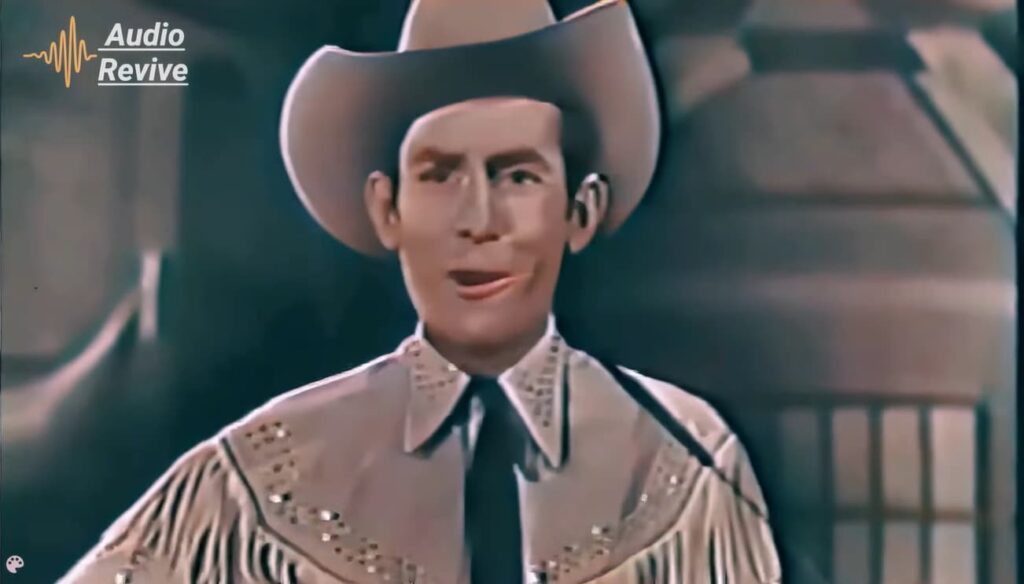
A wounded confession wrapped in simplicity, “Cold, Cold Heart” reveals how love can be quietly undone by doubt, pride, and the scars we carry within
When Hank Williams released “Cold, Cold Heart” in 1951, it did not merely climb the charts—it etched itself into the very foundation of country music. The song reached No. 1 on the Billboard Country & Western Best Sellers chart, where it remained for an impressive stretch, confirming Williams’ place as one of the most authentic and emotionally direct voices of his time. Yet, beyond its commercial success, the song carried something far more enduring: a truth so simple, so unguarded, that it continues to resonate decades later.
Performed live on The Kate Smith Evening Hour, Hank Williams brought “Cold, Cold Heart” into American living rooms with a presence that felt almost fragile. There was no barrier between the man and the song. Standing there, guitar in hand, dressed in his familiar Western suit, Williams did not perform in the theatrical sense—he revealed. His voice, slightly nasal yet deeply expressive, carried a weariness that could not be imitated. It was the sound of someone who had lived the words he sang.
The origins of “Cold, Cold Heart” are often linked to Williams’ turbulent relationship with his first wife, Audrey Sheppard. Their marriage was marked by tension, misunderstandings, and emotional distance—elements that seem to echo through every line of the song. Though Williams never framed the song explicitly as autobiographical, it is difficult to ignore the parallels. The lyrics speak of a lover unable to trust, unable to let go of past hurts, and in doing so, unable to fully embrace the love being offered.
“You’ll never know how much it hurts to see you sit and cry…”—there is no poetic excess here, no elaborate metaphor. The strength of the song lies precisely in its restraint. Williams understood that the deepest pain often speaks in the simplest language. And in that simplicity, he created something universal.
Musically, “Cold, Cold Heart” is built on a slow, deliberate tempo. The steel guitar weaves gently through the arrangement, its mournful tone acting almost as a second voice—one that speaks what words cannot. There is a stillness to the performance, a sense that time itself has slowed to accommodate the weight of emotion being carried. It is not a song that rushes; it lingers, allowing each phrase to settle fully before moving on.
The live performance on The Kate Smith Evening Hour adds another layer to its legacy. Television, still a relatively new medium at the time, offered a different kind of intimacy. Viewers were not just hearing the song—they were witnessing it. And in that moment, Hank Williams appeared not as a distant star, but as a man sharing something deeply personal. There is a quiet vulnerability in his posture, in the way he delivers each line without embellishment. It is this honesty that makes the performance unforgettable.
What makes “Cold, Cold Heart” particularly remarkable is its ability to cross musical boundaries. Later in 1951, Tony Bennett recorded a pop version of the song, which reached No. 1 on the Billboard charts as well, introducing Williams’ work to an entirely new audience. It was a rare achievement at the time—a country song embraced so fully by the mainstream. And yet, even in its more polished interpretations, the emotional core remained intact.
Looking back, there is something almost haunting about watching Hank Williams perform this song, knowing how brief his life would be. He passed away just two years later, in 1953, at the age of 29. But in those few years, he created a body of work that feels timeless, untouched by the passing decades.
“Cold, Cold Heart” endures because it speaks to something deeply human—the difficulty of loving and being loved when trust has been broken. It does not offer resolution, nor does it assign blame. Instead, it simply observes, with quiet sadness, how easily connection can be lost.
And perhaps that is why the song continues to find its way back into the heart. Not as a reminder of pain alone, but as a reflection of understanding—of how fragile, and how precious, love truly is.
 Oldies Songs