
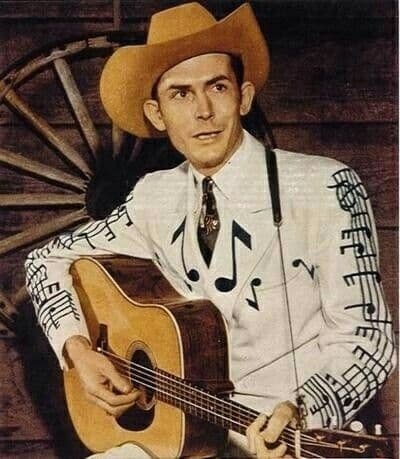
Hank Williams Became a Legend Not Only Because of the Songs He Sang, but Because of the Silence He Left Behind
Few figures in American music history carry the haunting permanence of Hank Williams. More than seven decades after his death, he remains one of the defining architects of country music, a songwriter whose influence stretches from honky-tonk and bluegrass to rock, folk, and modern Americana. Yet part of what continues to make Williams feel almost mythological is not merely the brilliance of songs like “I’m So Lonesome I Could Cry,” “Cold, Cold Heart,” or “Your Cheatin’ Heart.” It is the unfinished feeling surrounding his life itself. Every conversation about Hank Williams eventually circles back to absence, to roads not traveled, songs not written, and perhaps most painfully, to “the show he never gave.”
By the early 1950s, Williams had already transformed country music forever. His recordings for MGM Records, particularly through albums and compilations that would later preserve his legacy, elevated country songwriting into something emotionally devastating and poetically direct. He became a Grand Ole Opry sensation, a chart-dominating star, and one of the first country artists capable of transcending regional identity to reach mainstream America. Yet behind the success stood a man physically deteriorating at frightening speed. Chronic back pain caused by spina bifida, escalating alcohol dependency, prescription drug abuse, exhaustion from relentless touring, and emotional instability slowly consumed him while his fame continued growing.
That contradiction defined Williams’ final years. The larger his legend became, the more fragile the man himself appeared.
The phrase “The Show He Never Gave” carries such emotional power because it symbolizes the abruptness of his ending. On January 1, 1953, Hank Williams was scheduled to perform in Canton, Ohio. He never arrived. Somewhere along the icy road between Knoxville and his destination, inside the backseat of a powder-blue Cadillac driven through the night, the 29-year-old singer died alone. The concert audience waiting for him would eventually learn that the performance had become impossible before the new year had even truly begun.
There is something almost unbearably symbolic about that final journey. Williams spent much of his career singing about loneliness, spiritual exhaustion, betrayal, and emotional ruin. His songs often sounded less like entertainment than confessions whispered after midnight. Then, in the cruelest possible twist, his own life ended inside a scene that could have belonged to one of those songs. The mythology surrounding that final drive persists because it feels inseparable from the emotional universe he created in music.
But focusing solely on tragedy risks overlooking why Williams mattered so profoundly in the first place.
What separated Hank Williams from many of his contemporaries was his terrifying emotional clarity. He wrote songs that stripped human suffering down to its barest emotional truths. There was no ornamental language hiding the pain. In “I’m So Lonesome I Could Cry,” loneliness becomes cosmic. In “Lost Highway,” spiritual despair feels frighteningly intimate. In “Your Cheatin’ Heart,” betrayal carries the inevitability of fate itself. Williams understood that country music did not need sophistication to achieve profundity. Simplicity, delivered honestly enough, could devastate listeners more completely than any grand poetic flourish.
That honesty changed songwriting forever.
Artists across generations, from Johnny Cash and George Jones to Bob Dylan and Bruce Springsteen, recognized something revolutionary in Williams’ work. He treated emotional vulnerability not as weakness, but as artistic truth. Long before modern singer-songwriters turned confession into an art form, Williams had already exposed his inner life with startling directness.
And perhaps that is why “the show he never gave” still resonates so deeply today. It represents more than a missed concert. It represents the unbearable realization that one of America’s greatest songwriters disappeared before his story felt complete. At 29, Williams had already reshaped an entire genre. Yet listeners instinctively feel there was still more waiting inside him, more songs, more heartbreak, more wisdom, more ruin.
The silence left behind by his death became part of his legend.
In a strange way, that unfinished quality may explain why Hank Williams continues to feel so alive in American culture. His music never settled comfortably into nostalgia because the emotions inside it remain unresolved. Loneliness still sounds lonely. Regret still sounds permanent. Heartbreak still sounds dangerous. Williams sang about pain in ways that remain startlingly modern because human suffering itself has not changed.
So the story of “The Show He Never Gave” ultimately becomes larger than one canceled performance in Ohio. It becomes a metaphor for all the unwritten songs and unspoken truths buried alongside him far too early.
And somewhere inside that silence, the voice of Hank Williams still echoes louder than most artists who lived twice as long.
 Music Legend