
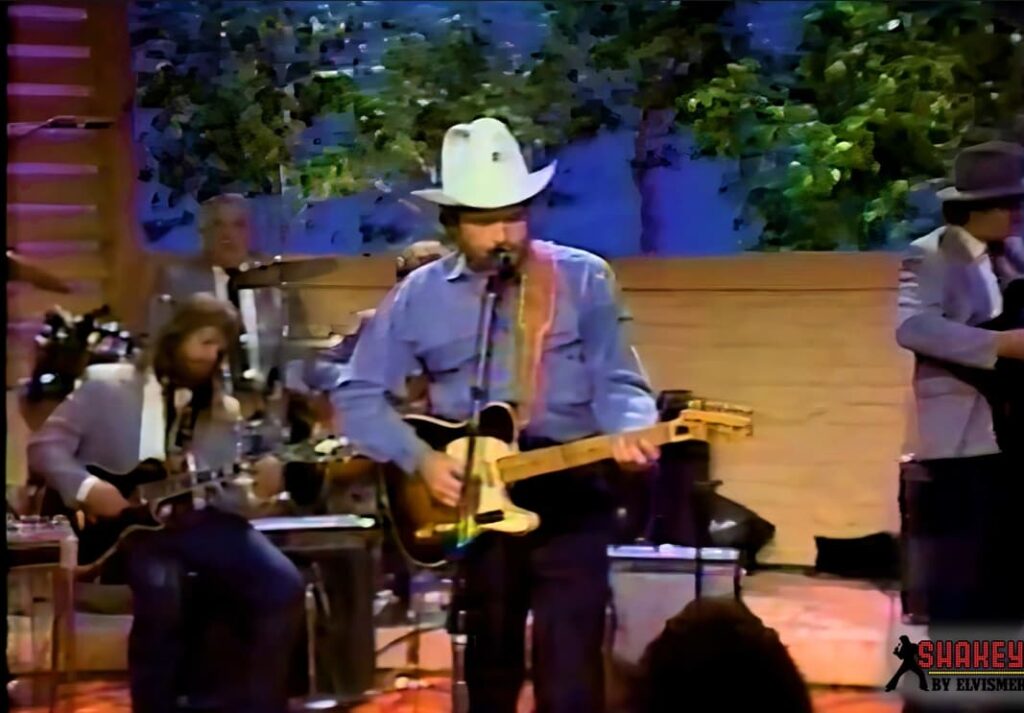
A quiet prayer to the night sky—where hope, regret, and love meet in the soft glow of a distant star
When “Twinkle, Twinkle Lucky Star” drifted onto the airwaves in late 1987, it carried with it a kind of quiet grace that only Merle Haggard could deliver. Released as the second single from the album “Chill Factor”, the song would go on to reach No. 1 on the Billboard Hot Country Singles chart in early 1988, marking yet another milestone in a career already filled with towering achievements. But unlike the defiant edge of “Okie from Muskogee” or the raw confession of “Mama Tried,” this song arrived like a soft-spoken letter—intimate, reflective, and deeply human.
Written by Merle Haggard himself alongside his longtime collaborator Freddy Powers, the song was born from a period in Haggard’s life marked by introspection. By the late 1980s, the outlaw image that once defined him had mellowed. The storms had not entirely passed, but they had quieted enough for him to look inward. And what he found there was not anger, but longing.
At its heart, “Twinkle, Twinkle Lucky Star” is disarmingly simple. A man stands beneath the vast night sky, searching for comfort in something distant and unchanging. The lyrics do not rely on elaborate metaphors or grand gestures. Instead, they speak in plain truths—about love lost, about chances missed, and about the fragile hope that somehow, somewhere, things might still be set right. That simplicity is precisely what gives the song its weight.
There is something profoundly moving in the way Haggard’s voice carries the melody. By this stage in his career, his vocals had acquired a certain weathered texture—less polished, perhaps, but richer with experience. Every line feels lived-in, as though he is not merely singing the words but remembering them. When he reaches the chorus, asking that “lucky star” to send down a bit of fortune, it does not sound like a wish made lightly. It feels like the kind of wish that comes after many others have gone unanswered.
Musically, the arrangement reflects the same restraint. Gentle steel guitar lines weave through the background, supported by a steady rhythm section that never demands attention but quietly sustains the mood. This was not the era of overproduction in Haggard’s world; instead, “Chill Factor” stayed rooted in traditional country sensibilities. The instrumentation leaves space—space for reflection, for memory, for the listener to fill in their own story.
The success of the song on the charts was, in many ways, a testament to its emotional honesty. Reaching the top position at a time when country music was beginning to shift toward a more polished, crossover-friendly sound, “Twinkle, Twinkle Lucky Star” stood as a reminder of what the genre had always done best: telling the truth, quietly and without pretense.
Behind the song, there is also a subtle narrative about endurance. Merle Haggard, who had faced his share of personal struggles—legal troubles in his youth, turbulent relationships, the constant pressures of fame—was no stranger to hardship. Yet this song does not dwell in bitterness. Instead, it suggests a kind of reconciliation with life’s imperfections. The act of looking up at the stars becomes symbolic—not just of wishing, but of accepting that some things remain beyond reach.
In the broader arc of his career, “Twinkle, Twinkle Lucky Star” may not always be the first title mentioned, but it occupies a special place. It represents a later chapter, where wisdom begins to replace defiance, where the voice softens but the message deepens. It is the sound of an artist who has nothing left to prove, yet still has something important to say.
And perhaps that is why the song lingers. Long after the final note fades, what remains is not just the melody, but the feeling it leaves behind—a quiet, lingering sense that even in moments of solitude, there is still a thread of hope stretching upward, waiting to be found among the stars.