
A Restless Spirit on Stage, Where Fame Feels Fleeting and the Road Never Truly Ends
When David Essex performed “Rolling Stone” in the archival INA live footage, the moment captured far more than a rising pop star delivering a hit—it revealed a young artist standing at the crossroads between image and identity, between the thrill of sudden fame and the quiet cost that comes with it. Originally released in 1973 as the debut single from his album “Rock On,” “Rolling Stone” climbed to No. 14 on the UK Singles Chart, marking an important early milestone in Essex’s ascent during a decade that would soon define him.
The early 1970s were a time when British pop was shifting in tone and texture. Glam rock was beginning to blur into something more introspective, and artists like David Essex occupied a unique space—part pop idol, part storyteller, part actor navigating the expectations placed upon him. “Rolling Stone” emerged in that environment not as a loud declaration, but as a subtle statement. It carried within it a sense of movement, not just physical, but emotional—a feeling of drifting, of searching, of never quite arriving.
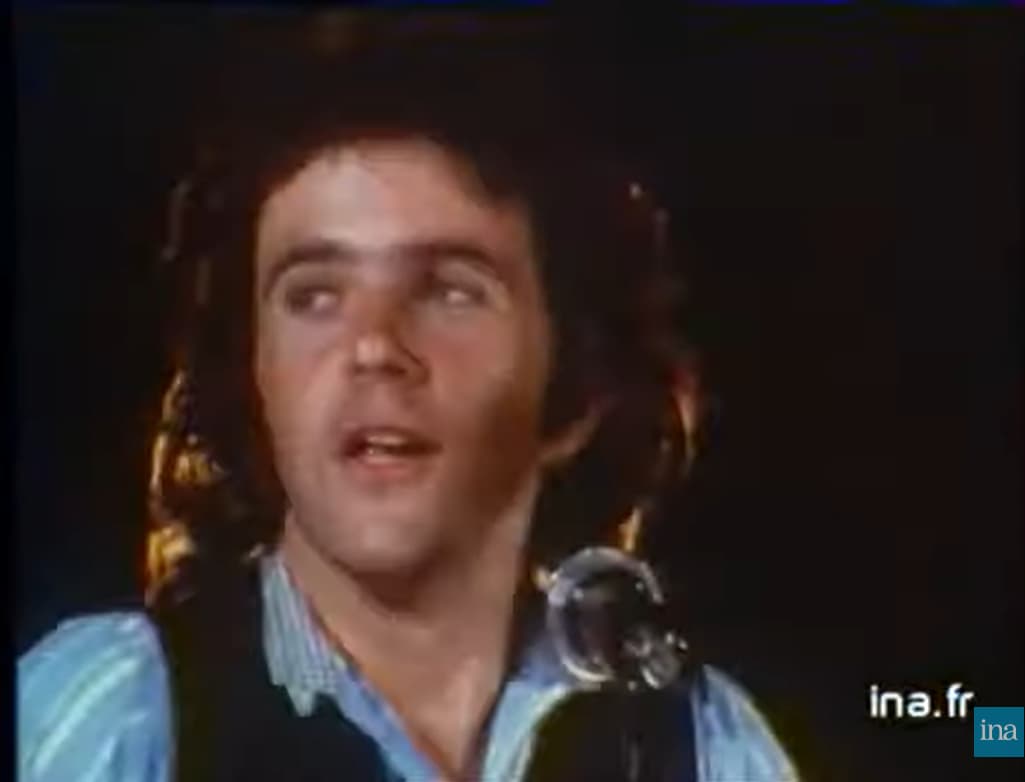
In the live Archive INA performance, that feeling becomes even more apparent. There is a rawness to Essex’s delivery that cannot be fully captured in studio recordings. His voice, slightly rough at the edges, carries a sense of immediacy, as though each line is being discovered in the moment rather than repeated from memory. The stage presence is unpolished in the most honest way—less about perfection, more about presence.
The meaning behind “Rolling Stone” lies in its quiet acknowledgment of transience. The title itself evokes an image of constant motion, of a life that resists stillness. But unlike the more defiant interpretations of that phrase in rock history, Essex’s version feels almost reflective. It is not about rebellion for its own sake; it is about understanding the cost of always moving forward, of never settling long enough to fully belong.
The story surrounding the song’s release adds another layer of depth. “Rock On,” the album that would follow, eventually produced Essex’s biggest international hit with the title track reaching No. 5 on the Billboard Hot 100 in 1974. But “Rolling Stone” came first—it was the introduction, the opening chapter. It hinted at the themes that would continue to shape his work: identity, isolation, and the delicate balance between public image and private self.
Watching that archived performance now, one senses the tension between who David Essex was becoming and who he might have been away from the spotlight. There is a certain distance in his eyes, a quiet awareness that the path he is on is already set in motion. And yet, there is no resistance—only acceptance, carried through the rhythm of the song.
Musically, “Rolling Stone” is understated. It does not rely on grand arrangements or dramatic shifts. Instead, it builds its atmosphere through simplicity—a steady beat, a melody that lingers rather than demands, and a vocal delivery that feels almost conversational. This restraint allows the emotional weight of the song to surface gradually, revealing itself not in moments of intensity, but in the spaces in between.
Over time, performances like this have taken on a different kind of significance. They are no longer just records of a moment in a career; they become windows into a particular time, a particular state of mind. The INA archive preserves not just the sound, but the feeling—the sense of being present at the beginning of something that would grow far larger than anyone could have predicted.
In the end, “Rolling Stone” stands as more than an early success in David Essex’s career. It is a quiet meditation on movement, on identity, on the subtle loneliness that can accompany a life in motion. And in that live performance, stripped of excess and grounded in sincerity, the song finds its truest form.
As the final notes fade, there is no grand conclusion, no sense of arrival. Only the lingering impression of a journey still unfolding—one that continues beyond the stage, beyond the moment, carried forward by a voice that understands, perhaps more than it lets on, that some roads are meant to be traveled without ever truly reaching their end.