
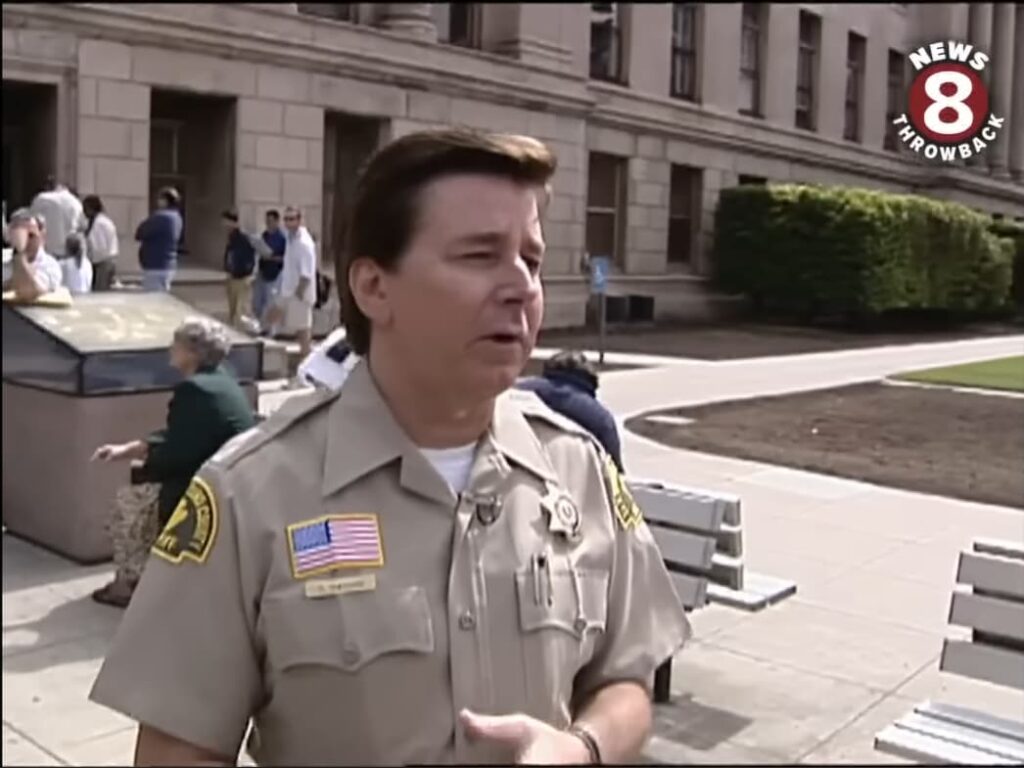
A former teen idol finds deeper purpose—Bobby Sherman steps away from fame to serve with quiet dignity and compassion
There is something profoundly moving about the arc of a life that begins in the bright glare of fame and gradually settles into a quieter, more purposeful light. The story of Bobby Sherman, once one of the most beloved teen idols of the late 1960s and early 1970s, offers exactly that kind of reflection. By October 2000, when he was serving as a volunteer with the San Bernardino County Sheriff’s Department, Sherman’s journey had taken a remarkable turn—away from screaming fans and gold records, toward a life defined by service, humility, and human connection.
At the height of his musical career, Bobby Sherman was a household name. Songs like “Little Woman” and “Julie, Do Ya Love Me” climbed the Billboard charts, with “Little Woman” reaching No. 3 on the Billboard Hot 100 in 1969. His boyish charm and clean-cut image made him a fixture on television and in teen magazines, while his role in the popular series Here Come the Brides further cemented his status as a cultural icon. For many, he represented a certain innocence in pop music—a time when melodies were simple, emotions were earnest, and the connection between artist and audience felt immediate and sincere.
And yet, as the years passed and the spotlight shifted, Sherman made a choice that few in his position ever consider. Rather than chasing a fading fame, he stepped away from the entertainment industry altogether. What followed was not a retreat, but a transformation. He pursued training as an emergency medical technician and later became involved in law enforcement work, eventually dedicating his time as a volunteer with the San Bernardino County Sheriff’s Department.
By the time of his service in October 2000, there was little trace of the teen idol persona that once defined him—at least on the surface. Instead, there stood a man committed to helping others in moments of vulnerability and crisis. It is a different kind of stage, one without applause, where the rewards are measured not in chart positions but in lives touched and quietly improved.
What makes this chapter of Bobby Sherman’s life so compelling is not simply the contrast, but the continuity beneath it. The same sincerity that once resonated through his music seems to have found a new expression in his public service. There is a sense that the compassion in his voice, so evident in songs like “Easy Come, Easy Go”, was never just performance—it was a reflection of character.
For those who remember his rise to fame, this later chapter invites a deeper appreciation. It challenges the notion that an artist’s value is confined to their years in the spotlight. Instead, it suggests that the truest measure of a person may emerge long after the applause has faded. Sherman did not reinvent himself for attention; he simply followed a different calling, one that required patience, discipline, and a willingness to serve without recognition.
There is also a quiet symbolism in this transition. The journey from entertainer to public servant mirrors a broader human experience—the search for meaning beyond success. In a world that often equates visibility with importance, Bobby Sherman’s path offers a gentle reminder that fulfillment can be found in the unseen, in the everyday acts of care and responsibility.
Looking back, his musical achievements remain significant, not only for their commercial success but for the memories they carry. Those songs still echo with a certain warmth, a reminder of a different time. But perhaps what endures even more powerfully is the life he chose to lead afterward—a life that speaks not through lyrics, but through actions.
In the end, the image of Bobby Sherman in a sheriff’s uniform, quietly serving his community in October 2000, feels as meaningful as any moment from his years on stage. It is a testament to growth, to humility, and to the enduring possibility of redefining one’s purpose. And in that quiet evolution, there is a kind of beauty that no spotlight could ever fully capture.