
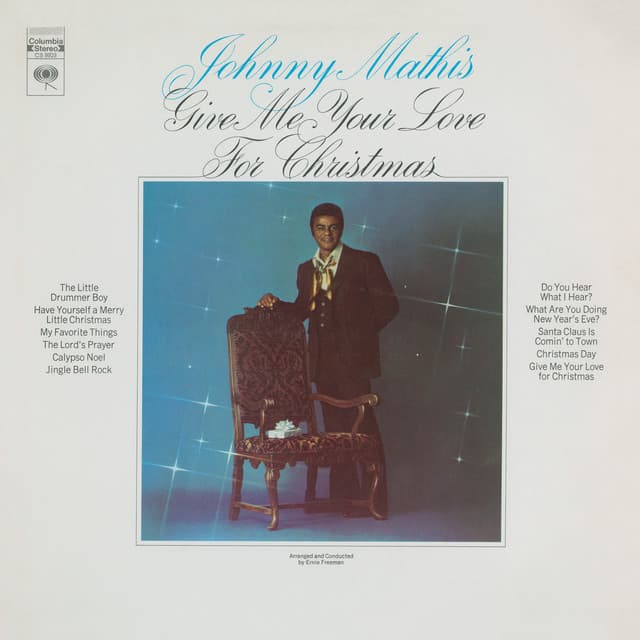
A lush, romantic ballad that compares love to the unpredictable power of nature, “Wild Is the Wind” remains one of Johnny Mathis’s most emotionally stirring performances.
When “Wild Is the Wind” was released as a single by Johnny Mathis in November 1957, it quickly became one of his most memorable recordings of that era. The song was tied to the romantic drama film Wild Is the Wind, where it served as the title song and was nominated for Best Original Song at the 30th Academy Awards in 1958, giving it not only chart presence but cinematic resonance. Mathis’s rendition entered the Billboard charts on December 16, 1957, eventually peaking at No. 22 on the Most Played by Jockeys chart, No. 30 on Best Sellers in Stores, and No. 37 on the Top 100 Sides chart in early 1958 — a strong showing during a competitive pop landscape. It also reached No. 20 on the Cash Box magazine Best Seller list.
Written by acclaimed composer Dimitri Tiomkin and celebrated lyricist Ned Washington for the movie, Wild Is the Wind carries a poetic tension that feels both elemental and intimate — an apt setting for Mathis’s velvet-smooth voice to unfold its story. The lyrics depict love as something untamed and essential, likened to the wind itself — unpredictable, free, and all-encompassing. Lines such as “For my love is like the wind, and wild is the wind” and “Like the leaf clings to the tree, oh, my darling, cling to me” use nature’s restless spirit as a metaphor for the immense force of emotion that binds two lives together.
In 1957, Mathis recorded the track with Ray Ellis conducting the orchestra, while producers Mitch Miller and Al Ham helped shape one of his most evocative pop singles of the decade. Critics of the time recognized the song’s expressive depth: Billboard magazine praised the performance as “a sensitive reading,” highlighting the effective combination of Mathis’s vocal interpretation with orchestral touches such as the contrapuntal harmonica theme. Cashbox noted that Mathis “displays his tremendous vocal range at its best,” underscoring how this recording captured both technical mastery and emotional sincerity.
The story behind Wild Is the Wind is rooted in cinema as much as in songcraft. The film, released in December 1957, starred Anthony Quinn, Anna Magnani, and Anthony Franciosa in a dramatic exploration of love, conflict, and desire. Mathis’s ballad — written specifically for the movie’s opening credits — mirrors that narrative’s emotional currents: longing, human connection, and the poignant experience of loving someone with a force that cannot be quieted or controlled.
Musically, the arrangement supports a feeling of both vastness and intimacy. Mathis’s voice — already a defining instrument of 1950s pop and romantic balladry — blends with lush strings and subtle orchestral flourishes that make the song feel like a confession set to music. His phrasing, sometimes bending time and rushing phrases like speech, gives the performance a spontaneous, heartfelt quality that makes it seem less like a staged studio product and more like a private aria shared under dim light.
Although later versions by artists such as Nina Simone, David Bowie, and George Michael have brought new shades of interpretation and genre influence, Mathis’s original remains foundational — the recording that introduced listeners to the song’s deep emotional landscape and made it a standard in pop and soul repertoires.
At its core, “Wild Is the Wind” is more than a love song; it is a meditation on passion’s unpredictable nature. The wind has no shape, no predictable path, yet it moves everything in its way. So too does love, capable of lifting the spirit or bearing down with irresistible force. Mathis captures that duality: a voice at once tender and powerful, earnest in its vulnerability yet confident in its capacity to articulate the moment when a heart surrenders to the vastness of affection.
For many listeners across generations, this song elicits memories not just of a time or place, but of feelings that defy easy description — the first ache of love, the quiet surrender to someone’s presence, and the ineffable way that music can become the vessel for our own stories. In the quiet spaces between each line, “Wild Is the Wind” finds its true poetry: in the yearning, in the release, and in the beautiful unpredictability of love itself.