
A song about returning to one’s roots, where memory, humility, and quiet faith in home still matter
When Ricky Van Shelton released “Backroads” in 1991, it arrived as a gentle but firm reminder of what country music had long done best. It told the truth plainly. The song was issued as the title track and lead single from his third studio album, Backroads, and it quickly resonated with listeners who recognized themselves in its lines. On the Billboard Hot Country Songs chart, “Backroads” peaked at No. 4, confirming Shelton’s position as one of the most dependable traditional voices of early 1990s country music.
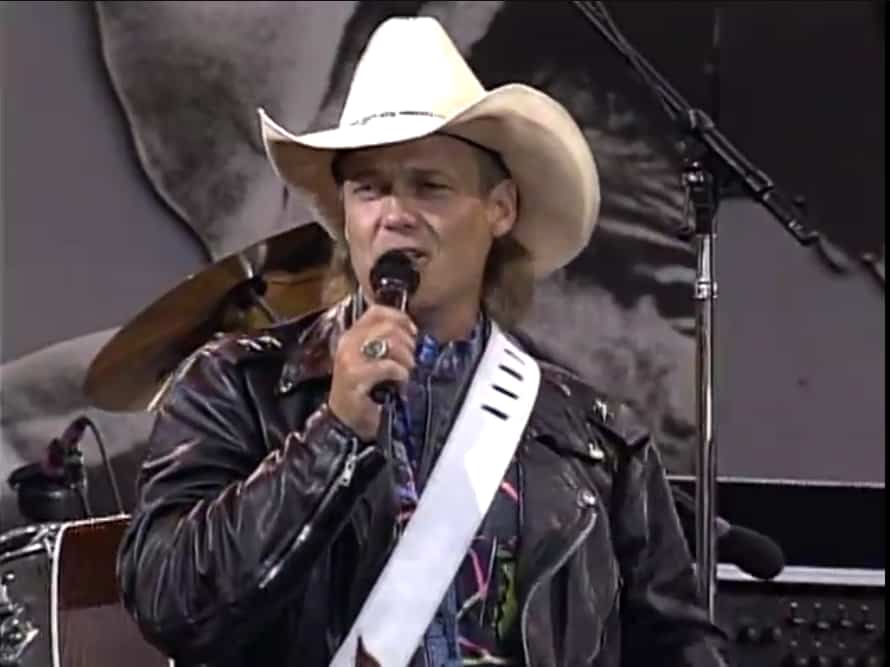
By the time Shelton performed “Backroads” live at Farm Aid 1993, the song had already settled into the hearts of many. Farm Aid, founded in 1985 by Willie Nelson, John Mellencamp, and Neil Young, was never just a concert. It was a statement about land, livelihood, and dignity. Shelton’s appearance there gave the song an added layer of meaning. Sung before an audience deeply connected to rural life, the lyrics sounded less like performance and more like shared memory.
Written by Don Cook and Gary Nicholson, “Backroads” is not built on clever wordplay or dramatic turns. Its strength lies in restraint. The narrator speaks of leaving a small town, chasing opportunity, and eventually realizing that success measured in distance from home can feel hollow. The song does not condemn ambition, nor does it romanticize hardship. Instead, it acknowledges a quiet truth many come to understand only with time. There is wisdom in where you started, and sometimes peace waits in places you once believed you had outgrown.
Ricky Van Shelton was uniquely suited to deliver this message. Born in Danville, Virginia, and raised partly in Martinsville, Shelton grew up absorbing gospel harmonies and classic country records. His voice carried a calm authority, never flashy, never forced. By the early 1990s, when country radio was beginning to embrace a more polished and pop oriented sound, Shelton remained grounded in tradition. Backroads, the album, reflected that balance. It was contemporary enough for its time but anchored in storytelling, melody, and emotional sincerity.
The live performance at Farm Aid 1993 stripped the song down even further. Without studio gloss, Shelton’s vocal phrasing became the focal point. Each line felt deliberate, as if weighed against lived experience. When he sang about turning back toward familiar roads, it echoed the larger Farm Aid mission. Support the people who feed the nation. Respect the land. Remember that progress should not erase identity.
The meaning of “Backroads” deepens with age. For younger listeners, it may sound like a cautionary tale. For older ones, it feels more like recognition. Life pulls people outward, toward careers, cities, and expectations. Years later, reflection brings different questions. What was left behind. What still matters. What remains unchanged. The song does not promise that returning home solves everything. It simply suggests that understanding oneself often requires looking back.
In the broader arc of Shelton’s career, “Backroads” stands as one of his most enduring recordings. It marked a moment when mainstream country still made space for quiet reflection. Its chart success proved that audiences were hungry for songs that spoke honestly, without irony or excess. Today, revisiting the Farm Aid 1993 performance feels like opening an old photograph. The edges are softer, the colors warmer, and the emotions more complex than we remembered.
“Backroads” endures because it respects its listeners. It trusts them to understand longing, regret, and grace without explanation. It reminds us that the roads we once hurried away from often become the ones we carry with us for the rest of our lives.
 Music Legend