
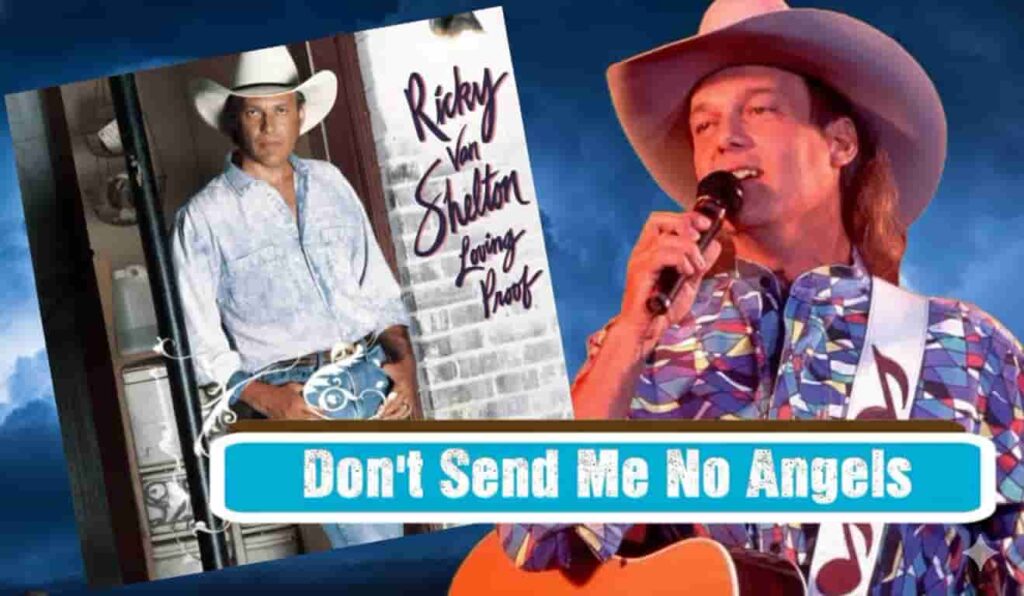
“Don’t Send Me No Angels” — A Soul-Stirring Testament to Earthly Love Over Heavenly Promise
When Ricky Van Shelton’s rendition of “Don’t Send Me No Angels” first emerged on his 1988 album Loving Proof, it arrived not with fanfare in the singles charts but as a deeply felt musical testament woven into an album that would come to define the artist’s imprint on neotraditional country music. Although it was not released as a high-charting single on the Billboard Hot Country Songs listings like many of his other hits, its home within an album that topped the US Top Country Albums chart and achieved Platinum status speaks to its importance in Shelton’s repertoire and the enduring affection it held among listeners who cherished story-driven country classics.
By the late 1980s, Ricky Van Shelton was already established among country music’s evocative storytellers, a singer whose voice could carry the weight of love, loss, and longing with an understated power. His album Loving Proof, released on September 20, 1988, captured this ethos fully, blending traditional instrumentation with heartfelt narratives that resonated deeply with audiences. While chart-topping singles like “I’ll Leave This World Loving You,” “From a Jack to a King,” and “Living Proof” brought commercial success and radio acclaim, tracks such as “Don’t Send Me No Angels” conveyed something far more intimate and reflective an emotional truth that transcended statistics.
Written by songwriter Wayne Kemp, whose penmanship shaped many country standards, “Don’t Send Me No Angels” tells a story of humble devotion rather than dramatic heartbreak. Instead of appealing for celestial intervention in times of hardship, the narrator implores that he not be delivered to such ethereal guardians. He asks instead to remain in the palpable warmth of his beloved’s presence, suggesting that her steadfast love is worth more than an army of angels. Lines from the chorus “When your trumpets start sounding and you’re calling me home / Don’t send me no angels cause I’ve got my own” crystallize this yearning for earthly companionship that feels real, dependable, and more sacred than mythic visions of heaven.
This emotional landscape, paradoxically simple yet profound, resonates with a generation for whom music was more than entertainment it was a companion in quiet moments and long roads. The song doesn’t chase trends or seek to dazzle with celebrity gloss. It speaks, in a voice seasoned by experience, to the heart that has known both hardship and solace. It is the kind of song that, when heard for the first time in later years, feels familiar as if it had always existed in the corner of one’s memory. “Don’t Send Me No Angels” stands as a reminder that the most unforgettable love songs often ask for nothing grander than presence and faithfulness.
Within the broader context of Shelton’s career, “Don’t Send Me No Angels” reflects the artistic continuity of an album and an era rooted in traditional values and storytelling integrity. Loving Proof not only cemented Shelton’s status as a leading voice of neotraditional country but also showcased his commitment to songs that felt lived-in, songs that might comfort as much as they stir the soul.
For listeners today, especially those who lived through the resurgence of classic country in the late 1980s, the song carries the texture of remembrance: a melody that might accompany an old highway at sunset or drift up from a dusty turntable on a Sunday morning. It invites reflection on love that endures beyond spectacle or divine promise a love that feels, in its tangible simplicity, like the truest kind of grace.
 Music Legend