
A glittering escape wrapped in loneliness—when the chase for freedom reveals the cost of never standing still
By the final days of 1975, Sweet had already carved their place into the restless, colorful fabric of glam rock. Yet “Fox on the Run” marked something different—something more self-defined. Released in late 1974 in the UK and gaining wider international success through 1975, the single reached No. 2 on the UK Singles Chart and climbed to No. 5 on the US Billboard Hot 100. It became one of the band’s most recognizable songs, but more importantly, it represented a turning point: the moment when Sweet stepped away from the songwriting team of Nicky Chinn and Mike Chapman, choosing instead to take creative control of their own sound.
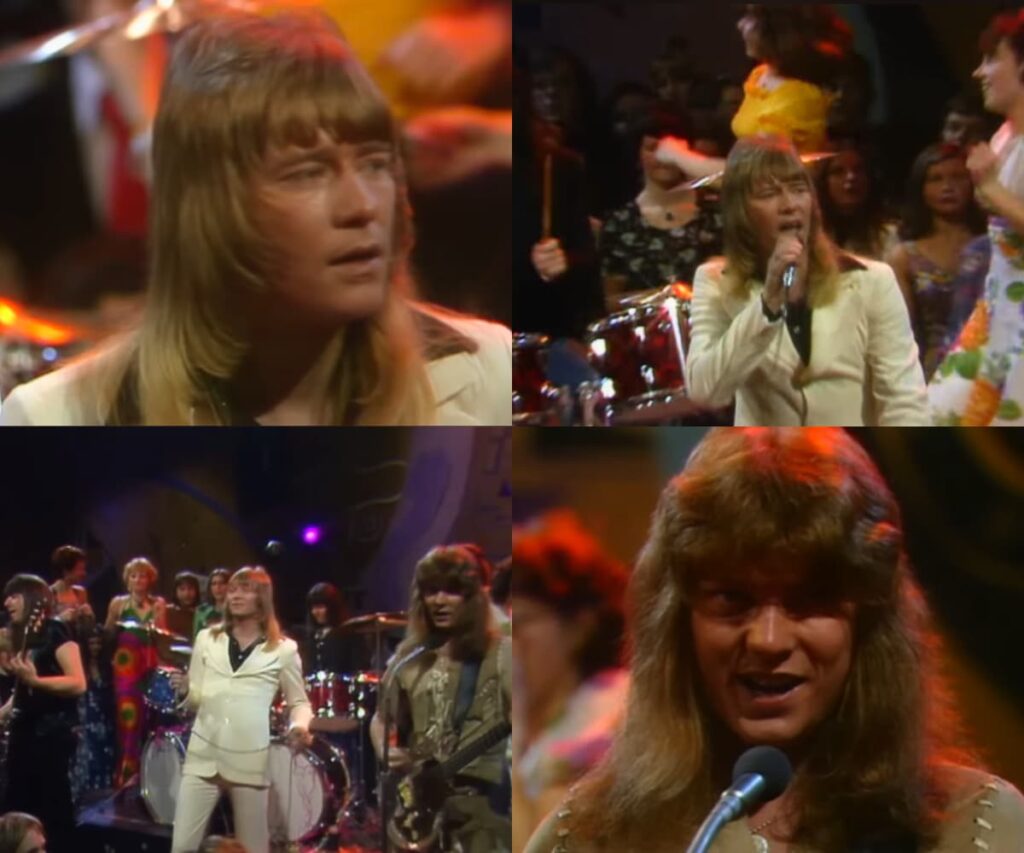
Their performance on Sylvester Tanzparty on December 31, 1975, captured that transition with quiet clarity. Beneath the glitter, the confident stage presence, and the familiar glam aesthetics, there was a band redefining itself in real time. The energy remained, but it felt more grounded—less like a spectacle designed by others, and more like a reflection of who they had become.
Musically, “Fox on the Run” carries a deceptively light surface. The opening—constructed with layered vocals that mimic a synthesized texture—immediately sets it apart. It feels modern even now, let alone in 1975, when such studio experimentation was still evolving. Then the rhythm settles in, steady and inviting, allowing the melody to unfold with an almost effortless charm. But beneath that accessibility lies something more complicated.
Lyrically, the song tells the story of a woman constantly in motion—beautiful, elusive, never staying long enough to be truly known. On its surface, it reads like a familiar narrative of attraction and distance. Yet there is a subtle shift in tone. This is not simply admiration. There is fatigue in the voice, a quiet recognition that the chase itself has become hollow. The “fox” is not just running from others—she is running from stillness, from commitment, perhaps even from herself.
In many ways, the song mirrors the experience of the band at that moment. Success had come quickly, brightly, and with a certain lack of control. The early hits, crafted under the guidance of Chinn and Chapman, brought fame but also a sense of limitation. With “Fox on the Run,” Sweet reclaimed their identity. They wrote and produced the track themselves, proving that they were more than performers of someone else’s vision.
Watching that Sylvester Tanzparty performance now, there is a noticeable shift in how the band carries itself. The flamboyance is still there, but it no longer feels like a mask. Brian Connolly’s vocal delivery, while polished, carries a hint of introspection. The harmonies are tighter, more deliberate. Even the instrumentation feels more assured, as though each note has been carefully considered rather than simply executed.
Time has a way of softening songs like this, turning what once felt immediate into something reflective. Today, “Fox on the Run” is often remembered for its infectious hook and its place within the glam rock era. But listening closely, it offers something more enduring. It speaks to the cost of constant motion—the realization that freedom, when taken to its extreme, can become its own kind of isolation.
There is no dramatic resolution in the song, no clear conclusion. The “fox” continues to run, and the voice observing her seems to accept that reality rather than challenge it. That quiet acceptance lingers long after the final chorus fades.
And perhaps that is why the song continues to resonate. Not because of its energy, or its polish, or even its success on the charts, but because it captures a feeling that does not belong to any single era. The sense of chasing something just out of reach, only to realize that the pursuit itself may be the thing keeping it distant.
In that moment, at the edge of a new year in 1975, Sweet stood between what they had been and what they were becoming. “Fox on the Run” was not just a song they performed—it was a quiet declaration. A statement of independence, wrapped in melody, carried forward by a rhythm that refuses to stand still.