
A quiet reckoning beneath the rhythm—when a lifetime of movement finally learns to speak in reflection
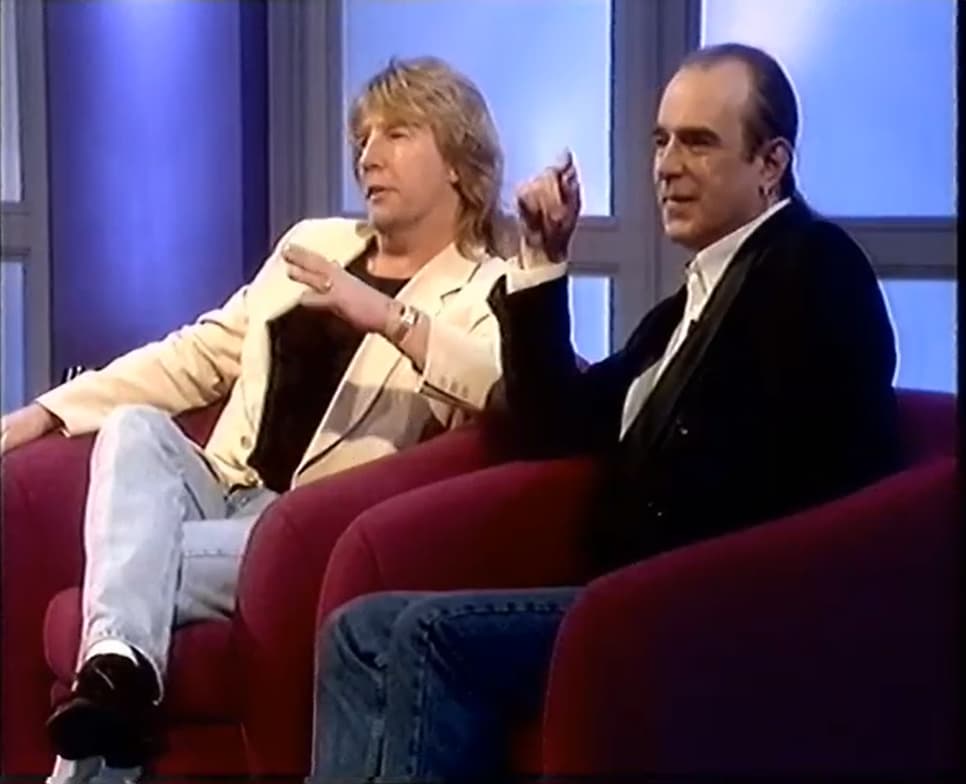
By 1999, Status Quo were no longer chasing the charts—they were living inside their legacy. Decades had passed since the band first found their unmistakable identity in the late 1960s, and yet their presence remained steady, grounded, almost stubbornly unchanged. The appearance on Vanessa that year, featuring an interview alongside a performance of “The Way It Goes”, offered something rare: not just music, but perspective.
Unlike their early hits such as “Pictures of Matchstick Men” (UK No. 7, 1968) or the relentless success of “Down Down” (UK No. 1, 1975), “The Way It Goes” was not a chart-defining single. Released as part of the album Under the Influence, it belonged to a different phase of their career—one less concerned with commercial peaks and more focused on continuity, honesty, and survival. The album itself did not produce major chart hits, but it reinforced what Status Quo had always done best: creating music that feels lived-in, unpolished in the most human sense.
Watching the 1999 interview, there is a noticeable shift in tone. The urgency that once defined their rise has softened into something more reflective. Francis Rossi, with his unmistakable voice and steady presence, speaks not as someone trying to prove anything, but as someone who has already endured the long road. Beside him, the band carries the quiet weight of years spent on stages, in studios, on endless tours that blur together into something almost mythic.
“The Way It Goes” itself feels like a conversation rather than a performance. Musically, it stays true to the familiar Quo formula—boogie-driven rhythm, simple chord progressions, a groove that rolls forward without hesitation. But there is something more restrained here. The energy is not explosive; it is controlled, almost introspective. The guitars do not demand attention—they accompany a thought that has been forming for a long time.
Lyrically, the song leans into acceptance. There is no dramatic declaration, no attempt to reshape the world. Instead, it acknowledges the unpredictable nature of life—the idea that things unfold beyond control, that not every question needs an answer. It is a sentiment that feels earned rather than written, shaped by experience rather than imagination.
In the context of 1999, this carried a quiet significance. The music industry had changed dramatically. Trends had come and gone, genres had risen and faded, and yet Status Quo remained. Not by adapting to every shift, but by holding onto something consistent. Their identity was not reinvented—it was sustained.
The Vanessa appearance captures that balance between past and present. There is no attempt to recreate the chaos of earlier years, no need for spectacle. Instead, there is clarity. The band understands exactly who they are, and more importantly, who they are not. That understanding shapes the performance of “The Way It Goes” into something almost understated, but deeply resonant.
Time has a way of changing how songs are heard. What might once have seemed simple can later reveal its depth. In this case, the repetition, the steady rhythm, the unassuming lyrics—they all begin to feel intentional. There is comfort in that steadiness, in the refusal to overcomplicate what has always worked.
And perhaps that is the lasting impression of this moment in 1999. Not a peak, not a comeback, not even a reinvention. Just a continuation. A band that has seen enough to understand that not every chapter needs to be louder than the last.
“The Way It Goes” does not try to hold onto the past, nor does it rush toward the future. It simply exists in the present, shaped by everything that came before. And in doing so, it offers something that feels increasingly rare—a sense of peace within the movement, a quiet acceptance that some things do not need to change to remain meaningful.