
A Quiet Master at His Peak—Where Storytelling, Reflection, and Time Itself Seem to Stand Still
By 1979, Gordon Lightfoot had already secured his place among the most respected voices in folk and soft rock, and his appearance on “SoundStage” that year serves as a remarkable portrait of an artist in full command of his craft. Unlike a single song tied to a specific chart position, this televised performance captures something far more expansive: a living anthology of Lightfoot’s most meaningful works, many of which had already left a profound mark on international charts. Songs like “Sundown” (which reached No. 1 on the Billboard Hot 100 in 1974) and “If You Could Read My Mind” (a Top 10 hit in both the United States and Canada) echo through this period, lending weight and familiarity to every note he sings on that stage.
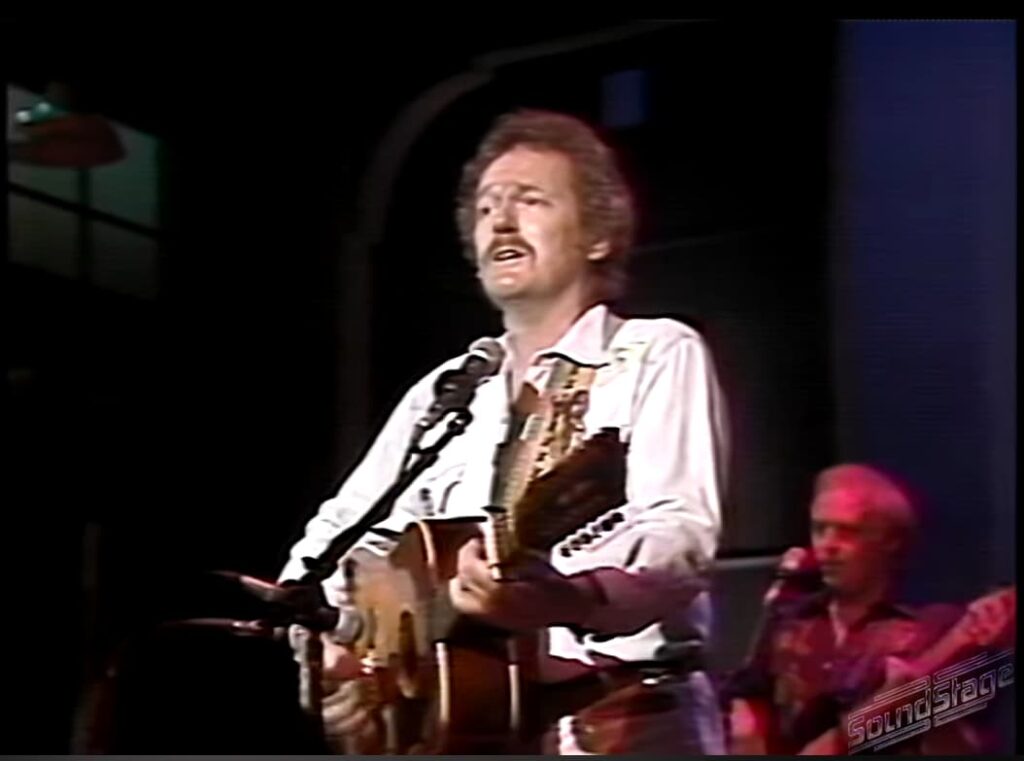
The SoundStage 1979 performance is not about spectacle. There are no elaborate visual effects, no overwhelming orchestration—only a man, his guitar, and the quiet, steady presence of a band that understands the importance of restraint. It is precisely this simplicity that allows the emotional depth of the music to surface so naturally. Watching Gordon Lightfoot in this setting feels less like attending a concert and more like being invited into a private space where memory and melody coexist.
By this point in his career, Lightfoot had evolved beyond the role of a successful songwriter. He had become, in many ways, a historian of human experience. His songs—whether telling the tragic story of the “Wreck of the Edmund Fitzgerald” (which reached No. 2 on the Billboard Hot 100 in 1976) or exploring the fragile intricacies of love and regret—carry a sense of lived truth. They are not merely compositions; they are reflections shaped by time, by observation, by a quiet understanding of life’s passing moments.
The late 1970s were a transitional era in popular music. Disco rhythms filled dance floors, punk rock challenged conventions, and yet there remained a space—almost sacred—for voices like Lightfoot’s. His presence on SoundStage in 1979 feels like a gentle counterpoint to the louder trends of the time. While the world around him seemed to move faster, his music invited listeners to slow down, to listen more closely, to remember.
There is a particular quality to his performance that stands out: an unspoken patience. Lightfoot never rushes a lyric, never forces an emotion. Each line unfolds with careful intention, as though he understands that meaning is not something to be delivered quickly, but something to be discovered gradually. His voice, slightly weathered yet deeply expressive, carries the weight of experience without ever becoming heavy.
What makes this SoundStage appearance especially poignant is how it captures an artist who no longer needs to prove anything. The success has already been achieved, the recognition firmly established. What remains is something quieter, perhaps more enduring—the simple act of sharing songs that continue to resonate. There is a humility in that approach, a sense that the music exists not for acclaim, but for connection.
In retrospect, performances like this take on a deeper significance. They become more than recordings; they become moments preserved in time, offering a glimpse into an era when songwriting was often rooted in storytelling rather than immediacy. Listening now, one can almost feel the stillness of that studio, the attentive silence between notes, the collective understanding that something meaningful is unfolding.
The 1979 SoundStage performance of Gordon Lightfoot stands as a testament to the enduring power of simplicity and sincerity. It reminds us that music does not always need to be loud to be heard, nor complex to be profound. Sometimes, all it requires is a voice willing to speak honestly—and an audience willing to listen.
And in that quiet exchange, something lasting is created—something that lingers long after the final chord fades.