
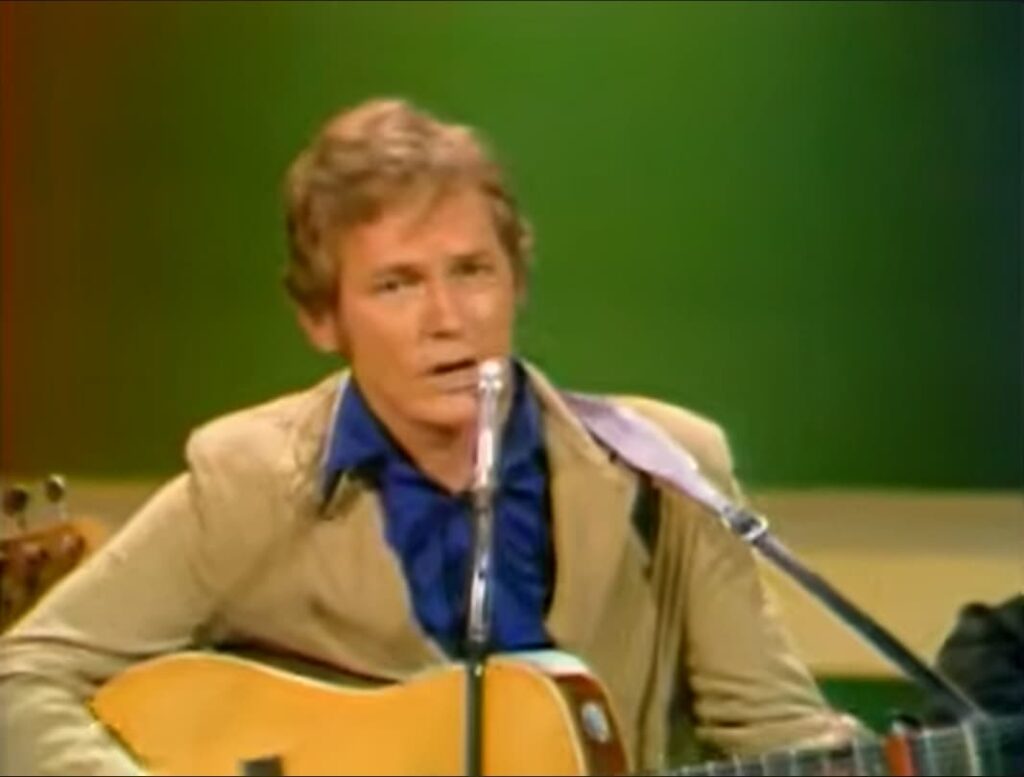
A restless confession of a wandering heart, where love is given freely yet never allowed to stay
In the vast and quietly profound songbook of Gordon Lightfoot, few compositions capture the uneasy tension between love and freedom quite like “For Lovin’ Me” (1967). Written during the early years of his career and released on the album “The Way I Feel,” the song did not achieve major chart success for Lightfoot himself upon its initial release. However, its true life unfolded through interpretation—most notably when Peter, Paul and Mary recorded their version in 1965, helping bring the song into wider public consciousness during the height of the folk revival. While it never climbed the upper reaches of the Billboard Hot 100, its cultural impact ran deeper than numbers could measure, embedding itself in the shared emotional vocabulary of a generation.
At first glance, “For Lovin’ Me” may seem deceptively simple. Its melody is gentle, almost comforting, carried by Lightfoot’s unmistakable acoustic style. But beneath that calm surface lies a strikingly candid admission—a portrait of a man who recognizes his own inability to remain, even when affection is real. Unlike traditional love songs that celebrate devotion, this one turns inward, revealing the fragile, often uncomfortable truth that love is not always enough to anchor a restless spirit.
The song emerged during a time when Gordon Lightfoot was still defining his artistic voice. The mid-1960s folk scene, shaped by figures like Bob Dylan and Joan Baez, encouraged introspection and honesty in songwriting. Lightfoot, however, brought something uniquely his own—a quiet Canadian sensibility, marked by restraint and clarity. In “For Lovin’ Me,” he does not dramatize his departure; he simply acknowledges it. That restraint is precisely what gives the song its enduring power.
There is a line that echoes throughout the piece—not as accusation, but as quiet resignation. The narrator does not deny the sincerity of his feelings; instead, he questions his own capacity to sustain them. This subtle self-awareness transforms the song into something more than a personal confession. It becomes a reflection on human nature itself—the way desire can coexist with distance, the way affection can be genuine yet fleeting.
Listening to “For Lovin’ Me” today, one is struck by how timeless its themes remain. The arrangement, anchored by acoustic guitar, allows every word to breathe. There are no grand orchestrations, no dramatic flourishes—only the steady rhythm of a story being told with honesty. It is this simplicity that invites the listener closer, creating an almost conversational intimacy.
Behind the song lies the broader narrative of a young artist grappling with identity, both personal and professional. Gordon Lightfoot was not yet the established figure who would later deliver classics like “If You Could Read My Mind” or “Sundown.” He was still searching, still refining his voice. And perhaps it is this sense of searching that permeates “For Lovin’ Me.” It feels less like a finished statement and more like a moment captured in motion—a fleeting glimpse into a mind that refuses to stand still.
The meaning of the song, ultimately, is not rooted in regret, but in recognition. There is no attempt to justify or condemn the narrator’s actions. Instead, there is an acceptance of impermanence, an understanding that some hearts are not meant to settle. This perspective, though quietly expressed, carries a weight that lingers long after the final note fades.
Over the years, “For Lovin’ Me” has been covered by numerous artists, each bringing their own interpretation. Yet, there is something irreplaceable about Lightfoot’s original delivery—its calm, almost understated tone that allows the listener to draw their own conclusions. It does not instruct; it reflects.
In the end, Gordon Lightfoot’s “For Lovin’ Me” stands as a gentle but unflinching exploration of love’s limitations. It reminds us that not all departures are born of indifference, and not all affection leads to permanence. Sometimes, the most honest thing one can offer is the truth, however quiet, however incomplete. And in that truth, there is a strange, enduring beauty—one that continues to resonate across the years, carried softly on the strings of a guitar and the voice of a man who understood that not every story is meant to have an ending, only a moment worth remembering.