
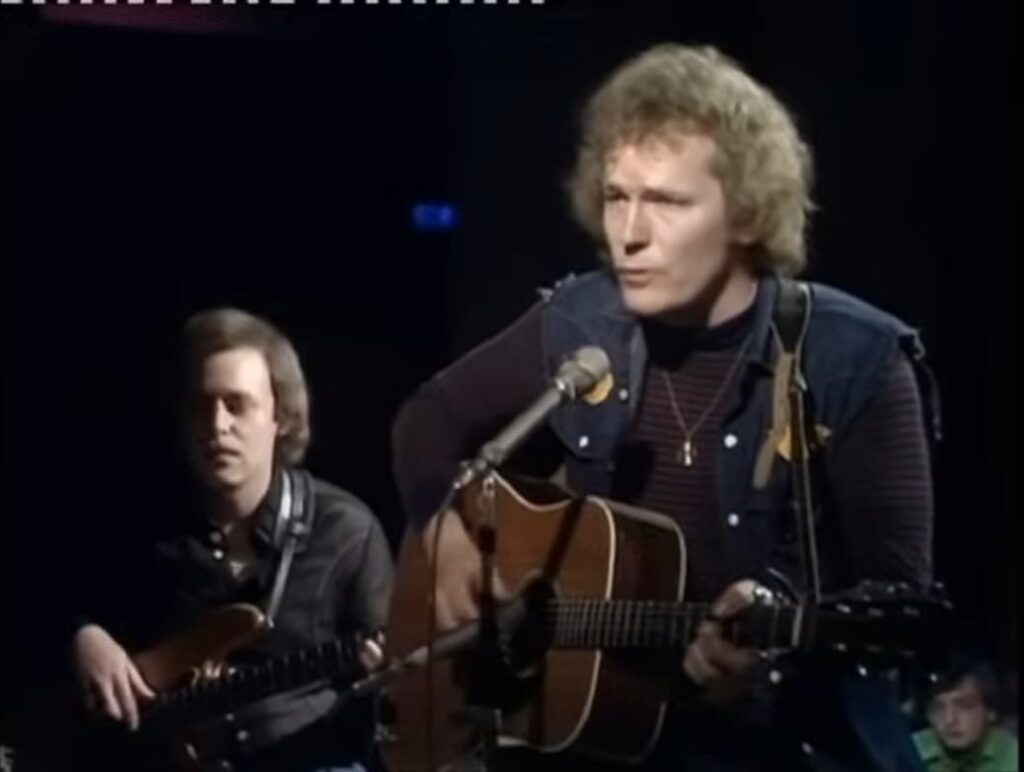
A quiet confession set to melody—“If You Could Read My Mind” captures the fragile unraveling of love and the aching clarity that follows
There are songs that entertain, and then there are songs that seem to understand us better than we understand ourselves. “If You Could Read My Mind” by Gordon Lightfoot belongs firmly in the latter category. First released in 1970 as part of the album Sit Down Young Stranger (later reissued under the song’s title due to its success), the track quickly became Lightfoot’s signature composition. It reached No. 5 on the Billboard Hot 100 in the United States and climbed to No. 1 on the Canadian charts, solidifying his place among the most respected singer-songwriters of his era.
Yet, beyond its chart success lies a deeply personal story. Lightfoot wrote the song during the painful dissolution of his marriage, and that emotional truth breathes through every line. When he performed it live—such as in the BBC concert in 1972—the song took on an even more intimate quality. Stripped of studio polish, accompanied by his gentle guitar work and unmistakable voice, the performance felt less like a concert piece and more like a private confession shared with a silent room.
What makes “If You Could Read My Mind” so enduring is its lyrical honesty. The song does not rely on dramatic outbursts or grand gestures. Instead, it unfolds quietly, like a letter never sent. Lightfoot uses imagery drawn from old movies and ghost stories—“I don’t know where we went wrong, but the feeling’s gone”—to illustrate the fading connection between two people who once knew each other completely. These metaphors are not decorative; they are essential, reflecting how love, when it fades, can feel as unreal and distant as fiction.
Listening to the 1972 BBC live performance, one is struck by the stillness. There is no urgency, no attempt to impress—only a steady, reflective delivery. Lightfoot’s voice carries a calm sorrow, the kind that comes not from fresh wounds but from the quiet acceptance that follows. It is this restraint that gives the song its power. He does not plead or accuse; he simply remembers.
Musically, the arrangement is deceptively simple. The gentle fingerpicking pattern, the soft progression, and the absence of elaborate instrumentation allow the lyrics to take center stage. This simplicity mirrors the emotional clarity of the song. There are no distractions—only the truth, laid bare.
Over the decades, “If You Could Read My Mind” has been covered by numerous artists, but none have captured the same delicate balance of vulnerability and composure that Lightfoot achieved. The song resonates because it speaks to a universal experience: the moment when love shifts from certainty to memory. It is not about heartbreak in its loudest form, but about something quieter and perhaps more profound—the realization that what once felt permanent has gently slipped away.
In the context of the early 1970s folk movement, Lightfoot stood apart. While many artists leaned into social commentary or political expression, he turned inward. His songs explored personal landscapes—relationships, regrets, and reflections—with a poetic sensibility that felt both timeless and immediate. “If You Could Read My Mind” is perhaps the purest example of this approach.
Returning to that BBC performance in 1972, one can almost feel the room holding its breath. There is a sense that everyone present understands they are witnessing something rare—not just a performance, but a moment of truth. And decades later, that feeling remains intact. The song has not aged; it has deepened.
In the end, Gordon Lightfoot did not just write a hit song—he created a quiet companion for anyone who has ever looked back on love with both gratitude and sorrow. And in that gentle, reflective space, “If You Could Read My Mind” continues to speak, as clearly and honestly as it did the very first time.