
A Life in Quiet Reflection—Gordon Lightfoot in 2019 Looks Back on Songs That Outlived Their Time
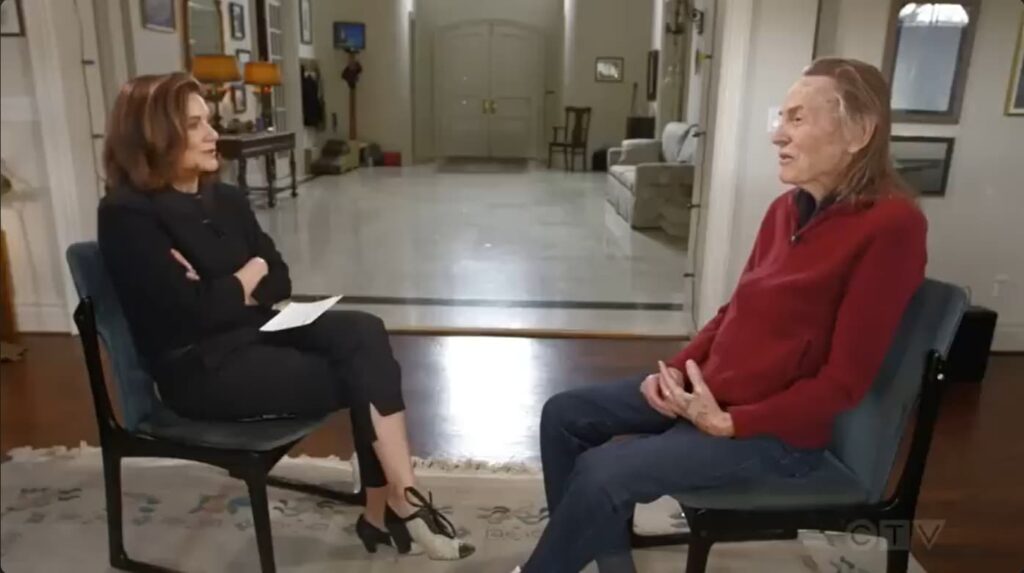
In May 2019, during a thoughtful and unhurried conversation with CTV News, Gordon Lightfoot appeared not as a distant legend, but as something far more meaningful—a man gently revisiting the long road behind him, aware that his songs had already taken on lives of their own. There was no sense of performance in that interview, no attempt to reshape his legacy. Instead, there was a calm honesty, the kind that only comes from someone who has spent decades telling the truth through music.
By that time, Lightfoot’s place in musical history was firmly established. His body of work had long transcended charts and trends, though the numbers themselves remain remarkable. “Sundown” reached No. 1 on the Billboard Hot 100 in 1974, while “If You Could Read My Mind” climbed to No. 5 in 1971, becoming one of the most enduring folk-pop recordings of its era. Perhaps most haunting of all, “The Wreck of the Edmund Fitzgerald” rose to No. 2 on the Billboard Hot 100 in 1976, a song that carried not just melody, but the weight of real tragedy across the cold waters of Lake Superior.
Yet in that 2019 interview, these achievements felt almost secondary.
What emerged instead was a portrait of an artist shaped not by success, but by persistence. Gordon Lightfoot spoke in a measured tone, reflecting on the discipline of songwriting—the quiet hours, the constant refinement, the willingness to let a song reveal itself slowly. There was an unmistakable humility in the way he described his work, as though he still saw himself as a craftsman rather than an icon.
And perhaps that is the key to understanding his music.
Because songs like “Early Morning Rain” (first released on the album “Lightfoot!” in 1966) were never designed to chase popularity. They were born from observation—from moments that might otherwise go unnoticed. A man at an airport, watching planes depart. A memory of love, half-remembered and half-lost. A ship disappearing beneath the weight of a storm. These are not grand narratives, yet in Lightfoot’s hands, they become something universal.
During the interview, there is a subtle sense that he understood this deeply.
He did not speak of his songs as possessions, but almost as companions—things that had traveled with him through time. And in doing so, he acknowledged something many artists struggle to accept: that once a song is released into the world, it no longer belongs solely to its creator. It becomes part of the listener’s life, woven into memories that the artist may never see.
There is a quiet poignancy in that realization.
Because by 2019, Lightfoot had already lived through the full arc of a musical career—rise, recognition, challenge, and endurance. He had seen the industry change, watched styles come and go, yet his songs remained. Not because they adapted to the times, but because they never needed to.
They were already timeless.
The CTV News interview captures this beautifully. There are moments when he pauses, choosing his words carefully, as if aware that each reflection carries weight. It is not nostalgia in the conventional sense. It is something deeper—a recognition of how far the journey has been, and how much of it is still present in every note he ever wrote.
Listening to him speak, one cannot help but think of the simplicity that defines his greatest work.
No excess. No unnecessary ornamentation. Just melody, story, and truth.
And perhaps that is why his music continues to resonate so strongly. In a world that often feels increasingly complex, Gordon Lightfoot’s songs offer something rare: clarity. They remind us that the most meaningful moments are often the quietest ones—the ones that pass without fanfare, yet stay with us long after.
The 2019 interview does not attempt to summarize his legacy.
It does something far more valuable.
It allows us to see the man behind the songs—still thoughtful, still grounded, still connected to the same instincts that first led him to write. And in that sense, it becomes more than just a conversation. It becomes a continuation of the music itself.
Because even without a guitar in his hands, Gordon Lightfoot was still telling a story.
And as always, it was one worth listening to—slowly, carefully, and with the understanding that its meaning might reveal itself long after the final word has been spoken.