
A quiet, heartfelt rendition of a national hymn becomes a reflection of identity, memory, and the enduring voice of a storyteller.
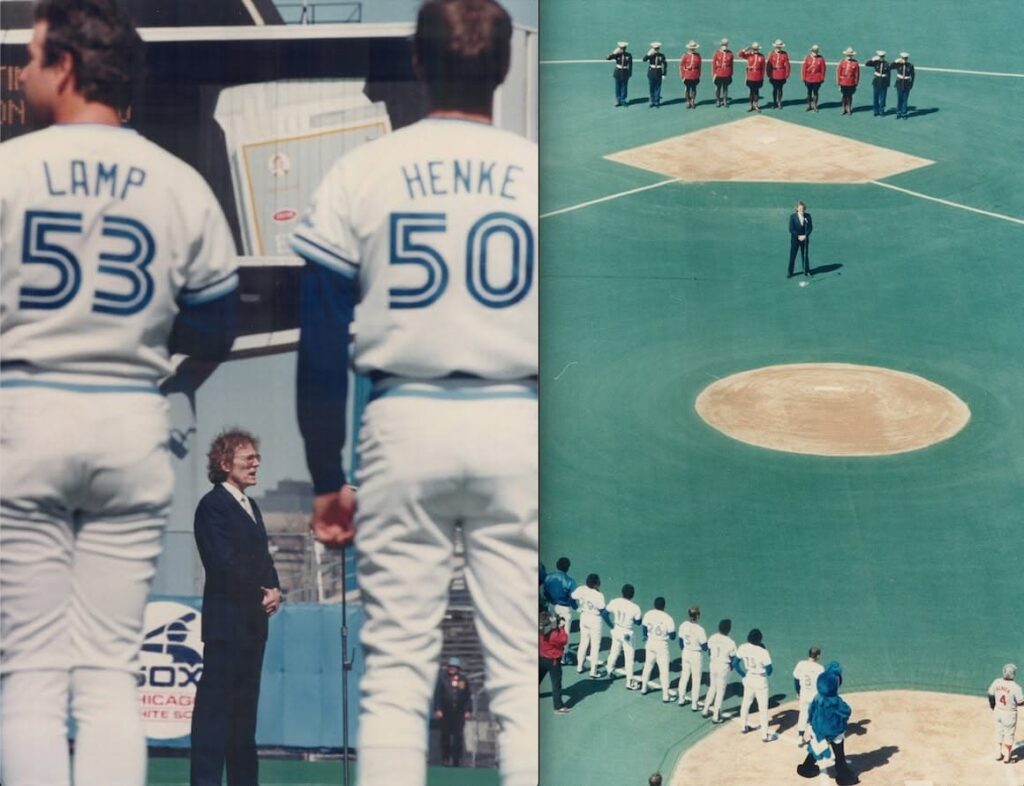
On April 14, 1986, Gordon Lightfoot stood before a packed stadium in Toronto to perform “O Canada”, marking the home opener of the Toronto Blue Jays. It was not a chart-topping single, nor a promotional performance tied to a new release. Yet, in its own understated way, this moment carried a weight equal to any of his greatest recordings. For here was an artist whose songs had long captured the spirit of a nation, now giving voice—quite literally—to its anthem.
By 1986, Gordon Lightfoot was already a towering figure in folk and soft rock, both in Canada and internationally. His career had been defined by a string of deeply evocative songs that resonated far beyond their initial release. “If You Could Read My Mind” (1970) reached No. 5 on the Billboard Hot 100, introducing audiences to his gift for introspective storytelling. Then came “Sundown” (1974), which climbed to No. 1 on the Billboard Hot 100, a rare achievement for a Canadian folk artist at the time. Perhaps most enduring of all was “The Wreck of the Edmund Fitzgerald” (1976), which reached No. 2 on the Billboard chart, a haunting narrative ballad that transformed a real-life tragedy into something almost mythic.
These songs were never merely compositions—they were landscapes of memory, shaped by quiet reflection and an unwavering sense of place. And so, when Gordon Lightfoot stepped onto the field that April evening to sing “O Canada”, he brought with him not just his voice, but the emotional weight of an entire body of work.
Unlike many anthem performances that aim for grandeur, Lightfoot’s interpretation was marked by restraint. There was no excessive ornamentation, no dramatic flourish designed to impress. Instead, he delivered the melody with the same clarity and sincerity that defined his own songs. His voice—slightly weathered, unmistakably warm—carried across the stadium with a quiet authority. It was not the voice of spectacle, but of authenticity.
The significance of this moment lies partly in timing. The mid-1980s represented a period of subtle cultural affirmation for Canada, and the Toronto Blue Jays, still a relatively young franchise, had begun to establish themselves as a source of national pride. To have Gordon Lightfoot—an artist so closely associated with Canadian identity—perform the anthem at such an event felt almost symbolic, as though music and sport had briefly aligned to express something larger than either could alone.
There is also a deeper layer to consider. Throughout his career, Lightfoot’s songs often explored themes of distance, longing, and the passage of time. Whether recounting lost love or maritime tragedy, he approached each subject with a sense of quiet dignity. In “O Canada”, those same qualities emerged, not through narrative, but through tone. The anthem, in his hands, became less a declaration and more a reflection—a moment to pause, to listen, and to remember.
One can imagine the crowd that day: thousands gathered, many perhaps more focused on the game to come. And yet, for those few minutes, attention shifted. The familiar words of the anthem, carried by a voice so deeply woven into the cultural fabric, took on a different resonance. It was no longer just a prelude—it was an experience in itself.
Looking back, this performance may not appear in discographies or chart histories, but it remains significant precisely because of its simplicity. It reminds us that music does not always need to be new to feel meaningful. Sometimes, it is the context—the setting, the voice, the moment—that transforms something familiar into something unforgettable.
For those who had followed Gordon Lightfoot through the decades—from the quiet introspection of “If You Could Read My Mind” to the stark storytelling of “The Wreck of the Edmund Fitzgerald”—this appearance offered a different kind of connection. It was not about discovering a new song, but about hearing a familiar voice in a new light.
And as the final notes of “O Canada” faded into the evening air, what remained was not applause alone, but a lingering sense of continuity. A reminder that some voices do more than entertain—they endure, carrying with them the stories, the landscapes, and the quiet truths of a nation.