
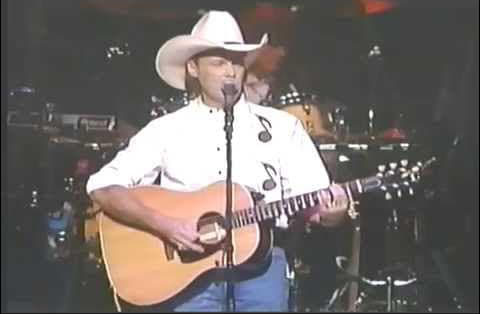
A Gentle Country Voice Carrying Buddy Holly’s Promise of Devotion Across Time
Few songs in the American canon speak about love with the quiet certainty and humility of “True Love Ways.” When Ricky Van Shelton performed this song live in Austin, Texas on October 18, 1990, it was not merely a cover of a classic. It was an act of reverence, a thoughtful conversation across generations between country music and one of rock and roll’s most tender voices.
“True Love Ways” was originally written by Buddy Holly and Norman Petty, recorded in 1958, and released posthumously in 1960 after Holly’s tragic death. The song climbed to No. 25 on the Billboard Hot 100 and reached No. 2 on the UK Singles Chart, becoming one of the most emotionally resonant reminders of Holly’s legacy. It was widely understood as a love song written for Holly’s wife, Maria Elena, and its lyrics carried a sense of devotion that felt almost prophetic in hindsight. Gentle strings, a restrained melody, and words spoken rather than declared made it feel like a private vow overheard by the world.
Three decades later, Ricky Van Shelton, one of country music’s most dependable hitmakers of the late 1980s and early 1990s, chose to bring this song into his own musical language. His studio version would later appear on the album Backroads released in 1991. When issued as a single, “True Love Ways” reached No. 21 on the Billboard Hot Country Songs chart. While not one of his chart-topping smashes, its placement reflected something more enduring than numbers. It showed that audiences were willing to slow down and listen.
By the time of the Austin performance in 1990, Ricky Van Shelton was already well established. With multiple No. 1 country hits behind him and a reputation for emotional restraint rather than theatrical excess, he was uniquely suited to this song. His voice had a calm, unforced quality, shaped by traditional country phrasing and a deep respect for melody. Where Buddy Holly’s version sounded like a young man promising forever, Shelton’s interpretation felt like a man who understood the cost and weight of such a promise.
The meaning of “True Love Ways” lies in its simplicity. There is no dramatic heartbreak, no grand climax, no clever twist. The song speaks about patience, faith, and quiet endurance. It suggests that love is not proven through passion alone, but through constancy. In Shelton’s hands, those words gained new gravity. Sung by someone who had already lived through success, pressure, and the solitude that often follows fame, the song became less about hope and more about trust.
The Austin performance stands out because it captures a moment before the song became part of Shelton’s recorded legacy. It is intimate, respectful, and understated. There is no attempt to overpower the arrangement or modernize the sentiment. Instead, Shelton allows the melody to breathe, letting silence and restraint do much of the emotional work. This approach mirrors the values of traditional country music, where truth is carried not by volume, but by conviction.
For listeners who had grown up with Buddy Holly, the performance felt like a bridge back to a gentler time. For those who discovered the song through Ricky Van Shelton, it became an introduction to a deeper emotional tradition within popular music. In both cases, “True Love Ways” functioned as a reminder that some songs do not belong to a single era. They wait patiently for new voices, new lives, and new experiences to give them meaning again.
In the end, Ricky Van Shelton’s live rendition did not seek to replace the original. It honored it. And in doing so, it reaffirmed one of music’s quiet truths. When a song is built on sincerity and emotional honesty, it does not age. It simply learns how to speak in another voice.
 Music Legend